


Receive free German economy updates
We’ll send you a myFT Daily Digest email rounding up the latest German economy news every morning.
The German government has rejected a proposal to subsidise power prices for energy-intensive industries, in a move business groups warned would cause an exodus of manufacturing to countries with lower energy costs.
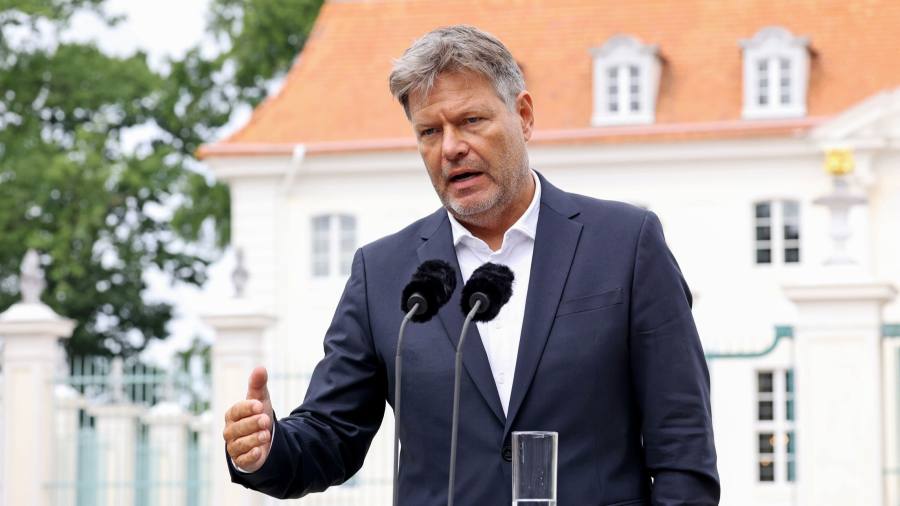
The decision is a setback for Green economy minister Robert Habeck, who had argued that high energy costs were damaging the competitiveness of companies in Europe’s largest economy.
“German industry is sending out an SOS, but the government continues to ignore an emergency that is now acute,” said Markus Steilemann, head of the VCI, the chemical industry lobby.
Tanja Gönner, managing director of the BDI, Germany’s main business lobby, said: “The absence of any tool that would reduce the burden of electricity costs in the current difficult situation is fatal. The government can’t duck away from this problem.”
But Olaf Scholz, chancellor, insisted the government was heeding industry’s calls for help, citing a €7bn package of corporate tax relief agreed by his cabinet.
Scholz said on Wednesday that securing a cheap energy supply was an “ongoing issue”, and stressed that his government had spent “several billion euros” to subsidise prices since Russia’s full-scale invasion of Ukraine 18 months ago.
But “we are now seeing that prices are falling . . . that import costs for Germany are declining — in part thanks to the strategy we developed”.
Russia’s attack on Ukraine and its decision to cut gas flows to Europe hit Germany hard, prompting alarm from business as gas prices hit record highs last year. Scholz’s government responded by building new import terminals for liquefied natural gas and spending billions to secure emergency LNG supplies from the US and Middle East.
“The fact we acted so quickly meant we got through the winter and it wasn’t cold in our flats and factories,” said Scholz, who was speaking after a two-day government retreat in Schloss Meseberg, a baroque palace outside Berlin.
But energy costs remain above prewar levels, and are widely cited as a reason why Germany’s economy stagnated in the three months to June after shrinking in the previous two quarters.
Habeck first unveiled plans for a subsidised electricity price in May, saying the government would spend €25bn-€30bn to ensure that big industrial consumers would not have to pay more than €0.06 per kilowatt hour (kWh) for electricity until 2030. The spot market price is currently €0.089/kWh.
The move came amid growing concern that low energy costs in the US and the vast subsidies on offer under President Joe Biden’s Inflation Reduction Act might tempt German companies to relocate.
Scholz said the best way to deal with the problem of high gas and electricity costs was to increase renewable energy capacity and expand Germany’s power grid. Germany plans to derive 80 per cent of its electricity from renewables by 2030.
But Steilemann insisted that until there was enough cheap renewable capacity available, the government must step in to help energy-intensive sectors such as chemicals. The idea was a “must-have for preventing deindustrialisation”, he said.
A survey by the German Chamber of Commerce and Industry (DIHK) found that 32 per cent of German companies favoured investment abroad over domestic expansion. The figure was double the 16 per cent in last year’s survey.
Scholz’s rejection of subsidies could antagonise many in his party, the Social Democrats (SPD). Its parliamentary group recently backed the idea of offering industry a state-backed subsidised electricity price of €0.05/kWh.
The SPD and Greens’ smaller coalition partners, the liberal Free Democrats are firmly opposed, to the idea. Christian Lindner, finance minister and FDP leader, has argued that subsidised energy would only benefit big industrial groups.
“It will distort competition between the big companies and the Mittelstand,” he told ARD TV, referring to the small- and medium-sized enterprises that are the backbone of Germany’s economy.
“We can’t make all taxpayers, all companies — the baker, the trader, the Mittelstand firm — pay for a reduced electricity price for a few companies,” he said on Tuesday.
Read the full article here

