


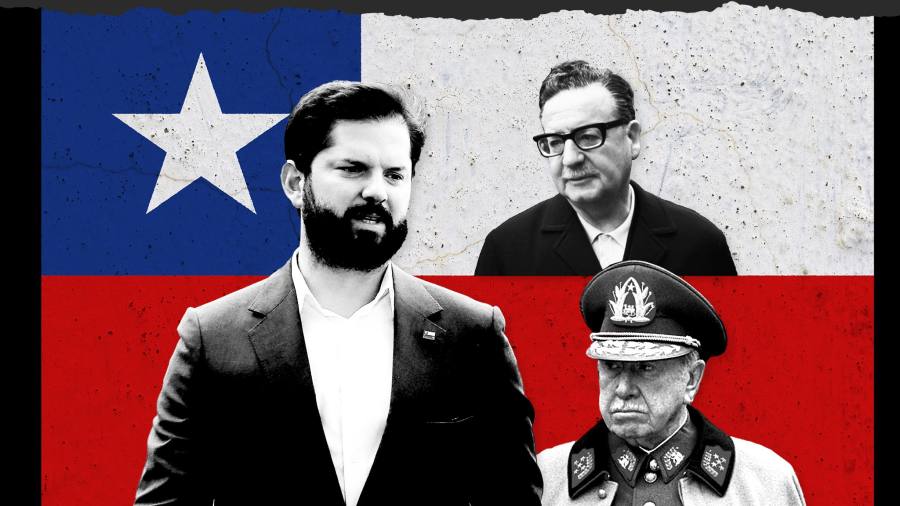
Sitting at the counter in his daughter’s grocery shop in downtown Santiago, Hugo Toro recalled his relief when, in 1973, Chile’s military overthrew the democratically elected government of socialist president Salvador Allende, installing rightwing dictator Augusto Pinochet.
“Many people wanted [the coup] to happen,” said Toro, who remembers standing in long lines for food as shops ran low amid economic havoc triggered by Allende’s policies. “People were shouting ‘coward’ at soldiers in the street because they weren’t stepping in.”
Ahead of the 50th anniversary on September 11, Chile’s leftist president Gabriel Boric had hoped for a moment of unity. He called on parties to sign a joint declaration condemning the coup and committing to democracy — what he labelled a “reasonable and minimal consensus”.
His efforts have largely failed, exacerbating both the country’s extreme polarisation and political paralysis. Right and leftwing leaders have spent months trading barbs over this dark period in Chile’s history.
Some 36 per cent of Chileans now say the military was right to act, according to research firm Mori, up from 16 per cent in 2013. And while few defend the abuses of Pinochet’s regime, which murdered at least 3,196 people and established more than a thousand torture centres, conservative politicians increasingly claim the coup was necessary to prevent Chile from becoming a Cuba-style dictatorship.
Last week, the rightwing Chile Vamos coalition presented its own declaration, committing to democracy, but describing the coup as “the culmination” of a process of “democratic breakdown”.
“They are all feeding divisions that have existed for 50 years,” Toro said. “It will never end.”
The stand-off reflects wider political stagnation. The rise of hard-left and hard-right forces over the past decade, along with disruptive mass protests in 2019 known as the “social explosion”, have divided lawmakers.
Congress, fragmented between 22 parties, has struggled to pass reforms to address the inequality and inadequate public services that sparked the unrest. Chile’s economy is forecast to expand just 0.2 per cent in 2023, the second-weakest growth in Latin America, after Argentina.
“We are in a state of paralysis,” said Marta Lagos, director of pollster Latinobaómetro. “People are profoundly unhappy.”
It is a stark contrast with the political climate from the end of the Pinochet regime in 1990 until around 2010, when a succession of centre-left governments ruled Chile. They tacitly agreed not to dramatically alter Pinochet’s economic model, which prioritised privatised services and an investor-friendly constitution guaranteeing property rights.
In return, the right collaborated on a very gradual expansion of the state through social reforms. Chile’s economy grew far faster than the regional average, and millions escaped poverty.
Jose Miguel Insulza, a senator for the centre-left Socialist party who was a minister in several of those governments, said they did not go far enough to tackle inequality.
“But today, neither the left nor the right seem interested in making any long-term agreements,” he said, adding that the leftwing coalition “is led by young people who came to power by denouncing the conciliatory nature of the old administrations”.
Insulza said the lack of compromise could permanently damage Chile’s export-led economy. “The world likes Chile for one simple reason — that it is credible and predictable. The day it stops being predictable, it loses a lot.”
Meanwhile, Chile Vamos, facing a growing challenge from far-right Republicanos, appears reluctant to make concessions to a government they perceive as weak. The approval ratings for Boric, sworn in 18 months ago, have fallen below 30 per cent, dragged down by Chile’s worst crime wave in three decades, a stalled economy and a faltering project to rewrite the constitution.
His unwieldy coalition, which stretches from the centre-left to the Communist party, lacks a majority in congress. That has hamstrung two major planks of Boric’s agenda: a plan to move part of the pension system into state hands, and an increase in Chile’s taxes, among the lowest in the OECD, to fund social programmes.
Guillermo Ramírez, leader of the rightwing Unión Democrática Independiente in the lower house, said Boric spent his first year in office “pursuing very maximalist reforms”. While he was optimistic that congress would agree a limited pension reform, a tax rise remains off the table for UDI.
The coup anniversary has pushed political polarisation to theatrical extremes. In August, after the Communists called for lawmakers to condemn a 1973 congressional declaration criticising Allende, which the left sees as having given the military the green light to intervene, rightwing lawmakers led by Ramírez instead voted to have it read aloud in the chamber.
It is a depressing spectacle, said former general Ricardo Martínez Menanteau, who led Chile’s military until 2022. “We saw 50 years ago what happens when politicians move to the extremes and can’t make compromises.”
Boric has struggled to unify politicians. In July, he bowed to pressure to dismiss Patricio Fernández, an adviser on the declaration, after the writer said historians “can keep discussing why [the coup] happened.” For the coalition’s far-left flank, it felt too much like a justification of the coup.
In August, when a former soldier died by suicide following his conviction for the extrajudicial execution of musician Victor Jara just after the coup, Boric shocked even his leftist coalition partners when he said some “die in a cowardly way in order to not face justice”.
“If Boric keeps speaking from a place of moral superiority, asking the rest of us to fall in line with his understanding of history, it’s impossible to move forward,” said Rojo Edwards, a Republicanos senator.
Carmen Hertz, a Communist lawmaker who led efforts to remove Fernández, rejected the idea that the coup can be seen as anything other than a crime against humanity. “It’s like saying there are different perspectives about the Holocaust,” Hertz said.
Fernández, sitting in his cluttered Santiago home, said politicians have “missed the point” of the anniversary. “The discussion shouldn’t be, ‘who do I like more, Pinochet or Allende?’ That’s a twisted way of seeing this,” he said. “This was a trauma, a horror.”
He and Boric had wanted “to end this polarisation” and “focus on finding lessons in the past about how to protect our democracy in future”, he added. “But we couldn’t do it. Maybe it’ll happen at the 51st anniversary.”
Read the full article here

