


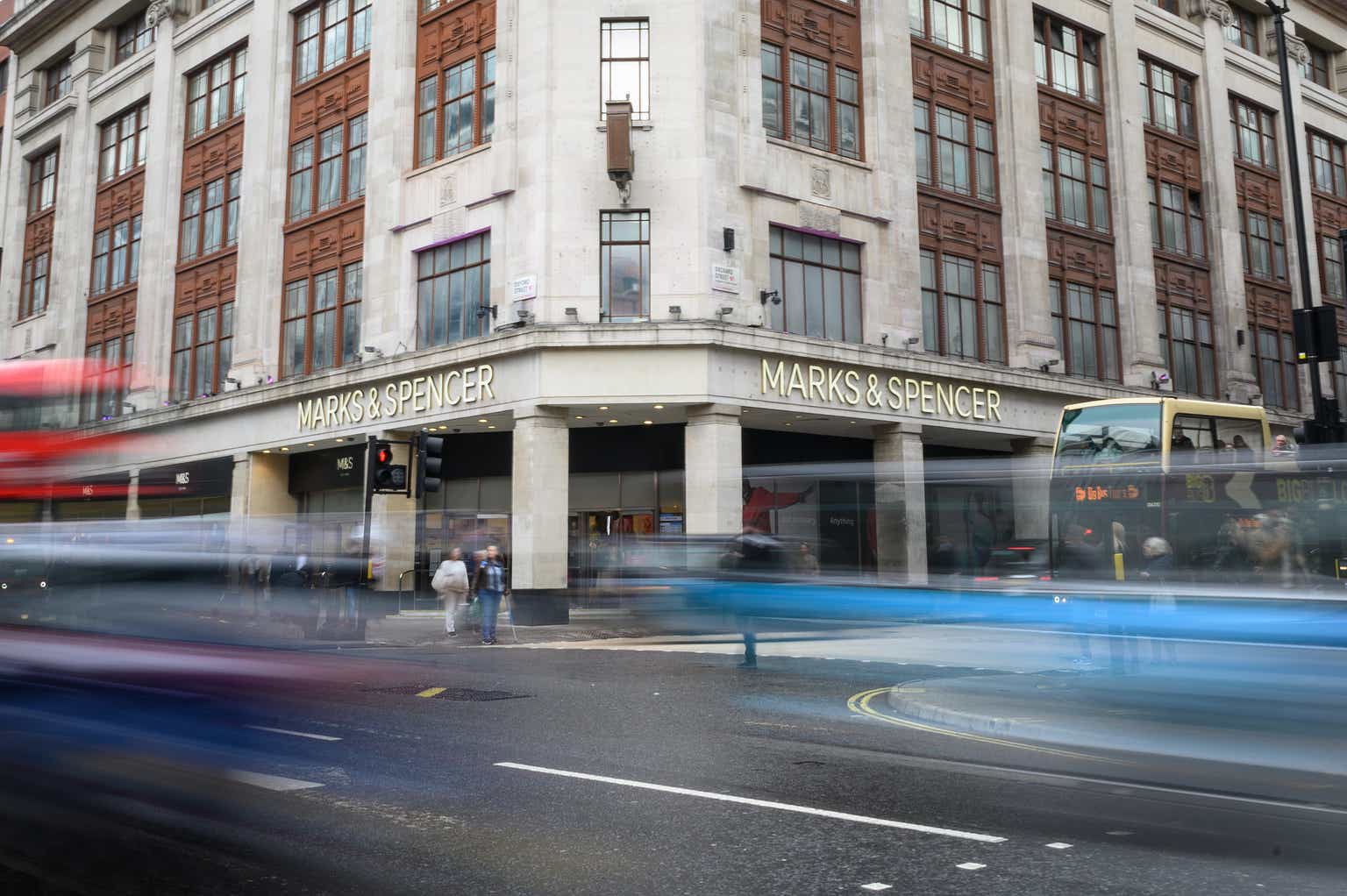
The momentum is building up for Marks and Spencer (OTCQX:MAKSF) (OTCQX:MAKSY). It is growing revenue on improved customer perception and has just raised the profit outlook, adding weight to the belief that the company’s turnaround is finally happening.
LSE:MKS returned 105% over the past year on price alone, more than any other British retailer. This has allowed the company to reenter FTSE100, four years after exiting it; the index is up 7% in comparison.
The stock’s price-to-earnings ratio has increased twofold in the same period, meaning that a lot of the good developments have already been priced in.
That leaves the question of dividends open. They are long overdue, but there might be a cause for concern. Although payouts are supposed to be reinstated in 2024, potentially poor results from M&S’s joint venture with Ocado and continued margin erosion could jeopardize the dividend prospects.
After many false dawns, the market needs more convincing, and fortunately for shareholders, the management seems to be up to the task.
Update
M&S published a 19-week trading update on August 15. In the four months of the new financial year, Food sales grew by 11%, Clothing & Home by 6%. It looks like the company’s investment into stores — a £480m programme to be delivered over the next three years — is showing results. The focus is clearly skewed towards Food, the better performer, with 104 standalone stores opening by 2028.
Given a sprightly start to the year, the management has upgraded its outlook “to show profit growth” and improved interim results, without specifics. Previously, the management predicted a small decrease in profits for FY2024. It would be safe to assume that margins have stayed the same: M&S continues to cut prices, particularly for food items in its value range as part of a long-term investment plan.
Background
It is no wonder that investors are excited about the latest reincarnation of M&S. For a business that had underperformed for such a long time — more than two decades since the mid-1990s — and had gone through multiple restructuring attempts, its recent strength is nothing short of miraculous. Shareholders, mostly small investors, who have stuck with it are beginning to see the fruits of their patience.
Things started changing in earnest with Marc Bolland who came to the helm in 2010. In six years as the chief executive, he managed to overhaul the warehousing and the website. Although his international ambitions came to naught, he left M&S more prepared for the next, more prominent phase of remodeling. And that took place under Steve Rowe who made the company leaner and dedicated more floor space to Food.
Now, under a somewhat peculiar leadership structure, M&S is investing in value, marrying it with the essence of the iconic British shop that is quality. Co-CEOs Stuart Machin and Katie Bickerstaffe aim for a modest 1% increase in the market shares of both Food (which has been stuck with less than 4% for years) and Clothing & Home (whose share of UK apparel, currently at 9%, has been steadily declining) over the next 3-5 years.
Investing in technology has also been high on the agenda. Through joint venture Ocado Retail, M&S’s food has become available online for the first time. Despite complaints about the cost of the tie-up and persisting post-pandemic losses (which are not yet consolidated), the management remains confident. With the latest recovery in Ocado Retail’s top line, a return to “marginal profit” is expected this year.
Risks
But if Ocado Retail improves, M&S will have to pay the remaining £156m for its half in the business. (The payment is subject to Ocado Retail meeting some undisclosed performance target by this November.) This could mean an additional funding burden for the beleaguered shareholders — who, having sponsored the initial consideration of £562m in 2019, may take another beating if the dividend promised for 2024 does not materialize.
Already cost pressures have been cited as the primary reason for delaying payouts. Although food inflation is easing, labor and energy remain big outlays. (Not that this stopped M&S from reinstating executive bonuses and raising staff salaries.) Further reducing the dividend prospects is the company’s determination to keep prices down. Margins decreased in the last financial year and remain below medium-term goals (Food: 3.4% adjusted operating margin vs. targeted 4%; Clothing & Home: 8.7% vs. 10%).
Then there is the small issue of debt obligations, like a £200m bond that must be repaid at year-end. In absolute value, debt has fallen since before the pandemic by about 30% to £1.4b as at April 1. During the same period, cash and equivalents almost doubled. Operating cash flow provides more than enough for debt with a 77% coverage.
Valuation
At 12.4x price-to-earnings, MKS is way cheaper than local peers such as J Sainsbury (31x) and Tesco (26x); the British consumer retailing industry averages about 22x.
Historical comparison is hard to make because of volatility in profits, although about a year ago the P/E stood at 6.2x. Clearly, the valuation has gone up; the price, in fact, is fast approaching the 3-year high of £2.57 per share.
At £2.29 as of September 19, the price is slightly above the 12-month median forecast of £2.26 (high: £3.00; low: £1.50). Analysts have always been more cautious than optimistic about M&S; this attitude has not changed yet.
Conclusion
M&S has at last made the transition shareholders have long wished for. At the beginning of the century, the majority of its sales came from clothing. Today, M&S’s main offering is decidedly food (60%), with a side of clothing business whose share reduced to 30%.
Since food has been consistently performing, the change-up makes sense. The only concern now is the sustainability of this new level of company-wide performance. The good news is that M&S has managed to drastically improve the customer perception of its goods. Sometime last year, it ranked as the UK’s best brand overall, top High Street Retailer and Supermarket.
M&S food halls may well maintain their position, but keeping up with price cuts as a non-discounter is likely to prove increasingly difficult. That will keep weighing down on the bottom line. Clothing and homewares do not inspire much confidence on their own.
The management needs to make the turnaround story more believable. That will take time and considerable effort.
Editor’s Note: This article discusses one or more securities that do not trade on a major U.S. exchange. Please be aware of the risks associated with these stocks.
Read the full article here

