


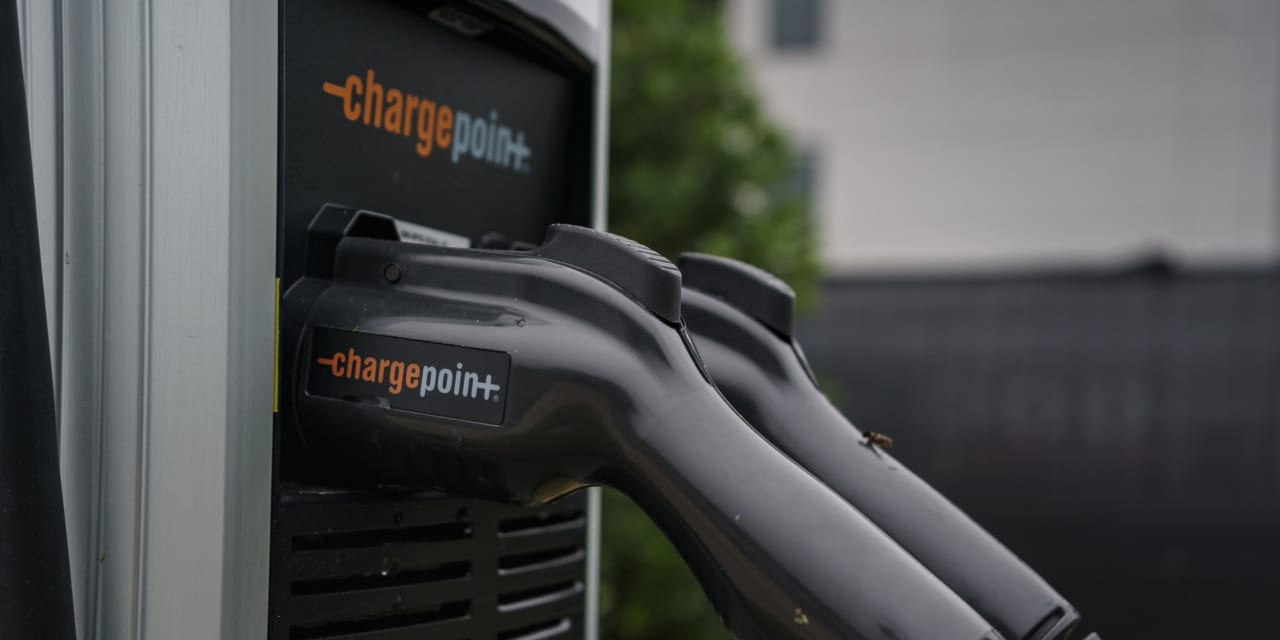
Everyone thinks about electric-vehicle charging and EV range all wrong. Range anxiety shouldn’t be what drivers feel in an EV. They should be experiencing range joy.
Range anxiety, or the fear of running out of juice with nowhere to recharge the car, is a common fear expressed by potential EV owners. No one can blame them. At the end of 2022, the U.S. had about 160,000 public EV charging plugs, according to BloombergNEF, the new energy finance research arm of Bloomberg. People just don’t see chargers every day. Compare that to gasoline. There are, perhaps, 1.2 million pumps at roughly 150,000 gas stations nationwide.
EV charging infrastructure needs to look like gasoline to alleviate range fear. Except it doesn’t.
EV charging infrastructure isn’t analogous to gas stations on the corner,
ChargePoint
(ticker: CHPT) Chief Financial Officer Rex Jackson tells Barron’s. Wi-Fi is a much better analogy.
“Gas station is destination charging…I’m gonna get in my car and drive over there and I’m gonna sit,” says Jackson. “No, no, no, no, your car sits all the time anyway. [Charging] should be something you never think about because it’s everywhere. That’s what we’re trying to get to.”
That’s where joy starts to bubble up. At work? The car is charging. At a hotel? The car is charging. Grocery shopping? Charging. Grabbing a coffee at
Starbucks
(SBUX)? Charging. No sitting or waiting, almost ever. That’s a happy thought.
Some of that charging will likely be free, which adds to the joy. Letting employees charge at work is roughly the same cost as providing them with free coffee, based on average commercial electricity rates across the country.
Jackson believes putting plugs at all those locations is a cost of doing business, like free Wi-Fi at
Starbucks
or, long ago, free HBO in hotel rooms.
That’s the reality ChargePoint is basing its business model around. It’s a one-stop shop for charging solutions that provide 25 miles or 250 miles of range per hour. It doesn’t want to own the charging assets. Instead, it provides hardware and software solutions. ChargePoint isn’t a gas station owner. It just wants to install and maintain plugs while managing uptime and payments.
So far the strategy is working. It’s the largest charging company in the U.S. with 225,000 ports under management.
Tesla
(TSLA) owns and operates the nation’s largest network of fast chargers, the kind that deliver 50 or 100 miles of range in a few minutes.
Those fast-charging stations are needed for road trips, but that type of charging accounts for less than 10% of total charging needs, estimates Jackson. (As for charging time on road trips, this Barron’s reporter has taken several in electric vehicles. EVs have added roughly 40 minutes of total trip time for every 400 miles driven.)
The Wi-Fi analogy works better than the gas station model in another way. Almost 80% of Americans have high-speed internet at home. Most internet activity, most likely, occurs at home. Most EV charging happens at home, too.
Range anxiety is still real, more real than joy for now. It’s ultimately conquered with EV experience. The Canadian Automobile Association found that range anxiety is a top concern of non-EV owners, cited by 67% of survey respondents. After driving one for a while, however, the percentage still harboring the fear drops by more than half to 30%.
That shouldn’t really surprise anyone. Investors, and drivers, can look at the experience of
Tesla
owners. A Tesla owner, as many know, will be happy to talk about their experience, including how much money they have saved using electricity instead of gas. However, the Electric Vehicle Council of Australia surveyed Tesla owners and found they drive just as much as owners of gasoline vehicles. “This finding highlights that driving range is not a major barrier for many existing owners,” says Australia’s Electric Vehicle Council in its survey report.
The survey also found that almost half of Tesla owners take their cars on long road trips and that 90% of Tesla owners use public charging less than one time a week.
Investors don’t feel the joy yet. ChargePoint stock is down about 72% over the past 12 months, while the
S&P 500
and
Nasdaq Composite
are up about 13% and 19%, respectively. Rising interest rates and a slowing economy have weighed on investor sentiment toward companies that aren’t profitable yet.
ChargePoint is trying to do something about that. Management has committed to generating positive earnings before interest, taxes, depreciation, and amortization, or Ebitda, by the fourth quarter of 2024. That’s one quarter faster than Wall Street projects.
Write to Al Root at [email protected]
Read the full article here

