


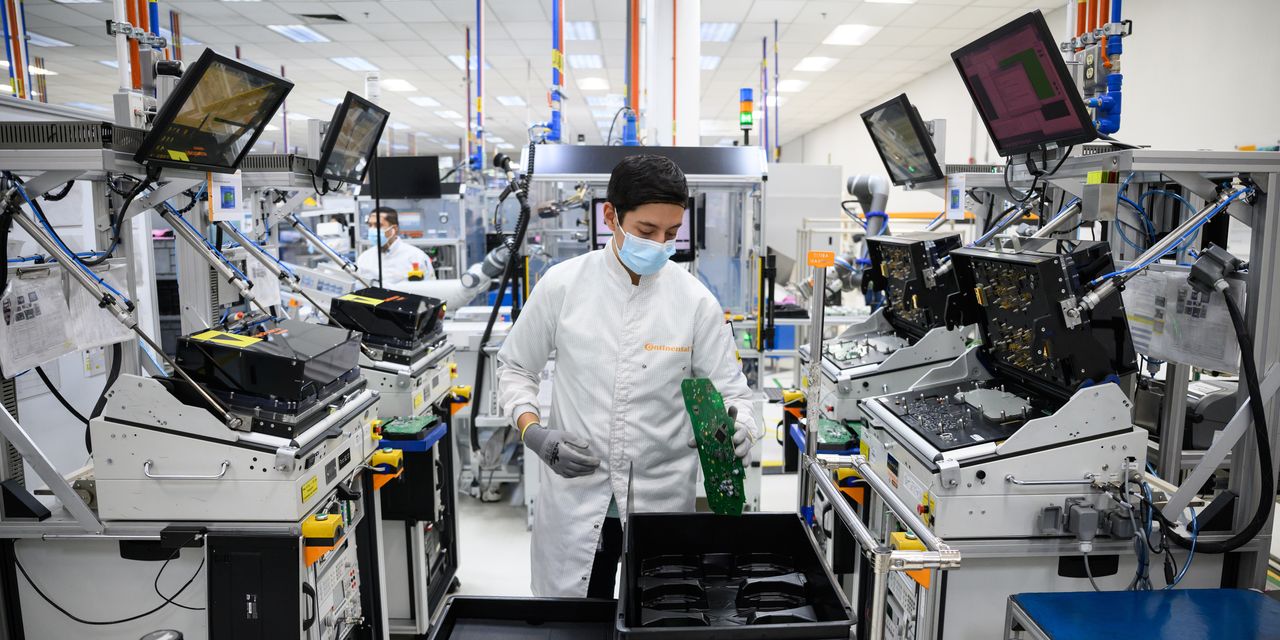
As it becomes clearer that the U.S.-China relationship is becoming more fraught and competitive, companies are looking to reduce their risks by using a “China Plus One” strategy of investing more in production in other countries.
The tiny Vietnamese market has long been a winner from efforts to keep costs low as wages have risen in China, but the new shift is broader and offers more ways for investors to benefit. Companies are now seeking to diversify for reasons beyond saving money, as the U.S. and China increasingly view their their relationship through the lens of national security and Russia’s war on Ukraine has showcased the potential economic fallout of relying too much on one country.
A wider array of countries—think India, Mexico, and Indonesia, among others—- could become the “plus one” for companies moving away from China. That will open up an opportunity for investors to gain as manufacturing activity takes off in these countries, as well as from the follow-on bump to their economies as more investment pours in.
Almost a quarter of respondents in an April survey of members of the American Chamber of Commerce in China said they were considering relocating, or working to do so. Another 27% said they had reprioritized their investments in other countries, up 21 percentage points from a survey earlier in the year.
One country vying for that business is India, which lagged behind China in manufacturing growth for decades. It has stepped up incentives such as tax rebates, cut import duties, and is improving infrastructure to woo companies looking for alternatives to China.
Its position is strong because unlike China, whose working-age population is already declining, India is expected to have more than 240 million people looking for work in the next 20 years. That makes it a natural candidate to gain from the next wave of relocations of low-end manufacturing.
“If we think about the next 10 to 20 years, looking at the policies and factors like labor, a changing trend is under way, and the stars are aligned for a manufacturing shift to India,” Bernstein analyst Venugopal Garre wrote in a recent note.
Analysts also see other Asian countries such as Indonesia—and those in Latin America, especially Mexico—as positioned to become hot destinations.
Mexico’s proximity to the U.S. is one draw but it has other advantages. On a panel discussion at the Milken Institute Global Investment conference this past week, Eugenio Madero, president of Rassini, a producer of suspension components for light commercial vehicles, noted that Mexico boasts the highest engineer graduation rates per capita, more than India.
The problem is that a broad-based emerging-markets fund may not give investors seeking to take advantage much exposure to those markets. The iShares MSCI Emerging Markets exchange-traded fund (EEM), for example, held less than 2% in Indonesia and just 2.6% in Mexico as of the end of the first quarter. The figure for India was below 14%.
Yet there are funds that would let investors ride the potential coming wave. Barron’s worked with MorningstarDirect to screen its pool of diversified emerging markets funds for those that had a higher allocation to each of these markets than the MSCI Emerging Markets index and had at least a three-year record.
The 10 biggest funds that made the cut included both active and passive investing strategies.
The GQG Partners Emerging Markets Equity Fund (
GQGPX
), run by veteran global manager Rajiv Jain, has one of the largest allocations to India, at 34%, as well as a hefty 6% in Mexico and almost 5% in Indonesia. The fund, which charges an expense ratio of 1.16%, reflects Jain’s wariness about China’s longer-term prospects. He says the country faces structural challenges to its growth, including a shrinking working-age population and Xi Jinping’s tighter grip on the economy, not to mention geopolitical concerns.
Of the group, the Allspring Emerging Markets Equity (
EMGYX
) has the heftiest stake in Mexico, with beverage and retailing giant
Fomento Economico Mexicana
(FMX) as its top holding. It has a relatively high expense ratio of 1.36%, according to
Morningstar.
The $8 billion JPMorgan Emerging Markets Equity Fund (
JFAMX
), with an expense ratio of 1.24%, also has a bigger share of its holdings in Indonesia and India than peers. Top holdings include financial companies in both countries, including
HDFC Bank
and PT Bank Central Asia.
Among the cheaper options is the $98 billion Vanguard Emerging Markets Stock Index Fund (
VEIEX
). The passive fund has a slightly higher allocation to each of these markets than its peers and charges an expense ratio of 0.29%.
Some fund consultants have advocated an approach to emerging markets that excludes China because of its outsize weighting in the underlying MSCI Emerging Markets index. The industry has launched many such funds as investors try to get a bigger helping of smaller emerging markets and as investor wariness about China grows.
The iShares MSCI Emerging Mkts ex China ETF (
EMXC
) is one example at the lower end of the scale in terms of costs. It has an expense ratio of 0.25% and hefty allocations to a range of smaller markets, with 20% in India, 4% in Mexico, and 3% in Indonesia.
The ETF also has a heftier allocation to companies in Saudi Arabia. That gives investors exposure to a part of the world that is seeing more interest as trade and capital flows are reassessed and the world adjusts to a tenser relationship between the U.S. and China.
Citi
Chief Executive Jane Fraser, on another panel at the Milken conference, said she has never before seen so much activity between the Middle East and China and Hong Kong.
For investors trying to capitalize on increased interest in areas that stand to gain from the push to diversify beyond China, this list offers a starting point.
| Fund / Ticker | AUM ($bil) | Allocation to Mexico | Allocation to India | Allocation to Indonesia |
|---|---|---|---|---|
| Vanguard Emerging Mkts Stock Index / VEIEX | $97.8 | 0.0% | 0.2% | 0.0% |
| Fidelity Series Emerging Markets Opportunities / FEMSX | 23.7 | 3.6 | 14.2 | 2.1 |
| GQG Partners Emerging Markets Equity / GQGRX | 11.4 | 6.0 | 33.7 | 4.5 |
| JPMorgan Emerging Markets Equity / JFMAX | 8.3 | 3.5 | 21.2 | 4.1 |
| Fidelity Emerging Markets / FEMKX | 7.0 | 3.5 | 15.5 | 2.3 |
| Baillie Gifford Emerging Markets Equities / BGELX | 4.6 | 3.8 | 13.7 | 2.3 |
| Allspring Emerging Markets Equity / EMGYX | 4.0 | 9.8 | 13.8 | 3.0 |
| iShares MSCI Emerging Mkts ex China ETF / EMXC | 3.4 | 3.9 | 19.8 | 3.0 |
| Fidelity Series Emerging Markets / FHKFX | 3.3 | 3.8 | 14.4 | 3.3 |
| Avantis Emerging Markets Equity ETF / AVEM | 2.8 | 2.9 | 14.4 | 2.3 |
Source: MorningstarDirect
Write to Reshma Kapadia at [email protected]
Read the full article here

