


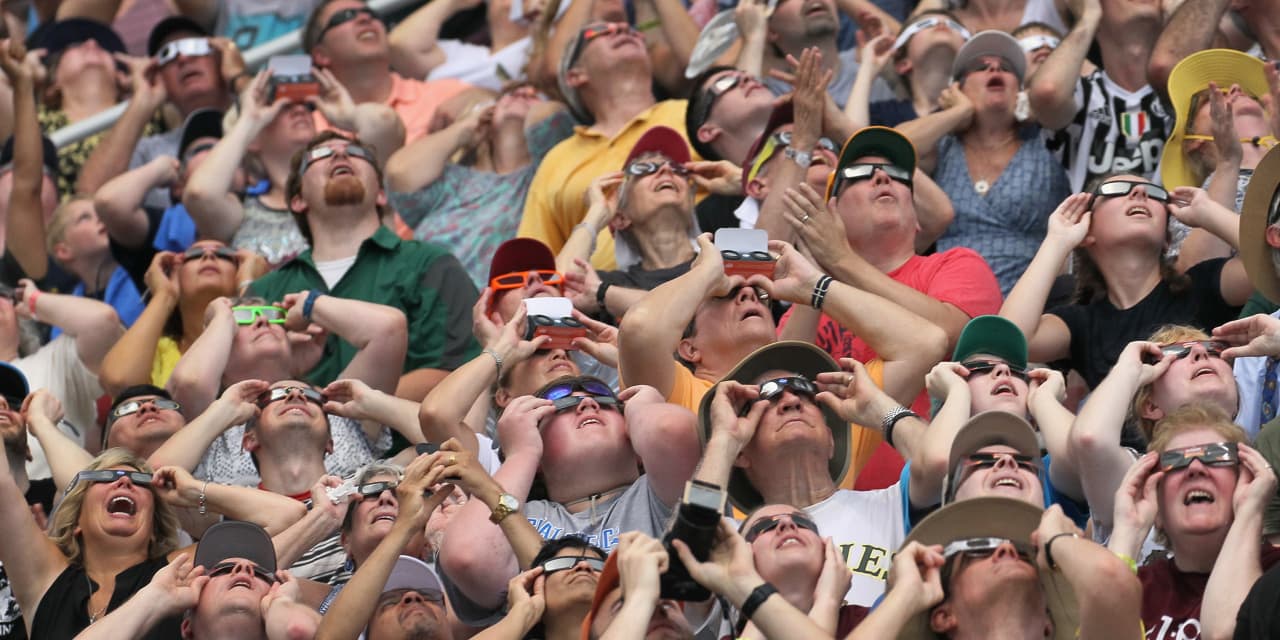
America’s power grids will face a test this Saturday as an annular solar eclipse—a so-called ring of fire—brings big swings to the nation’s solar output.
The skies will darken for about three hours as the moon blocks the passage of light toward the earth, taking most solar-power generation in states from California to Texas offline. Grid operators in the affected states are bolstering backup supplies to get ready.
How much solar capacity will be lost?
Saturday’s eclipse will start on the West Coast in Oregon and head toward the Sunbelt. While the shadow will pass solar hot spots like Arizona and Nevada, it will bring the most impact to California and Texas.
In 2022, the two states made up 42% of the nation’s total utility-scale solar electricity generation, according to the Energy Information Administration.
As California falls under partial shadow, solar output there could drop to less than a quarter of what is typical on a sunny October day, according to the California Independent System Operator, the organization that runs the state’s grid.
Officials from the Electric Reliability Council of Texas said that at the height of the eclipse, solar output in the state could plunge to 13% of normal levels for a clear day. Arizona and Nevada have projected similar losses.
The reduction in output in California and Texas alone would dent U.S. solar-power generation by one-third.
What does it mean for the power grid?
Grid operators in California and Texas say they are ready.
Solar energy, in its nature, is inconsistent at the best of times, so grid operators have lots of ways of keeping power flowing regardless of interruptions from clouds, wildfire smoke, and the like.
Excess solar energy produced during the day is stored in batteries so it can be used in the evening, or when hot weather or winter storms create extra demand. Other energy sources, such as natural gas and wind, also help to keep the lights on.
The grid operators say they have lined up enough alternative power sources to fill the gap. The challenge is easier because relatively temperate October weather means less demand for air conditioning and heating.
What if supply still runs low?
The electric grid in much of the western U.S. is connected, which allows states to help each other out. That should be particularly helpful on Saturday because sunlight won’t be blocked in all part of the West at the same time.
But Texas operates on its own grid, separate from national networks, which means it won’t be able to tap power across state borders. This has been a problem in the past.
In 2021, for example, millions of Texan households lost power as freezing winter storms knocked out infrastructure like wind turbines and natural gas plants. The state grid’s lack of connections with the rest of the country largely prevented it from importing electricity. This past summer, the state’s grid went into high alert again as heat waves lifted power demand.
The Texas grid operator said via X, formerly known as Twitter, that they have “planned for this forecasted reduced generations and expects grid conditions to be normal.”
Hasn’t this happened before?
There are usually two to five solar eclipses every year. About two-thirds are total or annular eclipses, when the moon blocks the sun completely or nearly so, leaving a ring of bright light around it. Those have more impact on solar power.
The last time a total solar eclipse traversed the continental U.S., in 2017, it moved across the middle part of the country. For much of California and Texas, the sun was only partially blocked. The current one should have a larger effect because of its projected course.
The impact will be more notable also because solar energy now accounts for a bigger share of power generation. In the summer of 2017, about 2% of the nation’s electricity generation came from utility-scale solar farms and panels on private rooftops. This July, the share was 6.2%, according to the Energy Information Administration.
The growth is even more notable in the sunny western states. In California, solar power now generates one-third of the state’s electricity, up from 9% at the beginning of 2017.
Meanwhile, Texas’ solar capacity has grown tenfold over the past six years, reaching half of California’s volume. It now powers 6% to 7% of the state’s summer electricity usage.
For the Lone Star state, Saturday’s annular eclipse amounts to a rehearsal for an even bigger test next year, a total solar eclipse on April 8. California will only face a partial blockage of the sun.
Write to Evie Liu at [email protected]
Read the full article here

