


When Prem Pariyar first came to the U.S. from Nepal in 2015, he got a job at an Indian restaurant in California and was assigned a room to live in by the restaurant’s owner. But other workers didn’t want to room with him, he said, because he is Dalit — the lowest-ranked caste, formerly known as “untouchable.”
“I heard so many casteist slurs — words that dehumanized and insulted me,” he said in an interview with MarketWatch this week. Eventually, he became homeless and had to live out of an RV van for a month, he said.
If Gov. Gavin Newsom signs a controversial bill that came out of Silicon Valley, California would become the first state to outlaw caste discrimination like the kind Pariyar says he experienced and witnessed at work, and then in higher education when he worked to get his graduate degree at Cal State East Bay in Hayward, Calif. Pariyar, now a social worker and a commissioner with the Alameda County Human Relations Commission, has testified on behalf of Senate Bill 403.
SB 403, which cleared its final vote last week, would add caste as a protected class to the state’s existing anti-discrimination laws. Caste, a social hierarchy constructed thousands of years ago in South Asia, is defined in the bill as “an individual’s perceived position in a system of social stratification on the basis of inherited status.”
The California legislation follows a similar ordinance passed in Seattle earlier this year, as well as anti-discrimination rules including caste that are in place in the California State University system and some University of California campuses, due in part to Pariyar’s advocacy. Other universities, such as Harvard University, have caste-bias protections in place for graduate-student workers.
From the archives (February 2023): Seattle becomes first U.S. city to ban caste discrimination
State Sen. Aisha Wahab, who represents a district that includes parts of Silicon Valley, wrote the legislation. It has proven so contentious, especially among some Indian Americans who say it unfairly targets them, that the first-term Democratic senator is facing threats and a recall effort.
After pressure from opponents, the bill no longer includes language stating that caste is “present across South Asia and the South Asian diaspora.” In addition, caste is now listed under “ancestry” and not as its own category, as it originally was presented.
Wahab, who is Afghan American and was the first Muslim elected to the California state senate, told MarketWatch last week that she introduced the bill because of stories many people have told her about being negatively affected at work or hurt in other ways because of their caste.
“There are people who really do take advantage of their power and position and really harm other people,” she said.
A 2016 survey of more than 1,500 South Asians living in the U.S. by Equality Labs, a civil-rights organization that advocates for ending caste-based oppression, found that 67% of Dalits reported experiencing unfair treatment in the workplace because of their caste. Four in 10 Dalit students reported experiencing caste discrimination in educational institutions.
Meanwhile, the senator said she has been targeted with “racist and bigoted” attacks on social media because of the legislation.
“Carrying a civil-rights bill is no easy task,” she said. Opponents of the bill are saying things like “Oh, she’s Afghan, let’s remember 9/11,” Wahab said.
Tanuja Gupta, a former Google
GOOG,
GOOGL,
manager who quit her job at the company last year after a talk she organized for the company’s employees on the topic of caste bias was canceled — and who eventually testified before the California Assembly Judiciary Committee in support of Wahab’s bill — called the senator courageous.
“I think she was so brave to take on this issue,” Gupta said in an interview with MarketWatch. “Not very many people would. Why rock the boat? Why risk [political] donors?”
‘I am that evidence’
Groups opposing the bill say existing California laws — the Unruh Civil Rights Act and the California Fair Employment and Housing Act — provide enough protection against all types of discrimination. They also say Wahab’s legislation targets American Hindus, whom they say are most closely associated with caste, though the bill does not mention any specific group.
Pushpita Prasad, a board member of the Coalition of Hindus of North America, said in an interview that the definition of caste in the dictionary, and the way it is taught in schools, equates caste with Hinduism — and that therefore the legislation scapegoats practicing Hindus in the state, many of whom are Indian American.
“This bill will presume us guilty until proven innocent,” Prasad said.
Sudha Jagannathan, Prasad’s fellow board member at CoHNA, also spoke with MarketWatch. “I come from a so-called oppressed community,” she said, referring to the Bahujan population. But she said she had lived in India, and then lived in the U.S. for 40 years, before learning her caste background.
“It was irrelevant in my life and networks,” Jagannathan said. There has been more awareness of caste since the bill was introduced, she added, which she doesn’t think is a good thing.
Both Prasad and Jagannathan questioned the research and claims about caste discrimination by Equality Labs. They also said they don’t want Indian-American employees to be asked about caste at work, or for children to be asked about caste in school.
“This could traumatize students and subject them to bullying,” Prasad said.
But Pariyar, the social worker from Nepal, conducted research into caste-based discrimination among the Nepali diaspora living in the San Francisco Bay Area and found instances of social exclusion, workplace prejudice, microaggressions and housing bias among more than a couple of dozen Nepali Dalits in the area.
“The opposition who are saying this bill is against the Hindu community, that’s absolutely wrong,” he said. “I myself am Hindu — I am Hindu Nepali Dalit, and I have been experiencing discrimination. They never speak up for my safety.”
Pariyar added: “The opposition is saying there is no evidence [of discrimination against Dalits in the United States]. I’m saying I am that evidence.”
“‘The opposition argues that South Asians will be disproportionately affected by the accountability in this bill. That’s analogous to saying that race-discrimination laws wrongly affect white people, or gender-discrimination laws wrongly affect men.’”
Caste has determined access to educational networks and connections for generations, said Anupama Rao, a history professor at Barnard College, Columbia University, who has written a book about caste and is currently working on another. Caste has functioned to “organize occupations, rituals, the religious, the legal, the political,” Rao said. “It organizes sexual relationships.”
Ancient Hindu texts describe the four main castes as Brahmins (priests and scholars); Kshatriyas (warriors); Vaishyas (merchants) and Shudras (laborers); with Dalits, falling outside the caste system, ranked lowest. Though India outlawed caste-based discrimination more than 70 years ago and Nepal banned it in 2011, advocacy groups and research say it has persisted in modern-day South Asia and beyond. India’s National Crime Records Bureau last year reported there had been 50,900 cases of crimes against Dalits in 2021, a slight uptick over the previous year.
“It’s a form of social capital and inherited privilege,” Rao added, noting that she herself is from an upper-caste family. “The kinds of people who have typically tended to come to the U.S. have been upper-caste members. What [that has] tended to do is invisibilize caste.”
It can be “deeply uncomfortable” for people to have to deal with the “outing” of their caste, Rao said, as affirmative action in India has increased the caste diversity of immigrants to the U.S. over the years.
The professor added that she finds the arguments of reverse discrimination “deeply ironic,” saying opponents of the bill think that to “give people rights is actually a form of denying you yours.”
“Every time a group wants to demand rights, dignity and recognition, it produces tremendous anxiety in a social space that’s organized around explicit and implicit practices of inequality,” Rao said.
The bill protects everyone whether they are from a higher or lower caste, Tarina Mand, a lawyer on the racial-justice task force of the South Asian Bar Association of North America, said during a news conference with Wahab last week after the bill’s final passage.
“The opposition argues that South Asians will be disproportionately affected by the accountability in this bill,” Mand said. “That’s analogous to saying that race-discrimination laws wrongly affect white people, or gender-discrimination laws wrongly affect men.”
Silicon Valley’s increased focus on caste
Wahab said caste systems “exist in every corner of the world” and that there are Hindus who support the bill, including the group Hindus for Caste Equity.
The state senator’s constituents include Silicon Valley tech workers, many of whom are Indian Americans. Caste has gained more attention in the Bay Area tech center in recent years.
When Gupta was still working at Google, she arranged for a speaker to come to the company to talk about caste bias. The speaker was Thenmozhi Soundararajan, the founder and executive director of Equality Labs, which has said it has received complaints about caste discrimination from many tech employees.
At the time, Soundararajan told MarketWatch that since caste is a protected class in India but not in this country, U.S.-based tech workers with H-1B visas at companies like Google didn’t have the same protections that they were used to having before they came to the U.S.
According to four Google employees who spoke with MarketWatch last year around that time and asked not to be named out of fear of reprisal, there was “defensiveness” from some employees at the company and claims that caste discrimination didn’t exist in the U.S. So the talk at the company never happened, though Gupta and Soundararajan eventually posted the discussion they had planned on Google-owned YouTube.
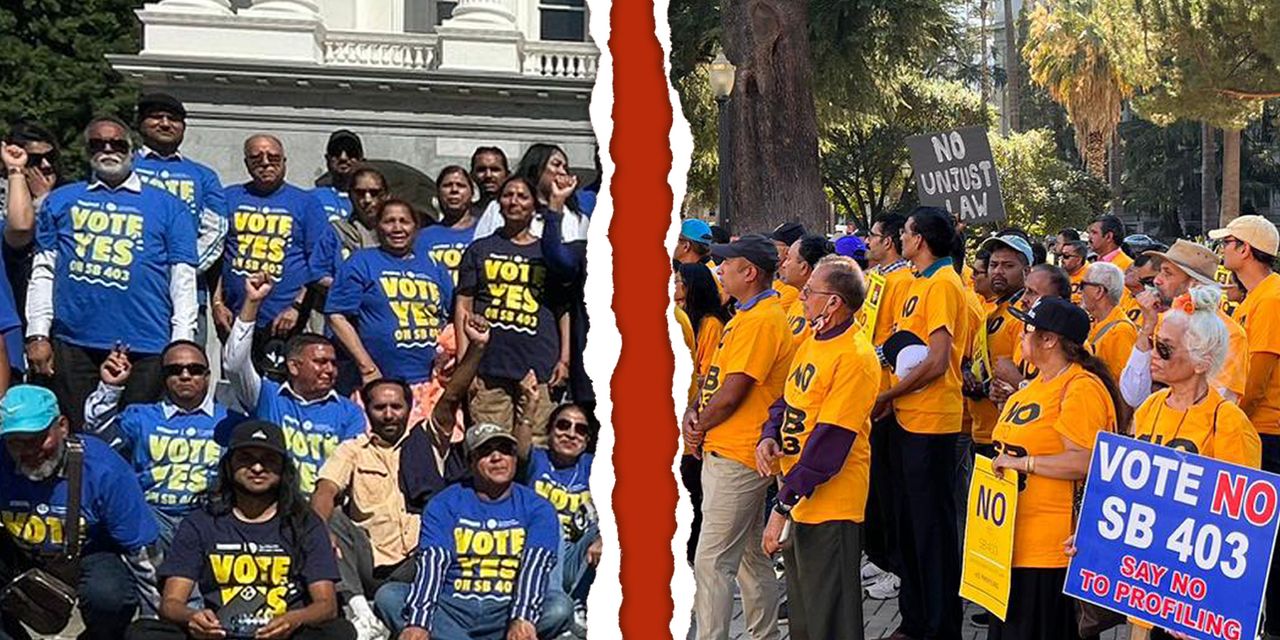
“Opponents continue to protest SB 403, including by rallying in front of the California Capitol building last weekend.”
Gupta, who was also an organizer of the famous 2018 Google walkout over the company’s handling of sexual-misconduct allegations against executives, left the tech giant last year after it started an investigation of her conduct related to the aftermath of the talk’s cancellation. The company also penalized her, a move she called retaliation and over which she filed a complaint against the company with the Equal Employment Opportunity Commission. The EEOC is now investigating.
A Google spokesperson said: “Caste discrimination has no place in our workplace and it’s prohibited in our policy on harassment and discrimination, falling under national origin, ancestry, and ethnic discrimination.” The spokesperson also said Soundararajan’s planned talk was canceled last year because it “was pulling employees apart rather than bringing our community together and raising awareness.”
A lawsuit brought by California’s Civil Rights Department a couple of years ago accused two Cisco Systems
CSCO,
engineers of caste discrimination. The lawsuit against the employees was dismissed in April, but the department has said it continues to pursue its case against the company.
A Cisco spokesperson said: “The California Civil Rights Department voluntarily dismissed the case alleging caste discrimination against two employees but not the lawsuit against Cisco. We have no comment on active litigation.”
Advocates of SB 403, including Soundararajan, have gone on a hunger strike until the governor signs the bill. More than 100 advocates across the state are on hunger strikes, she told MarketWatch this week, adding that she is consuming only liquids and no solids.
Of the opponents who question her research, religion and intent, Soundararajan — who said she was born Hindu and Christian but is now a Buddhist — said that “this bill doesn’t affect an ethnicity, religion or a nationality.” “The only people that this bill would target would be those who discriminate,” she said.
Opponents continue to protest the bill, including by rallying in front of the California Capitol building last weekend.
California’s governor does not comment on pending legislation, a spokesperson said. The bill was officially presented to him on Monday, and he has 12 days from that date to sign, veto or take no action on the bill.
Read the full article here

