


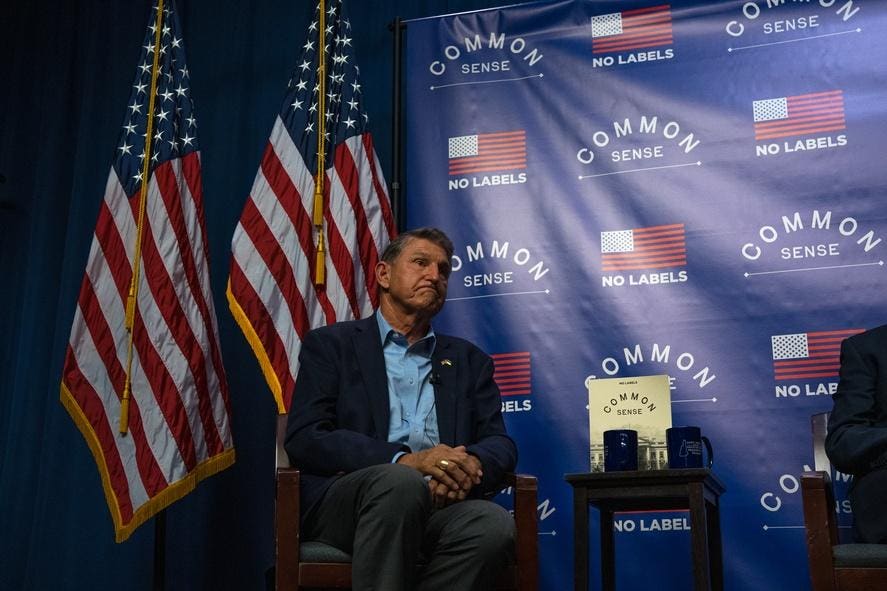
The bipartisan group No Labels is getting a lot of attention these days because it says it may run its own presidential candidate in 2024. It recently attempted to build on that interest by releasing a 63-page manifesto that describes its policy agenda on issues ranging from healthcare and immigration to crime and the environment.
On some issues, the group is highly specific, extoling the benefits of charter schools, Medicare drug pricing reform, and raising the age for gun purchases. But, unfortunately, when it comes to fiscal policy, No Labels has no details. Many platitudes. But few actual proposals.
ADVERTISEMENT
Tax policy gets no mention at all, except in passing. You might think that with $3 trillion in individual income tax cuts due to expire in 2025, voters would want to know whether the group thinks these tax benefits should be extended, and whether the extensions should be paid for with offsetting tax hikes or spending cuts. But its “Common Sense” agenda says not a word about the subject.
Instead, readers learn about only three small, highly targeted tax preferences the group would add to the revenue code.
Deficit Reduction, But How?
When it comes to fiscal policy, the manifesto says this: “Washington must stop spending so much more than it takes in. From now on, the annual budget should be reasonable and responsible, which means our national debt needs to stop growing faster than our economy.”
ADVERTISEMENT
Nothing wrong with promising a government that will “stop spending so much more than it takes in.” But what exactly does that mean: More taxes or less spending?
And that careful phrase “so much more” does a lot of work here. No Labels appears to believe that government still should spend some more than it collects in tax revenues. But how much more? “Enough so the national debt [stops] growing faster than our economy” is quite an ambitious target.
How would the group get there? It specifies some big cost reductions in Medicare. But otherwise, it has two big suggestions: Faster economic growth and a deficit commission.
Faster growth is largely a function of a growing working age population and an increase in worker productivity. There are limits to how public policy can influence either.
A more flexible immigration policy would help with the former, at least on the margins. But the real solution, a higher birthrate, seems to not be in the cards. And besides it would take decades to make any difference.
ADVERTISEMENT
Another Deficit Commission
And a deficit commission? The very idea makes my head hurt. No Labels acknowledges the failure of previous efforts but seems convinced that if only the new commission could be designed better, the outcome would be different this time. The sad reality is that if Congress wants to ignore a commission’s recommendations, it will find a way to do so. Guardrails or not.
Perhaps a commission could give lawmakers cover to do serious deficit reduction. But only if they want to reduce spending and raise taxes. By a lot. And recent experience, up to and including the recent debt limit deal, is clear and convincing evidence that they don’t.
Yes, Republicans want to talk about reducing the deficit. But most don’t want to do anything about it. Cut spending, yes. Cut taxes, for sure. But deficit reduction? Not really. And Democrats? Most want to raise taxes but they’d spend most of the extra money on social programs.
ADVERTISEMENT
Fixing Social Security
No Labels rightly acknowledges the importance of addressing Social Security’s pending insolvency. But it concludes, “In fixing Social Security, the next president and Congress should be grounded in two foundational principles…1) No one in retirement—or close to it—should face any benefit changes; and 2) no middle-class or lower-income Americans should face a benefit cut.”
Now we know what the group won’t do. But what will it do? Besides, isn’t the foundational principle of Social Security reform to make the program solvent well into the future? It surely isn’t to exempt various groups from uncomfortable reforms.
Unfortunately, the No Labels agenda reads exactly like what it is: A carefully crafted plan aimed at attracting moderate voters who don’t read too carefully. It is a gauzy wish list for the center-right and center-left that tries too hard to not offend. Hence, no explicit acknowledgment that Social Security reform will require benefit cuts and tax increases or that broader fiscal policy will too.
ADVERTISEMENT
The group has panicked Democrats, who fear a No Labels candidate would siphon 2024 votes from President Biden and help re-elect Donald Trump, assuming he is the Republican nominee. I’ll leave the politics to others. But while No Labels promises a practical, bipartisan, transparent solution to the nation’s problems, its fiscal platform delivers little more than its own version of the usual vague political promises we’ve gotten from Democrats and Republicans.
Read the full article here

