


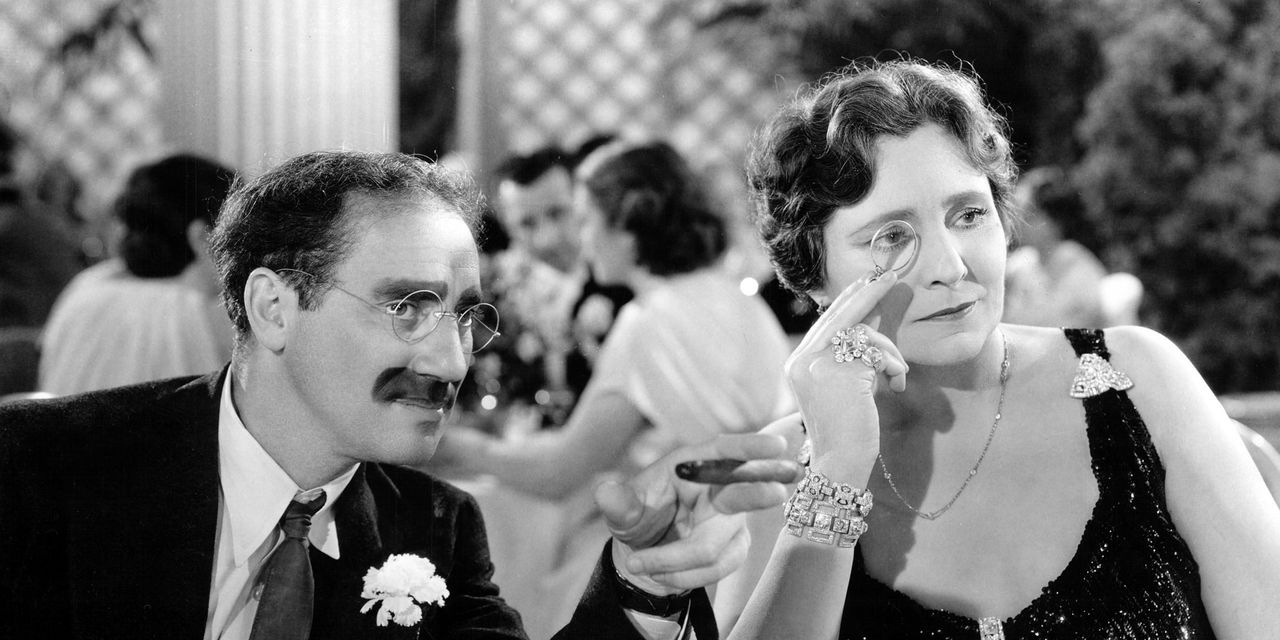
Mrs. Claypool: Mr. Driftwood! Three months ago you promised to put me into society. In all that time you’ve done nothing but draw a very handsome salary!
Otis B. Driftwood: You think that’s nothing? How many men do you suppose are drawing a handsome salary nowadays?
From the Marx Brothers’ 1935 movie “A Night At The Opera” to Mike Judge’s 1999 movie “Office Space,” and from Douglas Adams’s “The Hitchhiker’s Guide to the Galaxy” to Joseph Heller’s “Catch-22,” writers and satirists have long made fun of the jobs in modern society that seem to have absolutely no social purpose or benefit to humanity whatsoever.
Now we have an actual head count — and it’s a doozy.
One U.S. worker in five confesses in a new academic study that they think their job adds no value to the world. That’s the share who say their job “rarely” or “never” gives them “the feeling of making a positive impact on [their] community and society” or “the feeling of doing useful work.”
“In total, more than 19% of all respondents … perceive their jobs as socially useless,” writes University of Zurich sociology researcher Simon Walo in the latest issue of the peer-reviewed academic journal Work, Employment and Society.
This includes nearly one-third of those in jobs involving transportation or moving things, and, surprisingly, of those in occupations involved in making or using material things, from carpenters and butchers to aerospace engineers. Sales and marketing jobs, along with office and administrative jobs, also scored very poorly.
Doctors, nurses and teachers were at the other end of the spectrum, with fewer than 5% of teachers saying they thought their jobs were socially useless.
Meanwhile, fewer than 25% of those in business and finance, and fewer than 20% of lawyers and managers think they are adding no value.
Money managers, stockbrokers, research analysts and “strategists” were not broken out as a separate group — more’s the pity.
The numbers are drawn from a study of the 2015 American Working Conditions Survey, itself a part of the long-running RAND American Life Panel, a nationally representative group of people who take part in regular surveys. The findings are based on responses from 1,800 people.
Walo, the study’s author, was testing a theory thrown out a decade ago by the late David Graeber, an anthropologist, radical and professor at the London School of Economics. Graeber argued that in the modern economy, some or many jobs are “bulls— jobs.”
“Huge swathes of people, in Europe and North America in particular, spend their entire working lives performing tasks they secretly believe do not really need to be performed,” Graeber wrote back then. He sought to explain why everyone was still working so hard, even though society could now satisfy all its basic needs with a tiny percentage of effort.
“We have seen the ballooning of not even so much of the ‘service’ sector as of the administrative sector, up to and including the creation of whole new industries like financial services or telemarketing, or the unprecedented expansion of sectors like corporate law, academic and health administration, human resources, and public relations,” Graeber wrote.
Apparently this idea was so new to academics, publishers and the commentariat that Graeber even got a book deal out of it. It isn’t new to anyone who’s actually worked for a living in any kind of bureaucracy. Or to anyone with even a passing acquaintance with popular culture.
“What would ya say you do here?” consultant Bob Slydell asks product manager Tom Smykowski in the 1999 movie “Office Space.” Smykowski struggles to find an answer.
English humorist Douglas Adams, author of the celebrated science-fiction satire “The Hitchhiker’s Guide to the Galaxy,” imagined that Earth had been populated by all the useless people from another planet, who were tricked into leaving by everyone else.
And it was about 50 years ago that humorist Art Buchwald came up with the theory that so many people were doing make-work jobs that there was only one person left in America who knew how to fix anything mechanical.
Walo’s study finds two things: The first is that some — or many — people really do perform jobs they consider to be socially useless. The other is that even people in useful jobs are likely to feel useless if they end up doing boring, repetitive work. This may explain why many in so-called “productive occupations” give their jobs the thumbs-down, even though they’re among the few people actually doing something.
Also read: Companies that took a ‘leap of faith’ with a four-day workweek saw improved productivity — and held fewer boring meetings
And: Switching jobs isn’t a surefire way to get a big pay raise anymore — think twice before you jump ship
Read the full article here

