


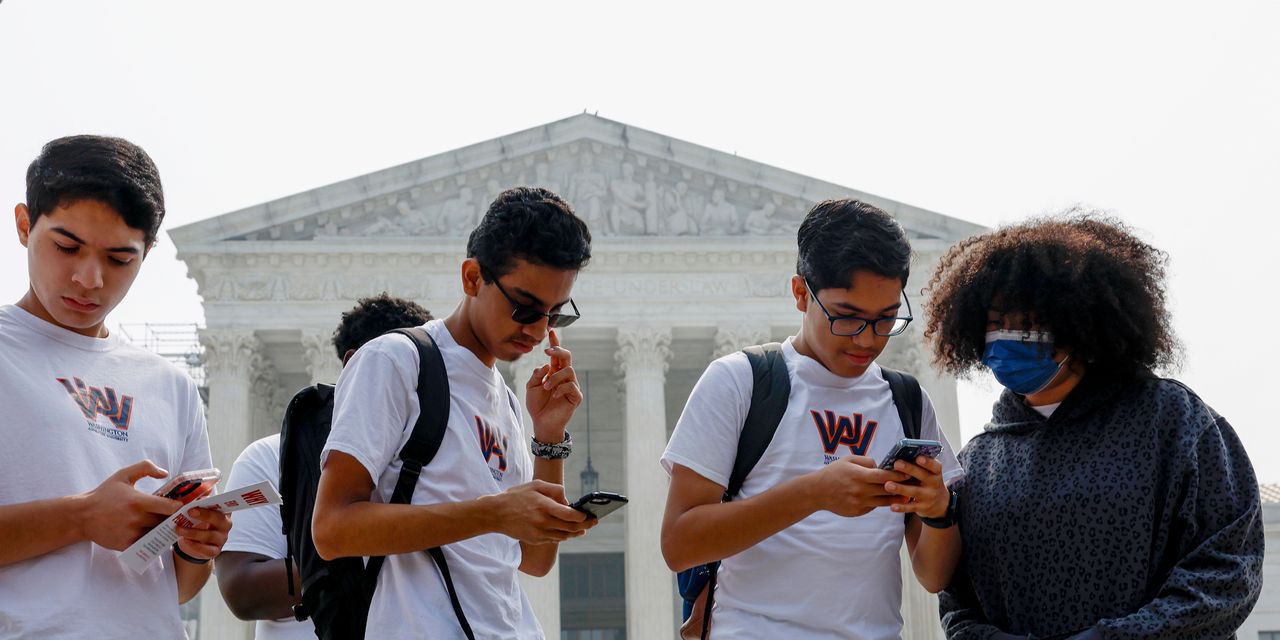
The Supreme Court’s decision to strike down affirmative action in the college-admissions process Thursday may have also dealt a blow to corporate America’s slow-going efforts toward diversity in top-tier positions, experts and others say.
A key voice making that argument is Justice Sonia Sotomayor, a member of the court’s liberal wing.
In a dissent on the cases involving Harvard University’s and the University of North Carolina’s use of race-conscious admissions policies, Sotomayor said diplomas from elite schools bring along high-powered alumni networks and the chance for economic mobility.
“Admission to college is therefore often the entry ticket to top jobs in workplaces where important decisions are made,” she wrote in Students for Fair Admissions v. Harvard University and Students for Fair Admissions v. University of North Carolina. “Today’s decision further entrenches racial inequality by making these pipelines to leadership roles less diverse.”
Read more: How college admissions will change in America after the Supreme Court knocked down affirmative action
HR professionals fear a ‘diminished’ talent pool
As some human-resources professionals and lawyers review the decision, they also say the watershed decision for higher education will reverberate in the workplace.
“The decision, while not surprising, will create issues for employers in future,” said Tim Bartl, the president and CEO of the HR Policy Association, a trade association of chief human-resources officers for more than 400 of the country’s largest corporations.
Civil-rights laws say employers cannot make hiring and promotion decisions based on race, even in the interest of diversity, Bartl noted. But companies can work to broaden the pool of job applicants who come their way in the first place.
The short-term effect of Thursday’s ruling could be a crimped pipeline to applicants of color over the next few years, he said. The long-term effect could be a labor market where companies have to work harder to find diverse talent pools, Bartl said.
“It’s going to require employers to engage, to educate and to explain and market their brand to attract the highest-level talent among qualified, diverse candidates,” Bartl said.
The HR Policy Association filed a friend-of-the-court brief, also known as an amicus brief, in support of Harvard and UNC. Its member companies “rely heavily” on colleges and universities to supply a diverse and qualified talent pool, the organization said in its filing.
“Creating this pool of diverse talent requires admissions processes that provide opportunities for students of all backgrounds to achieve a higher education,” the organization’s lawyers told the court. “Accordingly, amicus members are most concerned that the availability of such a pool of qualified candidates as a whole not be diminished.”
One of the member companies, Johnson & Johnson
JNJ,
released a statement after decision.
“We hire and advance individuals strictly on merit, based on the skills and competencies most needed by our business now and for the future,” said a spokesperson. “We also believe higher education plays a significant role in creating equitable opportunities for individuals to reach their full potential and in developing the diverse talent that corporations need to thrive.”
Johnson & Johnson remains “steadfast in our commitment to foster a diverse, equitable and inclusive workforce and environment,” the company added.
The decision “effectively turns away from decades of precedent,” said Charlotte Burrows, the chair of the Equal Employment Opportunity Commission, the federal regulator on workplace laws. Still, she said, “It remains lawful for employers to implement diversity, equity, inclusion, and accessibility programs that seek to ensure workers of all backgrounds are afforded equal opportunity in the workplace.”
Skepticism from the Supreme Court majority
Of course, there are skeptics who question why race should play any role. Those include the Supreme Court majority, which found the admissions policies violated the 14th Amendment’s equal-protection clause.
“Because Harvard’s and UNC’s admissions programs lack sufficiently focused and measurable objectives warranting the use of race, unavoidably employ race in a negative manner, involve racial stereotyping, and lack meaningful end points, those admissions programs cannot be reconciled with the guarantees of the Equal Protection Clause,” the majority wrote. “Many universities have for too long wrongly concluded that the touchstone of an individual’s identity is not challenges bested, skills built, or lessons learned, but the color of their skin.”
In a concurring opinion, Justice Clarence Thomas said, “Universities’ self-proclaimed righteousness does not afford them license to discriminate on the basis of race.” Federal law doesn’t give allow institutions to lean on race as a justification for action elsewhere, he added, citing employment-discrimination cases as one example.
Whatever happens next with recruiting and talent development, data shows the current face of C-suite executives doesn’t entirely match the country’s makeup.
The U.S. workforce is a diverse place as a whole, according to findings this year from a Harvard Law School Forum on Corporate Governance. Still, C-suites in corporate America remain “disproportionately white and male.”
“We see severe under-representation of women, Black, and Hispanic/Latino executives in most C-suite positions,” said researchers at Russell Reynolds Associates, a leadership advisory firm.
Some high-profile attorneys are already looking at the ruling’s employment consequences for businesses and schools.
After the decision hit, the New York State Bar Association said it had convened a task force on how keep diversity efforts intact. The group is led by Brad Karp, chairman of Paul, Weiss, Rifkind, Wharton & Garrison, and Jeh Johnson, a partner at the high-powered firm and former Homeland Security secretary.
“Businesses — including law firms — are worried about the legitimacy of corporate diversity initiatives. This could also impact governmental programs that require quotas such as minority business enterprise requirements,” said Richard Lewis, the bar association’s president. “We want to prepare our members, clients and lawyers throughout the state and nation for any eventuality.”
Johnson, who became the first Black partner at Paul, Weiss in 1994, said in a statement that “for all my professional and personal life, I have seen the benefits of a diverse environment.”
“Now that the Supreme Court has ruled, we must find the path forward,” Johnson said. “Our task is to identity ways consistent with today’s decision to continue to foster an integrated, not a segregated, America.”
Read the full article here

