


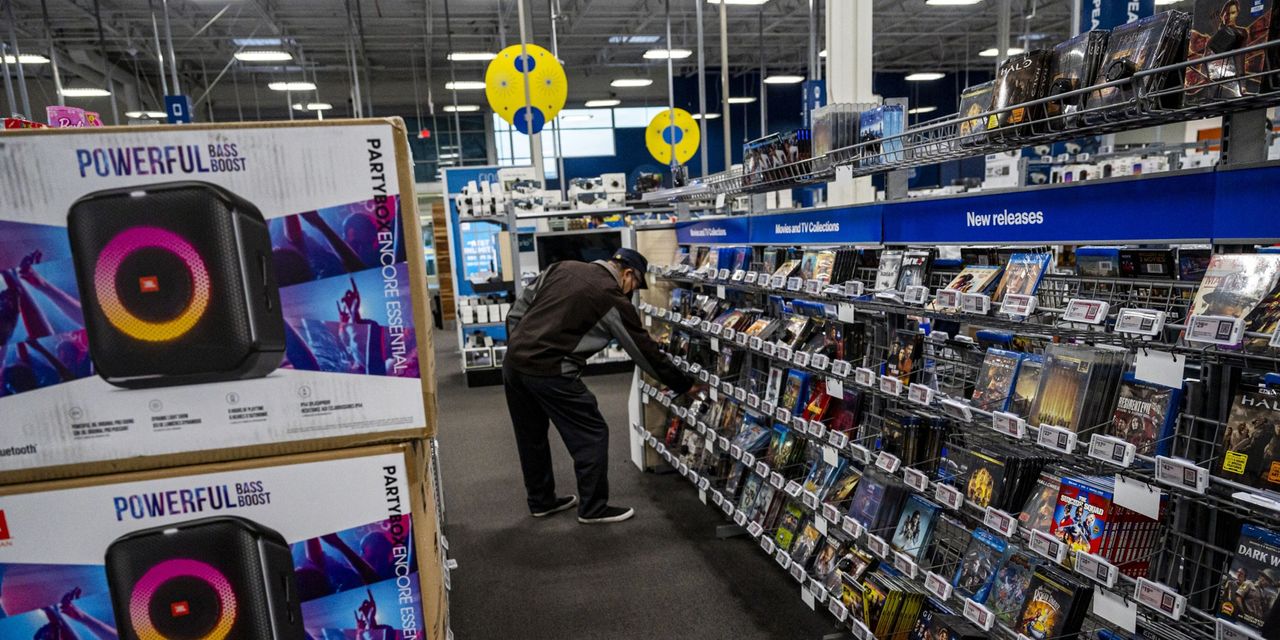
Best Buy’s
earnings, due Tuesday morning, will show whether consumers are still hesitant to splurge on a new flatscreen TV— or if demand for consumer electronics may be poised for a comeback.
Analysts are forecasting Best Buy (ticker: BBY) will post adjusted earnings of $1.06 a share on $9.52 billion in revenue, according to consensus estimates compiled by
FactSet.
That would compare with earnings of $1.54 a share from $10.6 billion of revenue in the year-earlier quarter.
The past year has been a challenging one for Best Buy and other companies in the consumer electronics business. Inflation and higher interest rates have dissuaded shoppers from buying pricey electronics, especially because many people upgraded their gear during pandemic-era lockdowns.
Sales at electronics and appliance stores were 3.1% lower in July than a year ago, according to the Census Bureau’s latest report on retail sales. Electronic sales were also lower than in June, the report found.
That makes sense given earnings reports from other retailers, which suggest that consumers are being more discerning about how they spend their money. Many are cutting down on discretionary purchases.
But some analysts are betting that Best Buy has put the worst behind it. Sales at other retailers suggest consumer demand for electronics has picked up slightly in the summer months, wrote Wedbush analyst Seth Basham in a note last week.
Back-to-school season may also be driving more people to look for electronics. While foot traffic to Best Buy was down 10.7% from a year earlier in the last week of May, according to Placer.ai, it was off just 2.4% in the first week of July.
Same-store sales, which track the performance of stores open for more than a year, should reflect that momentum. Wall Street is forecasting that Best Buy’s same-store sales will fall by 7% this quarter. While still negative, that would mark an improvement from the year-earlier quarter’s 12.1% decline, and the previous quarter’s 10.1% drop.
Still, like most Wall Street analysts, Basham is cautious about the stock. He rates it at Neutral with a target of $72 for the price. Only 14% of analysts rate the stock at Buy, compared with an average of 55% for companies in the
S&P 500.
Close to 80% of analysts following Best Buy rate it at Hold, while 7% have it at Sell, according to FactSet.
“Demand continues to face pressure within big ticket discretionary home-oriented purchases and others have pointed to an unwinding of pulled forward demand for these purchases during the pandemic as consumers were spending an increased amount of time at home,” he wrote. “That said, the sequential improvement—particularly during the month of June—has been stronger than expected.”
Last week, Barron’s made the case for buying Best Buy ahead of the earnings, arguing that Best Buy has surpassed forecasts in six of the past seven quarters. The stock has gained on the trading day after earnings in six of those quarters, partly because it is cheap. Shares trade at about 11.1 times 12-month forward estimates, below the five-year average of 12.4 times.
Best Buy stock closed 1.9% higher on Monday for a loss of 7.7% so far this year.
Write to Sabrina Escobar at [email protected]
Read the full article here

