


About the author: Thomas W. Hazlett is H.H. Macaulay endowed professor of economics at Clemson University.
The federal judge deciding the U.S. Department of Justice Antitrust Division case to block
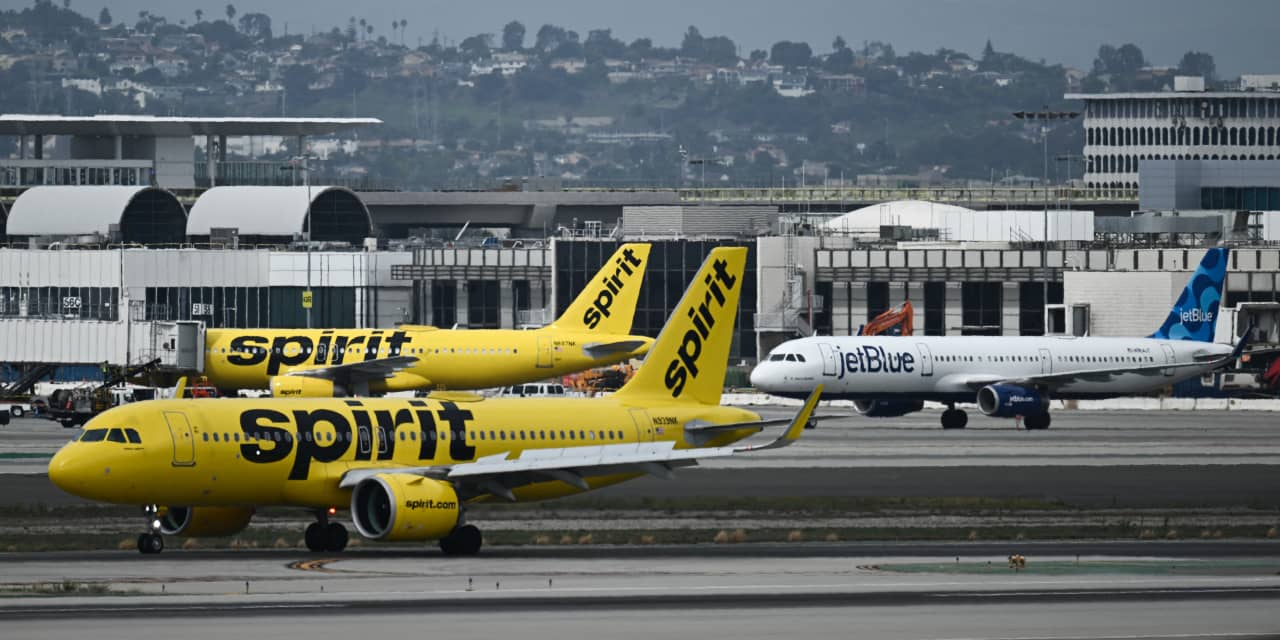
JetBlue’s
$3.8 billion bid to buy
Spirit Airlines
was bubbly in his 113-page decision thwarting the merger. “Spirit is a small airline,” wrote William Young, a Reagan appointee. “But there are those who love it. To those dedicated customers of Spirit, this one’s for you.”
It perhaps isn’t much of a present. Spirit’s shares plunged 62% in the three days after the news of the court’s ruling broke. The firm’s 2025 bonds were trading at 179 cents on the par dollar a year ago. They are down to 97 cents today, amid talk of liquidation. The “small airline” loved by some may soon be no airline at all.
Spirit’s shares have recovered some of their losses in the days since, though they remain down more than 40% from the start of the year. The company outlined a new financial plan to investors last week, and JetBlue and Sprint said they would appeal the ruling. The matter is now in the hands of the 1st U.S. Circuit Court of Appeals.
Spirit is an ultra low-cost carrier. It offers rock bottom fares by unbundling—a bottle of water is $4. Judge Young makes music when he analogizes to the business model of the barkeep in Les Miserables: “Charge ‘em for the lice; extra for the mice; 2% for looking in the mirror twice.” But the merry dance for budget-conscious travelers would last—even improve—were Spirit to pay its bills and buy more planes.
Enter the acquirer. “JetBlue had pursued Spirit in hopes that its planes and pilots would supercharge JetBlue’s growth plans, helping it challenge the larger carriers that dominate the industry in the U.S.,” explained The Wall Street Journal.
Of course, a carrier eyeing monopoly profits might think (or say) the same. The antitrust law is charged with parsing the truth of the matter. The judge was impressed with the DOJ’s assertion that air carriers easily coordinate with rivals, boosting prices and profits. By buying the disrupter, JetBlue stands to cash in on that anti-competitive practice.
The opinion makes much of the “Spirit Effect,” the observation that when the no-frills carrier jumps into a market, prices plunge 15-20%. Moving Spirit into the JetBlue network would threaten those savings, with no offsetting gains that the judge was willing to credit.
The basic idea here, however, is simple supply and demand. Raise the former, price falls. The phenomenon has been called, at various times, the “Southwest Effect,” the “Frontier Effect,” or the “JetBlue Effect.”
A concern might be that planes on a route served by both JetBlue and Spirit could be moved elsewhere. But moving that effect does not lose competitive impact but shifts it—improving it overall, the host airline hopes, in its chase for profits.
Curiously, the merger opinion ignores such offsets and follows a “billion-to-one” rule. If a Spirit customer saves a dollar, eliminating those benefits is anti-competitive and “presumptively illegal.” If Spirit’s assets move from one market to another, and make happy consumers on a new route, those gains to customers should logically be included in a cost-benefit test to evaluate consumer impact. If quality-adjusted prices generally rise, then antitrust law has a charter to block. But the opinion didn’t go there. Instead, the billion-to-one rule was invoked: If a Spirit fan lost a dollar, gains to others (or even to that very same customer flying on a different ticket) of $1 billion in newfound consumer surplus are irrelevant.
That a beefed-up JetBlue, with a stronger (and incorporated) Spirit, would better compete in the airline business is a highly plausible theory. The court might have weighed it. Both the merging parties are low-cost operators nipping at the heels of larger air travel networks: No. 6 (JetBlue) purchasing No. 7 (Spirit) to become No. 5 makes the new firm still less than a third the size (in revenues) of No. 4, United. Based on revenues, JetBlue supplies 5% of U.S. air travel, Spirit 4%. These kinds of market shares do not inspire monopoly, not according to antitrust precedent or airline industry history. As McKinsey stated in a 2022 report: “The airline industry has failed to earn its cost of capital in every year of its existence.” Amazingly, such easy means for monopoly pricing tend to result in less than even competitive returns.
The merger opinion accepts the DOJ assertion that JetBlue’s plans to retrofit Spirit’s planes will result in anti-competitive damage. Spirit’s aircraft feature a crowded configuration: Standard seats are equipped with “tiny tray tables—you can’t fit a laptop on them,” says Travel & Leisure. The DOJ’s logic is that fewer seats will raise prices, but that is because the quality of each seat and the travelers’ overall flying experience is assumed irrelevant. Anyone who believes this must never be restricted to a middle seat with a 28-degree pitch and 28-inch leg room for 250,000 miles.
With any luck, JetBlue will have its appeal heard by justices who have flown Spirit, brought their laptop for an assignment on deadline, and endured a very thirsty flight.
Guest commentaries like this one are written by authors outside the Barron’s and MarketWatch newsroom. They reflect the perspective and opinions of the authors. Submit commentary proposals and other feedback to [email protected].
Read the full article here

