


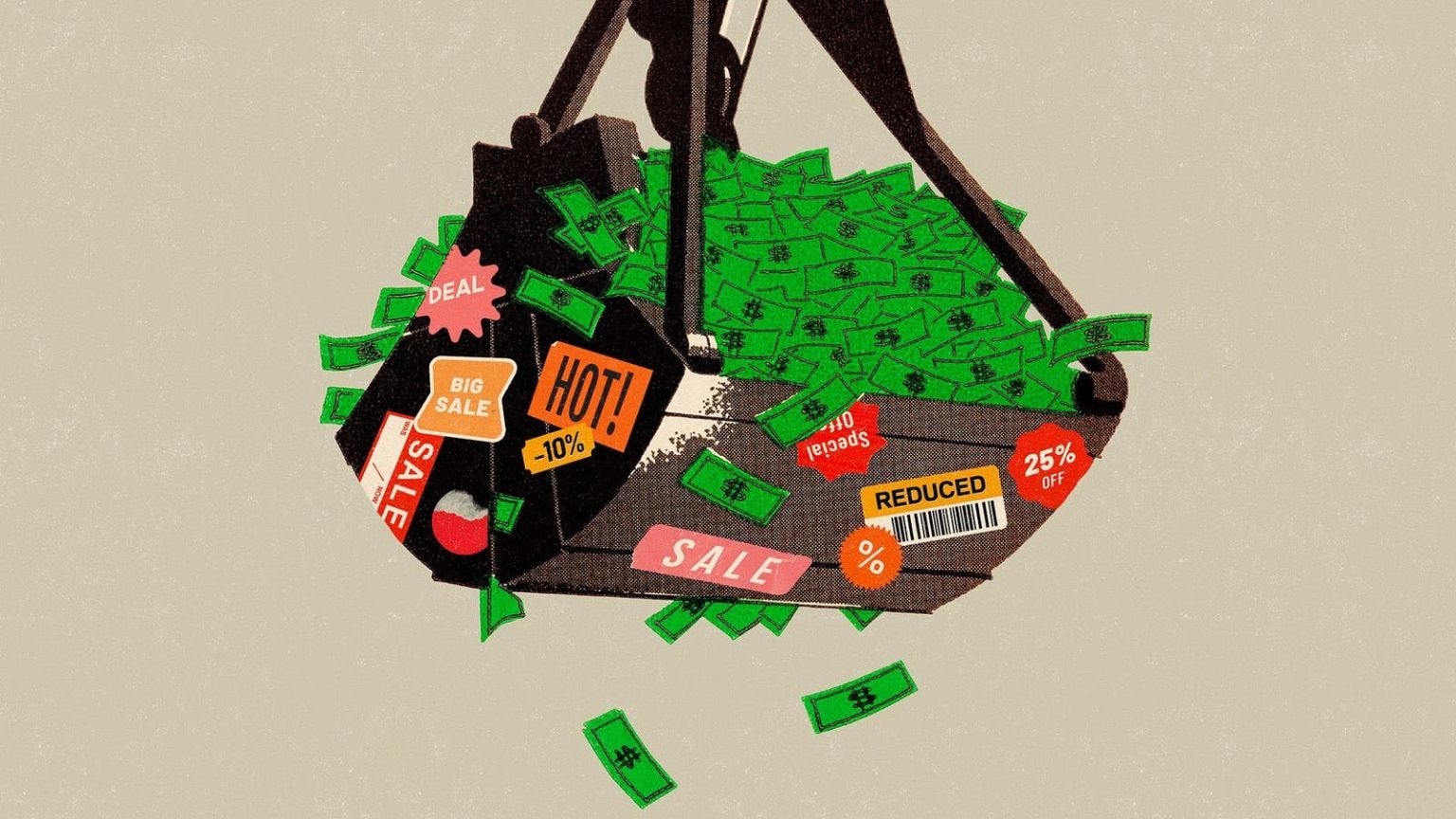
The $220 billion closed-end universe is the scene of sometimes whacky pricing, including a fair number of good buys and a few really bad ones. There’s a formula to help you tell the difference.
By William Baldwin, Forbes Staff
Discount! Fund on sale!
Closed-end funds trading at a discount to their liquidating value look like screaming buys. A few are. Most of them are best avoided.
A closed-end investment company is a peculiar beast. Unlike funds that are open-end or exchange-traded, a closed-end does not have any mechanism for liquidating the holdings of departing customers. Its shares trade in the second-hand market, with prices, set by supply and demand, that can veer far away from their asset value.
A fund selling with a “15% off” sticker is not the same sort of thing as a discounted kitchen appliance. If you were prepared to buy the dishwasher at full price, a 15% sale is money in the bank.
Not so with a fund. Availability of a discount on it doesn’t leave you better off unless something happens to turn the fund’s portfolio into cash for you. That could be a liquidation of the fund, an uncommon occurrence, or else a payout from the fund.
It might seem that the discount, all by itself, would magnify your returns. It doesn’t.
Suppose a fund is trading at a 15% discount to its net assets. Then, for every $85 you invest, you have $100 going to work for you in the market. Alas, that doesn’t enhance your return. If the fund’s portfolio doubles in value, each $100 inside it goes up to $200, but you don’t come out $100 ahead. If the discount stays put, your $85 grows to $170, and you have the very same 100% return you would have had if there were never a discount.
Sometimes fund discounts narrow. Sometimes they widen. A neutral assumption in your analysis is that a discount stays put.
Most of the closed-end funds out there are trading at discounts. Only a few are genuine bargains. These are the ones that combine a discount with two other things: distributions of cash and reasonable expense ratios.
There is, in fact, a simple formula that relates three variables—discount, distribution rate and expense ratio—to tell you when a closed-end is worth a look. Here’s what comes out when the formula is cranked into a database of closed-ends available from Ycharts, an online investor resource. The screen counted only the 421 funds with at least $50 million in net assets.
Closed-End Funds: 15 Best Buys
Discounts on these funds mean you effectively get paid to own them.
What all these funds have in common: a negative cost of ownership. In effect, you are being paid to let someone select securities for your portfolio.
How does that formula work? Let’s go back to our hypothetical fund worth $100 a share but available at a price of $85. Suppose that the fund makes annual cash distributions equal to 10% of the fund’s asset value. Every $10 check you get in the mail is something you bought for $8.50. So you have an instant $1.50 gain.
Now suppose that the fund runs up annual overhead of 1%. That’s $1 out of your pocket. But then there’s the $1.50 windfall more than offsetting the expenses. The annual holding cost of a share with a net asset value of $100 is negative 50 cents. Your effective expense ratio is -0.5%.
Here’s the formula for the cost of ownership: Add to the published expense ratio the product of the distribution yield and the discount or premium, with a discount being treated as a negative number and a premium as a positive one.
In the hypothetical example: 1% + 10% x -15% = -0.5%. A negative expense ratio, not to be found on any conventional mutual or exchange-traded fund, is a good deal. If the discount neither shrinks nor widens, your return from a fund with a -0.5% effective expense ratio will be whatever the portfolio delivers plus an incremental 0.5% a year.
Premium-priced funds work in reverse, with distributions poisoning the returns. If our hypothetical fund were trading at $115, the expense formula would be 1% + 10% x 15% = 1.5%. Your return would be whatever the portfolio delivers minus 1.5% a year. Bad deal.
The remunerative impact of a cash payout on a discounted fund applies no matter what is the source of that cash. It could constitute interest and dividends on the portfolio, or capital gains realized on the portfolio or just a return of the shareholders’ own capital.
What does matter is whether the distributions continue, and that is sometimes hard to predict. The table of cheap funds features those with a negative 0.5% or better cost of ownership, based on recent distributions. In some cases the payouts are related to capital gains that can’t be counted on. In other cases—the BlackRock tech fund, for example—the yield reflects a policy of delivering a certain monthly payout, whether earned or not. The three at the bottom don’t clear the -0.5% hurdle but still have a negative cost using a more conservative yield figure (not shown) equal to the average of the total distribution yield and the income-only yield.
An asterisk must be attached to two of the winners in the negative-cost competition, namely, the Highland funds. A large fraction of their portfolios is sunk into affiliated companies whose valuations require a leap of faith. They might turn out to be bargains or they might not.Money managers who spend their whole day evaluating closed-end funds take into account many variables, including volatility, trading volume and the historical range of a fund’s discount or premium. One such expert, Erik Herzfeld, is profiled in this story.
Investors not prepared to delve into such statistical depths need a simpler approach. Here, we adopt the John Bogle principle that costs matter more than anything else. Thus, the tables assign no value to how a portfolio has performed in the past. That approach is justified by the fact that, apart from expenses, past performance has only the faintest connection to future performance. Paying more to get a hot fund is, on average, just a way of paying more for average performance.
Now let’s use the effective-cost formula to zero in on the worst buys. These are funds that combine stiff expenses, a share price above net asset value and lavish payouts. A cash distribution from a premium-priced fund is a form of dollar destruction. Here are five standouts in the high-cost derby.
Closed-End Funds: 5 Worst Buys
Premium prices on these funds give them a huge cost drag to overcome.
What about liquidations? The closing down of a fund erases a discount. It happens, rarely. Goldman Sachs threw in the towel this summer on its MLP & Energy Renaissance Fund, generating a windfall for anyone who bought in just before the liquidation was announced.
But it would be unwise to count on such events, which usually need cooperation from the money manager who earns fees from the fund. As farmers are wont to say, it’s awfully hard to get a hog to butcher itself. Don’t stick around in a fund with high expenses unless the payouts, combined with the discount, offset those expenses.
MORE FROM FORBES
Read the full article here

