


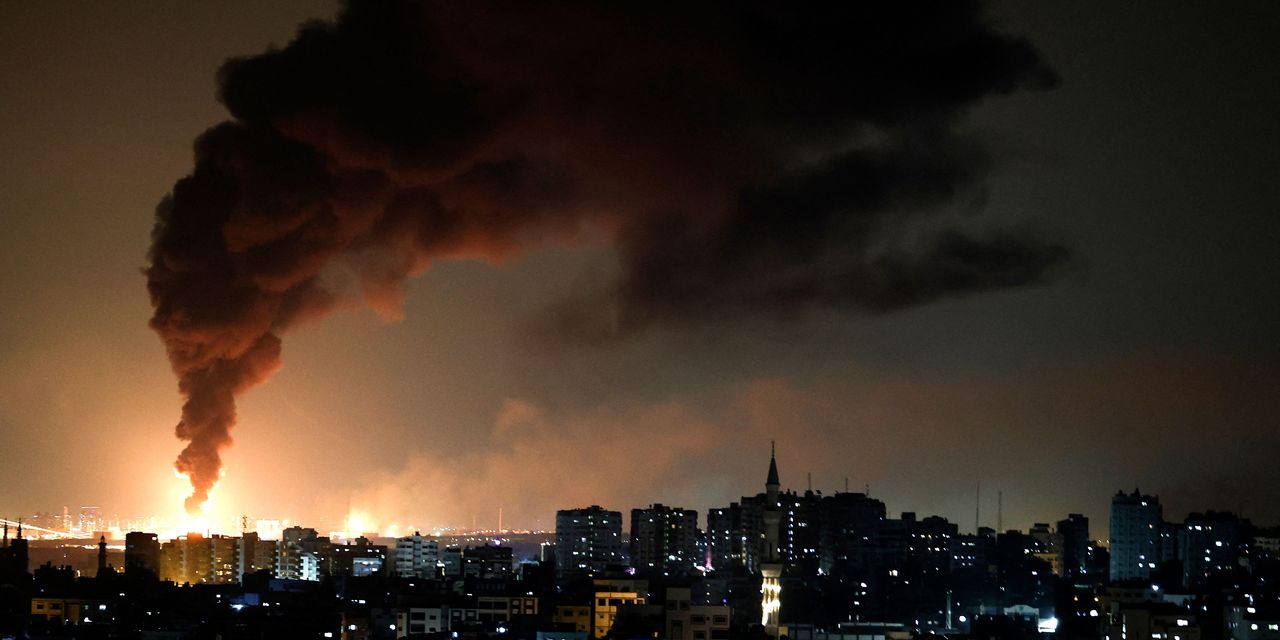
What happens to oil prices, and production and supply flow in the Middle East, is highly dependent on whether Iran was directly involved in the attack by Palestinian militant group Hamas on Israel last weekend, analysts say.
Oil prices initially rallied on Monday following the attack and Israel’s declaration of war against Hamas, even though Israel isn’t a major oil producer.
“The crucial factor for oil production and exports hinges on whether the conflict extends beyond the Israel-Gaza region,” Rebecca Babin, senior energy trader at CIBC Private Wealth U.S., told MarketWatch. “The situation remains dynamic, and its future course remains uncertain.”
“An important trigger for further escalation would be if Israel directly implicates Iran by suggesting it had knowledge of the attacks or was involved in facilitating them,” she said.
Iran has been known to provide funding and training to Hamas. It is a significant producer in the energy market — the fifth-largest crude-oil producer in the Organization of the Petroleum Exporting Countries in 2021 and the world’s third-largest natural-gas producer in 2020, according to the Energy Information Administration (EIA).
The Wall Street Journal on Sunday reported that Iranian military officials helped plan and coordinate the Hamas attack. White House national-security adviser Jake Sullivan has described Iran as “complicit” in the attacks, having long provided funding and training to Hamas, but has said the U.S. so far hasn’t confirmed Tehran had advance knowledge of the attack.
For now, neither Israel nor the U.S. has made direct allegations against Iran, and there have been conflicting news reports regarding Iran’s awareness of the situation, said Babin.
The New York Times reported Wednesday that the U.S. has collected multiple pieces of intelligence showing that key Iranian leaders were surprised by the Hamas attack in Israel.
That news contributed to Wednesday’s decline in oil prices, said Babin. On Wednesday, U.S. crude benchmark November West Texas Intermediate oil
CL.1,
CLX23,
fell $2.48, or 2.9%, to settle at $83.49 a barrel on the New York Mercantile Exchange. December Brent
BRN00,
BRNZ23,
ended at $85.82 a barrel on ICE Futures Europe, down $1.83, or 2.1%. Prices for both WTI and Brent had settled with a gain of more than 4% on Monday.
Iran’s potential involvement
“Signals and reporting around Iran’s involvement will be pivotal to the potential escalation and will be closely monitored by the crude-oil markets, leading to increased volatility,” Babin said.
Prior to last weekend’s events, news reports had indicated a more relaxed enforcement of U.S. sanctions on Iran.
Iran’s oil exports were moving higher as the U.S. looked to de-escalate tensions and instead prioritizing Russian sanctions and keeping the oil market well supplied, according to an article from Energy Intelligence published in early September.
Iranian crude-oil exports are at a five-year high due to soft enforcement by the U.S., said Babin. Iranian exports topped 2 million barrels per day in August and are set to increase by 700,000 barrels per day year on year and that would make Iran the second-largest source of supply growth behind the U.S. this year, she said.
Price scenarios
“Stricter enforcement” of sanctions could take 500,000 barrels per day off the market and would a price impact, said Babin. She said she believes prices for Brent crude would rise back above $95, while WTI climbs to the mid-$90s — but not above $100 a barrel.
“An important consideration here is that sanctions enforcement takes time … so market impacts would be gradual,” she said.
Meanwhile, if Israel were to implement direct military strikes on Iran, that would potentially impair Iranian crude-oil production, which is currently over 3 million barrels per day, said Babin. “This would cause crude to move above $100.”
Still, the rally would be “contained by the fact that OPEC+ has more than 4 [million barrels per day] of spare capacity that it would bring back online to fill the supply gap,” and it’s likely to do so in this scenario, she said.
Iran could decide to block the Straight of Hormuz, a critical passage for the global crude market, said Babin. The waterway is located between the Persian Gulf and the Gulf of Oman.
Around 20% of the world’s total oil consumption passes through the strait each day with “little available alternatives,” she said. “This would cause crude to rise above $115.”
“The length of time that this strait was impacted would be key here, but this is a very extreme outcome,” added Babin.
Saudi influence
The impact from the Israel-Hamas conflict, however, may also include Saudi Arabia, said Babin.
Israel’s diplomatic normalization efforts, facilitated by the U.S., are derailed, reducing U.S. influence on Saudi Arabia’s oil-production decisions, she said. The failure of achieving a “grand bargain will hit the pause button on improving strained relations between the U.S. and Saudi Arabia.”
Context: Biden’s hopes for normalized Israeli-Saudi relations could be casualty of new Mideast war
Saudi Arabia had told the U.S. that it would be willing to boost oil production early next year if crude prices are high, according to a report from the Wall Street Journal dated Oct. 6, ahead of the Hamas attack on Israel. That was said amid efforts for the kingdom to recognize Israel and in return get a defense pact with Washington, the report said.
As odds of a deal fall, the potential for U.S. please to the Saudis to unwind its voluntary production cuts will continue to go “straight to voicemail,” said Babin.
“Price impact is limited as it is more supportive of crude prices than catalyst for significant upside,” she said.
U.S. moves
If oil prices do rally to $100 and beyond, that would pose a deeper challenge to the U.S., as its central bank continues to make moves to tame inflation, without leading the economy into a recession.
The U.S. Strategic Petroleum Reserve was created as an emergency supply of crude to reduce the impact of inventory disruptions, but last year the Biden administration announced its largest-ever release of oil from the reserve in an effort to combat persistently high gasoline prices in the wake of the Russian invasion of neighboring Ukraine.
The SPR is at its lowest level since the 1980s. Babin said she “would not rule out more releases even though it is low in an extreme scenario.”
There are 350 million barrels in the SPR, and the U.S. is producing around 13 million barrels of crude a day versus the 1980s when it was producing less than 5 million barrels a day, she said. “It would not be popular to tap SPR again.”
Oil prices, however, are likely to see a sharp rise next year, according to a monthly report issued by the Energy Information Administration.
The EIA forecast an average 2024 price of $90.91 a barrel for WTI oil, up 9.2% from the September forecast, and up from the 2023 forecast average of $79.59. Brent crude is expected to average $94.91 next year, up 7.6% from the previous forecast and up from the 2023 forecast average of $84.09.
The EIA said global crude-oil supply growth has been limited this year because of voluntary production cuts from Saudi Arabia and reduced output targets from other OPEC+ countries. It expects countries within the OPEC+ agreement to have lowered oil production by 1.4 million barrels a day in 2023, partly offsetting production growth of 2.7 million barrels a day by non-OPEC+ producers.
The U.S. is among those non-OPEC+ producers. Babin expects producers in the U.S. to respond with “meaningful production increases” if the back end of the crude-price curve (one year out) traders above $90 a barrel, she said. It’s current trading at around $75.
They are not going to respond to front-month oil-price increases because it takes time to get crude out of the ground and they know Saudi Arabia has spare capacity, she said.
“There may be marginal increases, but I don’t think more than [200,000 barrels per day] in terms of short-term supply response,” Babin said.
Saudi Arabia will bring back barrels if front-month crude rises above $100, she said. “They have the capacity. The only reason they don’t is if they can’t” because of a transport disruption at the Strait of Hormuz or some other “very extreme outcome.”
Read the full article here

