


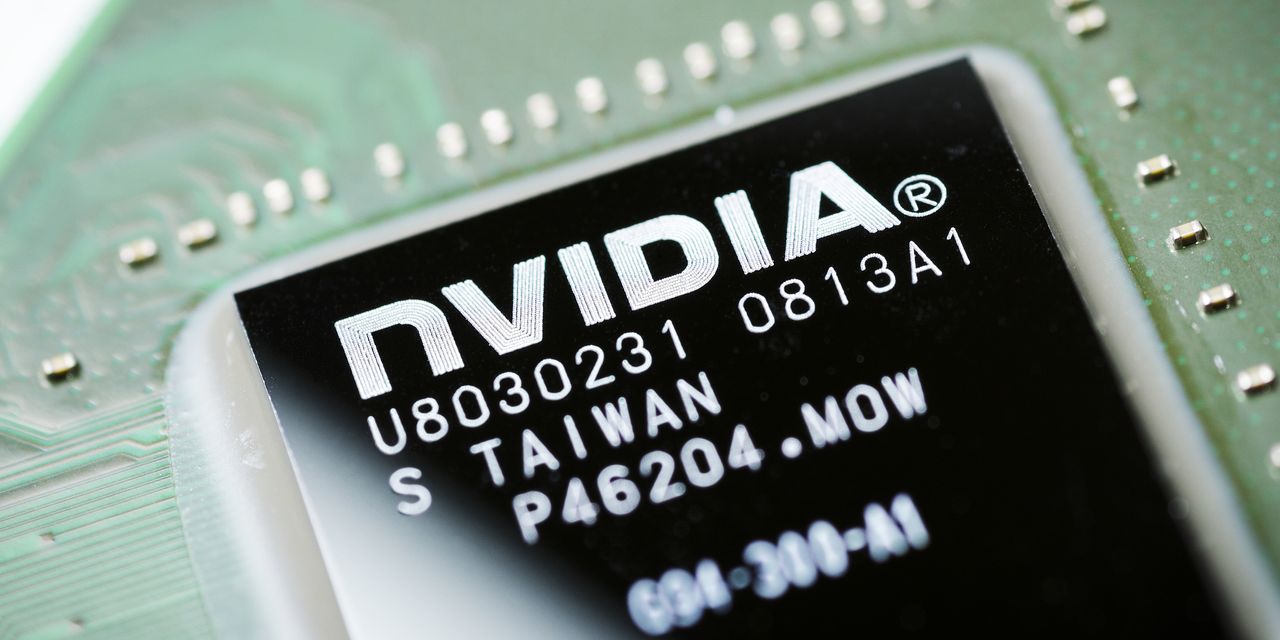
There were two significant developments in the tech world this week that could go a long way to defining the coming year for stocks:
Nvidia’s
blockbuster earnings and Arm Holding’s IPO filing.
Both news events were followed by lots of quick takes on their meaning: that Nvidia’s (ticker: NVDA) banner results were an all-clear for other artificial-intelligence plays, and that Arm’s public listing was a do-or-die moment for the IPO market.
But investors should be careful with the binary analysis. Reality will be more complicated, involving a more nuanced list of winners and losers.
Nvidia’s fiscal second quarter, reported Wednesday, was historic in scope. There is little precedent for a chip maker as large as Nvidia doubling its revenue—to $13.5 billion—in one year. Its data center business, driven by AI demand, was even more impressive, growing 171% year over year and rising 141% from the prior quarter.
“A new computing era has begun. Companies worldwide are transitioning from general-purpose to accelerated computing and generative AI,” Nvidia CEO Jensen Huang said in the company’s earnings statement. “The race is on to adopt generative AI.”
Huang long ago stated that the $1 trillion invested in global data-center infrastructure would move from traditional server central processing units, or CPUs, to graphics processing units, or GPUs, that are better enabled to power the parallel computations needed for new applications like AI.
That bodes well for Nvidia. Developers prefer the company’s GPUs because of their performance paired with Nvidia’s robust software programming platform ecosystem, known as CUDA. They have been building and sharing AI-related tools and software libraries for over a decade on Nvidia’s proprietary platform, making it easier to now rapidly build AI applications.
They’re sticky advantages. So, while investors are clamoring for the next version of Nvidia (i.e., Arm Holdings), the reality is that most of the value for AI-related hardware is likely to keep accruing to Nvidia—not others.
That’s a problem for the rest of the industry. Nvidia’s gain may be other companies’ pain. The latest surveys of chief information officers reveal that technology buyers aren’t expanding their overall budgets to accommodate the increased AI spending, but rather taking dollars from other buckets.
That spells trouble for makers of legacy server hardware and chips. Huang said on Nvidia’s earnings call that the company had broad-based order visibility well into next year. With large internet companies, enterprises, and start-ups prioritizing AI projects, the structural shift toward GPUs could last for years.
Beyond AI, the other big question for technology investors has been when the IPO market might reopen after two years of meager activity.
So far this year, the dynamic remains the same. According to Renaissance Capital, 68 IPOs have raised $9.9 billion in 2023, compared with 281 IPOs generating $96.3 billion by this time in 2021. Over the past decade, an average of 129 IPOs have raised $33 billion this far into the year.
That’s why Arm Holdings’ IPO filing this past week could be a big moment. When it goes public, the listing is likely to be the biggest tech debut in a long time.
Arm makes money from licensing its chip architecture and other chip designs to semiconductor companies and hardware makers.
SoftBank Group
(9984.Japan) acquired Arm for $32 billion in 2016. In 2020, the company reached an agreement to sell Arm to Nvidia, but that deal was terminated two years later after it faced opposition from global regulators and other chip companies.
In its IPO filing this past week, Arm made sure to tie itself to the AI hype. “As the world moves increasingly toward AI- and [machine learning]-enabled computing, Arm will be central to this transition.” But that story is far from written.
In Arm’s latest quarter ended June, the company saw a small drop in revenue and a 53% decline in net profit versus the prior year. That isn’t very Nvidia-like. Arm is primarily exposed to a fading smartphone market; it has yet to extract large profits from AI spending.
This doesn’t reduce the importance of Arm to the broader new-issue market. It’s surely an upbeat sign that bankers and SoftBank think the market has improved enough to handle a substantial public listing. Ultimately, Arm could be the first of several large technology IPOs later in the year—particularly in the area of cloud software, which has been blown open by AI.
No area of the tech market is more exposed to AI disruption or transformation than the software industry, as customers quickly come to expect the latest in AI. It makes the sector ripe for change—and open to a wave of successful start-ups.
Elliott Robinson, a partner at Bessemer Venture Partners, says nearly all cloud software companies are actively developing AI-capable products and features to be released by the end of this year.
Robinson expects five to 10 tech start-ups go public in the fourth quarter. He cited a recent survey his firm conducted of top private cloud company CEOs who said that Databricks, Stripe, Canva, Klaviyo, and Snyk were the ones most likely to IPO next. If those are well received, Robinson predicts another 15 to 30 start-ups could get out in the first half of next year.
We are about to enter a dynamic period as AI drives a wave of disruption across semiconductors, technology hardware, and software, creating a new list of winners in the public markets. It’s going to be a wild ride.
Write to Tae Kim at [email protected]
Read the full article here

