


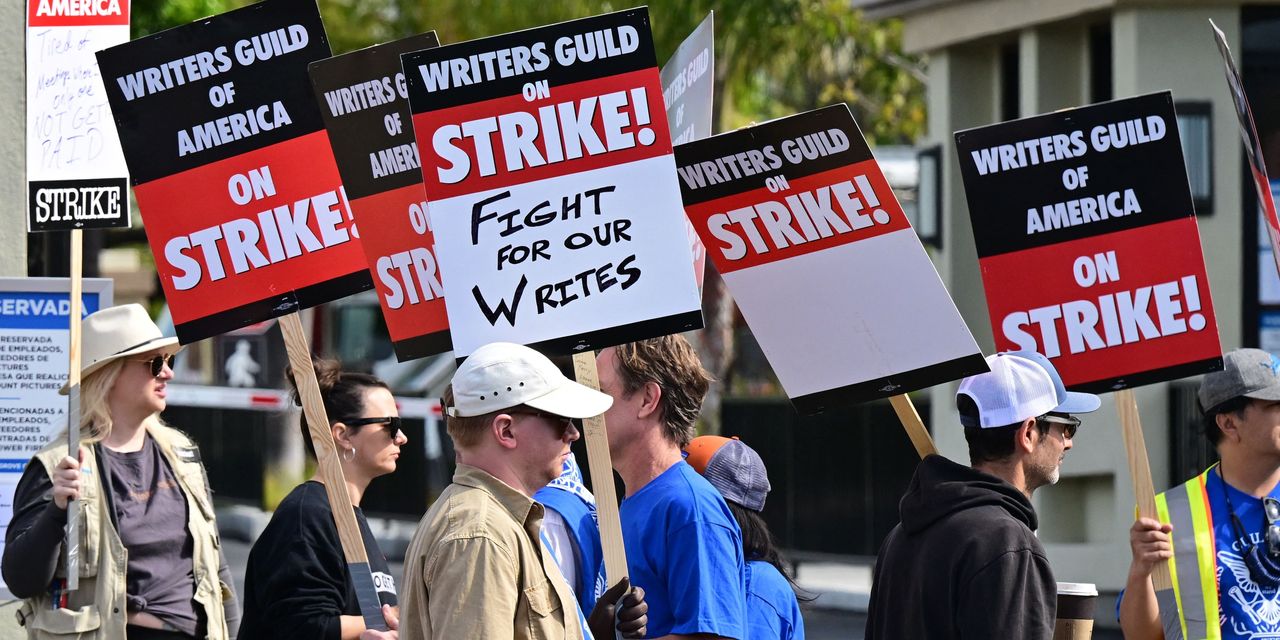
The Hollywood writers’ strike has no resolution in sight. In July, SAG-AFTRA launched a simultaneous and much-publicized strike of its own. The stakes are historically high since any successful agreement will define a new era of Hollywood, an industry that has already been disrupted by the streaming business model and on the verge of the facing negative or positive impact of artificial intelligence (AI).
To ensure a fair deal for both sides, two conditions must be true: studios must diverge from the current economics of streaming, and writers must understand future regulation of AI use is impractical.
The underlying driver of this situation is the economics of streaming that has radically dislodged studios and distributors’ traditional business models. What used to be direct revenue attribution to individual productions through box office, cable and TV advertising has now become a complex entangled web.
Compared to paying the individual price for one movie or TV show, a membership to a single streaming platform allows limitless viewing — we can watch anything, anywhere all at once with a small monthly subscription. This would have been unimaginable only a few years ago, but it is now a boon and ingrained in the viewer experience.
But the streaming model makes it extremely challenging to quantify and distribute streaming revenue to writers and actors. In contrast, with a sales model there is an established royalty sharing framework, driven by box office receipts, cable and TV revenue, pay-per-view and DVD sales.
Because subscribers pay a flat subscription, its allocation to library content is complex and contentious. The streamers record every view but have not developed a transparent equitable framework for royalty sharing. It will be years before this will be measured and audited. Music streaming has been grappling with this as well.
“Studios would benefit from reconsidering how to create a reworked framework for royalty sharing.”
Studios have spent an enormous amount to establish and build their footholds in the streaming market, often overspending and hemorrhaging cash to beat competitors in a race to the bottom. The top four studios have lost collectively upwards of $300 billion or 40%-50% of their market valuation. With huge investment overlays and shrinking profit margins, studios would benefit from reconsidering how to create a reworked framework for royalty sharing. This would require a negotiated framework that is universally followed by the industry with individual variances in the allocations and percentages.
On the other side, writers want to be paid more and limit the use of AI. As Bo Goldman — screenwriter and two-time Oscar winner who passed away earlier this year — once said about screenwriting: “…it is a yearning, a longing to make the people real and capture their lives on the screen… capturing life in art (is) like trying to catch starlight.”
We need the writers to keep catching that starlight and actors to portray the lives we love to watch. They deserve fair and transparent compensation regardless the size of AI’s role.
Additionally, the difference between the writers’ proposal and studios’ offer is estimated at around $350 million per year. Compared to the annual production budgets of the eight largest studios and streamers of $130 billion, the current compensation gap is about a quarter of one percent — a difference in rounding that is effectively an insignificant accounting difference. Studios’ shareholders reward good strategy, execution, and blockbusters that add to subscriber numbers and revenue. Costs are equally important, but shareholders will not quibble about this small but critical cost of doing business. On this point, studios should yield to the writers and actors.
“ AI has the potential to increase any writer’s individual and group productivity, but it will not replace them. ”
Writers will also need to be flexible, especially with their demands around AI. Hollywood’s production has always been impacted by highly innovative technologies. Computer-generated imagery (CGI) is commonly found in today’s movies, having displaced the days of hand drawn animation. Digital-image capture and nonlinear editing platforms have changed the production process and improved efficiency. Similarly, AI has the potential to increase any writer’s individual and group productivity, but it will not replace them.
The use of AI in any field or industry is a continuum and as such, defining and governing how the technology will be used in screenwriting is practically impossible. Advanced word processing, data collection and management platforms, and other tools will increasingly be embedded with AI.
Studios should not throw the baby out with the bathwater for a rounding difference, and the writers will need to recognize the realities of AI. With billions in production spending now put on hold, there is tremendous financial pressure on writers and actors, and a trickle-down economic impact for us all when studios do not earn revenue from creative investments. Both sides should get back to the table and start talking before they lapse into positions of weakness. We need all of you.
Sanjay Sharma, Ph.D. is an adjunct professor of finance and business economics at the USC Marshall School of Business.
More: Hollywood strikes have cost California $5 billion, analyst says
Also read: Big Three automakers need to step up for the workers who keep them profitable
Read the full article here

