


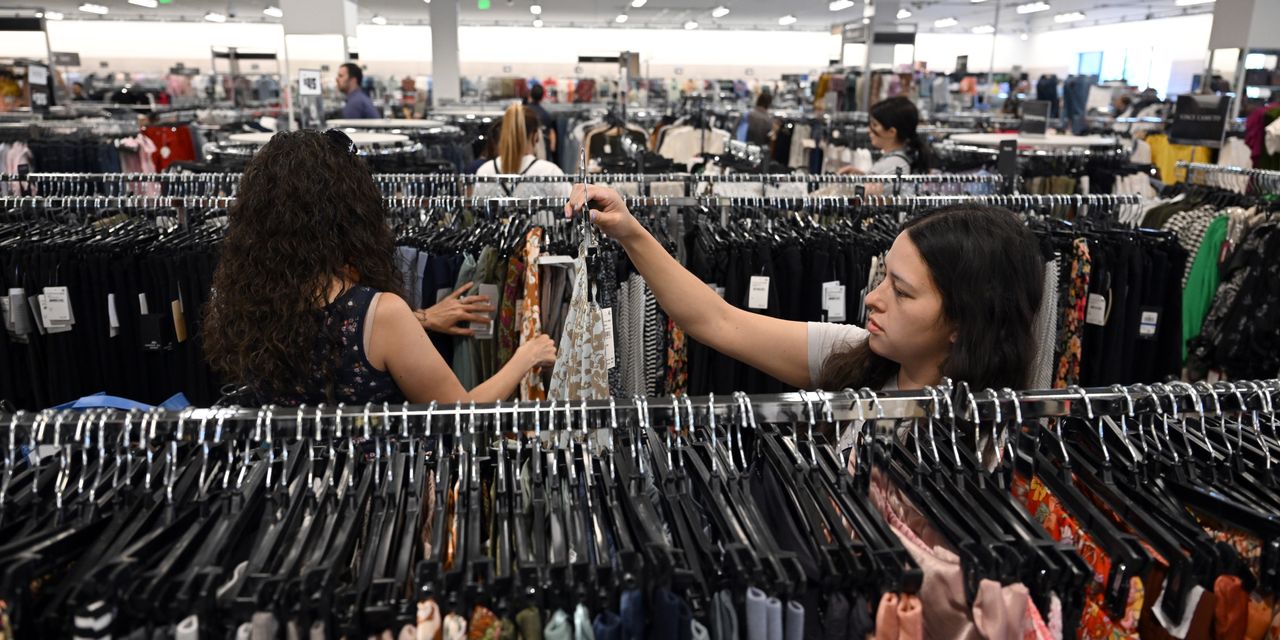
Retail sales rose at a slower pace in June, but the pace is still strong enough to keep the economy chugging along—and the Federal Reserve at ease.
Retail sales were $689.5 billion in June, rising 0.2% from May, according to the Census Bureau. The result was below expectations for a 0.6% increase in June, according to
FactSet,
and May’s revised 0.5% gain.
While June’s reading came in softer than projected, it marked the third consecutive month of retail sales growth, and was better than March and February’s negative readings.
Moreover, the control series—which excludes sales for cars, gas, building materials and food services‚—increased by 0.6% in June, slightly above FactSet’s 0.5% consensus. The control series feeds into gross domestic product calculations, leading some economists to project that the beat will lift second-quarter GDP.
Adjusted for inflation, retail sales volumes were flat last month, as households exercise caution and are more selective with their spending, wrote Lydia Boussour, senior economist at EY.
Excluding auto and gas sales, retail sales rose by 0.3%, below forecasts for a 0.4% increase. Economists had been projecting car sales would drive growth in June. Motor vehicle and parts dealer sales were up 0.3%. But the strongest performance last month came from furniture and electronics stores, up 1.4% and 1.1%, respectively. Clothing stores, nonstore retailers, and miscellaneous store retailers also saw gains in June.
The weakest categories in June were department stores, down 2.4%; gas stations, down 1.4%; and building material stores, down 1.2%. Stores selling groceries, general merchandise, sporting goods supplies, and health and personal care items also saw declines in June.
“While consumers are still spending, they are exercising more discretion as lingering inflation and the Federal Reserve’s tightening cycle take their toll,” Boussour wrote.
The resilience of consumer spending has puzzled experts for several months now, given that the Fed has been trying to curb demand for goods and services to bring down inflation. Many economists and analysts had assumed that shoppers would have buckled by now, slashing their spending, in response to the pressure of rising interest rates and inflation. But while there has been a pullback in some discretionary consumption, it hasn’t turned into the sharp decline—a so-called spending cliff—that some were forecasting last year.
The main factors propping up consumers’ willingness to spend have been a healthy labor market, higher wages, and savings accumulated during the pandemic. But Americans are also feeling more optimistic about the economy and their financial prospects as inflation declines. June’s gain of 3% in the consumer price index was the lowest annual increase in more than two years.
Still, bringing inflation down from its 3% level to the central bank’s 2% target will be harder than it was getting it to 3% from its 9% peak, as Barron’s has reported. That implies there is more for the Fed to do– and more pain ahead for consumers.
“Today’s data increases the already high likelihood that the Fed will hike interest rates at the conclusion of next week’s policy meeting,” wrote Oren Klachkin, lead U.S. economist at Oxford Economics. “However, we see the tide shifting in H2 as the labor market loses momentum, excess savings are depleted, and interest rates stay relatively elevated.”
The stock market initially wavered following June’s sales report as investors digested the strong likelihood of another 25 basis-point-hike, but had regained some steam in mid-morning trading. The
S&P 500
was up 0.2%, while the
Dow Jones Industrial Average
was up 0.6%. The
Nasdaq Composite
fell 0.2%.
Indeed, to some analysts, June’s report suggests that the Fed’s plan for a soft landing might still be on track.
“The economy is plodding along without overheating,” wrote David Russell, vice president of market intelligence at Trade Station. “Americans have gotten relief at the gas pump, but also don’t have an excessive demand for consumer goods. This is modestly positive news for investors worried about the Fed needing to hike after July. Goldilocks marches on.”
Write to Sabrina Escobar at [email protected]
Read the full article here

