


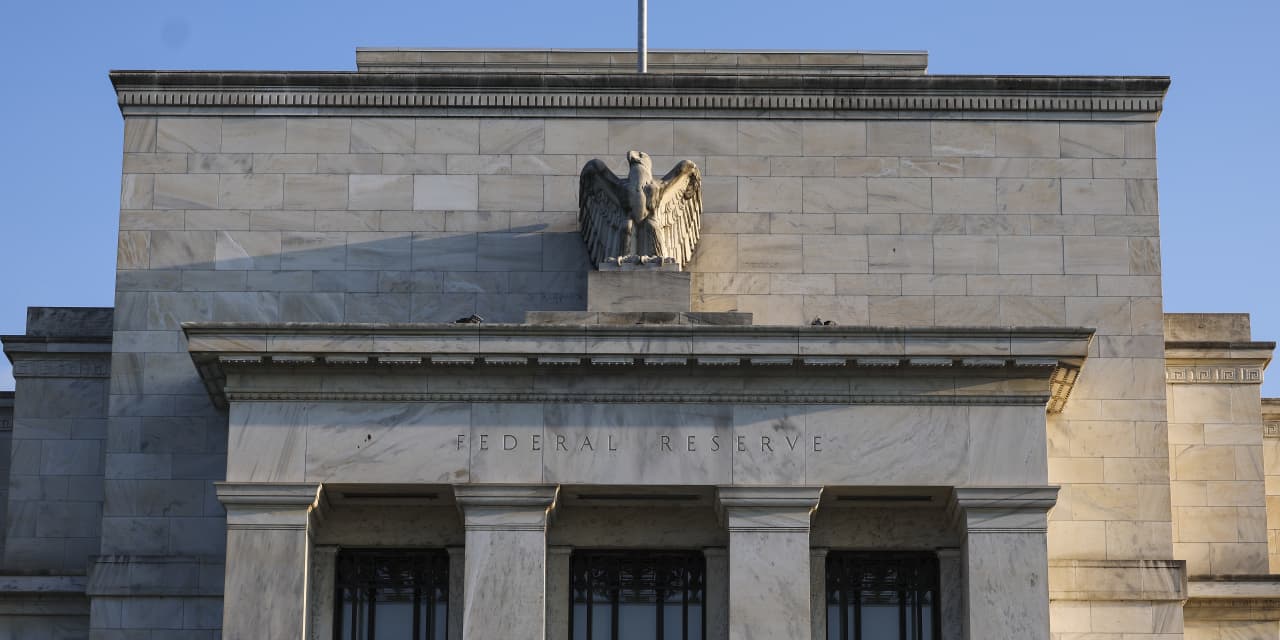
The Federal Open Market Committee will hold a meeting this coming week that could be important even without any change in interest rates.
After increasing its key federal-funds rate target a huge, 5.25 percentage points over the past year and a half, the most aggressive monetary tightening in over a generation, the Federal Reserve’s policy-setting panel is all but certain to hold its key rate range at 5.25% to 5.5%. Most of the commentariat has been obsessed with the question of whether there could be another quarter-point hike before the end of the year, as implied by the FOMC’s most recent Summary of Economic Projections, or SEP.
But that misses the real point—the course of Fed policy in 2024 and beyond. More important than how high will rates go is how long they will stay there, according to John Ryding, chief economic advisor for Brean Capital and a longtime Wall Street Fed watcher who has also served stints with both the U.S. central bank and the Bank of England.
The most recent SEP indicates that the Fed will raise the fed-funds rate another quarter percentage point by the end of this year, to a median projection of 5.6%, with a projections indicating a tight bunching around that point. For its part, the fed-funds futures market puts about a 40% probability of such a hike in December, with no change having about a 60% chance, according the CME FedWatch Tool.
The FOMC SEP shows a median projection for a full point cut by the end of 2024, to 4.6%. But there is a wide range of outcomes clustered around that “central tendency” ranging from 4.4% to 5.1%. And for its part, fed-funds futures for December 2024 are priced for a 4.58% rate, closer to the lower end of the range.
But those projections were released on June 14, nearly a week before the summer solstice in the Northern Hemisphere, while the new SEP will be unveiled at the end of the two-day FOMC confab on Wednesday, a couple of days shy of the autumnal equinox. In other words, a whole season has passed in the meantime, during which a lot has changed.
The economy has held up better than the Fed expected, which should mean some substantial revisions from the June SEP.
Bank of America economists look for the 2023 real gross-domestic-product estimate to be revised up to 2% growth, from 1%, measured fourth quarter over fourth quarter. They look for the year-end unemployment rate to be revised to 3.8%, in line with August’s reading, from 4.1%. As for inflation, the BofA economists see the recent readings leading to a 3.7% estimate for the core personal-consumption expenditures, or PCE, deflator (which excludes food and energy), fourth quarter to fourth quarter, from June’s 3.9% estimate. Basically, the numbers are being adjusted to actual outcomes.
As noted, the big reveal will be what the FOMC now expects for 2024. Along with the fed-funds futures market, many economists think the Fed will be cutting its key policy rate. One popular notion is that if inflation recedes in line with the FOMC’s projection, a failure to cut the funds target would result in a “passive” and presumably unintentional tightening from a rise in the real (inflation adjusted) rate. The June SEP envisaged the Fed’s favorite inflation measure, the core PCE, easing markedly next year, to 2.6%, getting within range of the Fed’s long-run 2% target.
But anticipating four quarter-point interest-rate cuts next year “might be a bit much,” Ryding says in an interview. The Fed has engaged in a costly fight to bring down inflation, and it has done well so far. It would be easier for the monetary authorities to hold rates and wait to cut when it’s needed.
The last thing policy makers would want to do, he adds, is to have to hike again after lowering rates prematurely, a fix the Fed got into during the 1970s. Premature cuts also could risk financial instability, especially if they were to spark rallies in risk assets that would ease financial conditions excessively.
Another aspect ignored by the debate of will they or won’t they hike once more is the long-run equilibrium real fed-funds rate, which the FOMC has basically assumed to be 0.5%, after deducting the presumed long-run inflation rate of 2%.
Yet it is open to question if that equilibrium real rate (dubbed R* for R-star by economists) is still the 0.5% assumed by the Fed. After all, this level, which neither boosts nor brakes the economy, is unobservable in real time.
Ryding wonders why that 0.5% is assumed when the market estimates that the real, long-run equilibrium rate has risen to about 2%.
One reason to think the equilibrium rate has increased is the huge federal budget deficit. Macroeconomics 101 holds that fiscal expansion raises interest rates, he says, unless additional borrowing is accommodated by the central bank.
The Fed now is doing the opposite, reducing its holdings of Treasury and agency mortgage-backed securities, leaving the private sector to finance more of the federal government’s massive borrowing. All else being equal, that should mean a higher level of interest rates.
Ryding says this is a long-term matter that the Fed has to start addressing, although he adds that it isn’t likely to happen at the coming week’s confab.
What investors should focus on are projections for 2024 rather than guesses about the waning days of 2023. After this week’s meeting, the FOMC might be flying blind into the following get-together on Oct. 31 to Nov. 1 if a federal government shutdown halts subsequent economic releases, pointed out Chris Krueger, head of the TD Cowen Washington Research Group, in a client note this past week. More importantly, the presumption of rate cuts next year rests on the continued easing in inflation even as crude oil prices have jumped, which could affect other costs, as warnings from several airlines this past week suggested.
The U.S. economy also has continued to defy recession predictions, despite the end of ultralow rates. All of which would suggest the FOMC could hold rates higher for longer.
Write to Randall W. Forsyth at [email protected]
Read the full article here

