


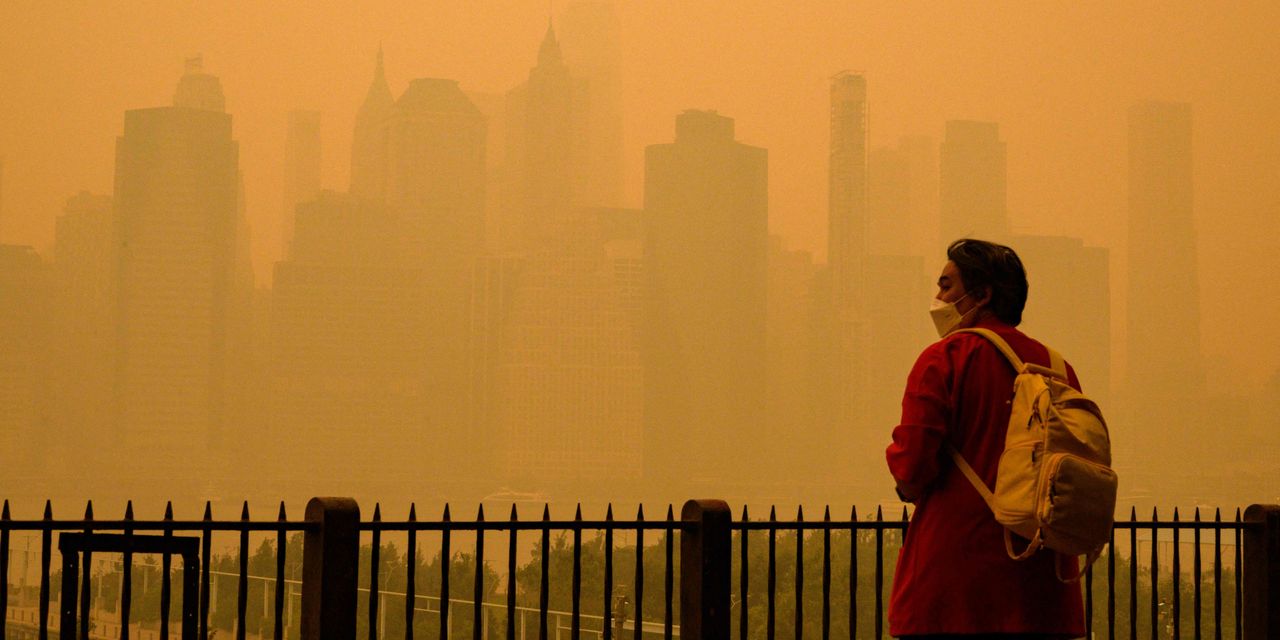
As wildfire smoke intermittently plagues swaths of the U.S., a whole-house air filtration system makes sense for more Americans.
Poor air quality isn’t just a problem for people with lung issues such as asthma, emphysema or chronic obstructive pulmonary disease, it affects many healthy individuals.
Dr. Juanita Mora, an allergist and immunologist and spokesperson for the American Lung Association, treated normally healthy people with swollen and inflamed airways—conditions seen in asthma patients—at her Chicago practice during the worst of the Canadian wildfire smoke. It reinforced her thoughts that indoor air quality matters for all.
“Everyone should have a good filtration system in the house,” she says.
If you have a central heating/cooling system, adding a whole-house air filtration system is the most efficient and cost-effective way to treat the air for many pollutants throughout the home. Ray Grimm, CEO of Air.Water.Energy, in suburban Chicago, who has installed HVAC systems for nearly 40 years, says whole-house air filtration systems will clean air better and more effectively than traditional one-inch furnace filters used on HVAC systems.
Grimm says there needs to be at least six inches between the furnace and the air return ductwork to install a system, so homeowners may need space around the HVAC unit to add additional ductwork.
There are different types of filtration systems. The first uses thicker, pleated furnace filters, five inches deep or more. Called media filters, they trap more pollutants and last at least a year without needing to be changed. Depending on where the homeowner lives, these units start around $500 installed, Grimm says. Costs for high efficiency media filters start around $50.
The second system uses an electronic filter, which is also incorporated into the ductwork, Grimm says. These aluminum filters treat the air by using an electric charge to grab pollutants. However, some may produce small amounts of ozone, which can be a lung irritant. These can cost about $1,500 or more installed. Those filters don’t need to be changed, but must be cleaned periodically.
Homeowners who don’t have the space for the additional ductwork on their HVAC units should use high efficiency air filters in their traditional air filter slots. Change these between 60 and 90 days or sooner, and check after poor air quality days to see if they are dirty. Look for the highest MERV rating your system can handle, the most common rating system for HVAC filters.
MERV stands for minimum efficiency reporting values, a rating developed by American Society of Heating, Refrigerating, and Air Conditioning Engineers that measures a filter’s ability to capture larger particles between 0.3 and 10 microns. A MERV rating of 13 is a high efficiency filter, according to the Environmental Protection Agency. These cost around $15.
While higher-rated MERV filter traps more pollutants, don’t buy filters that exceed the furnace manufacturer’s recommendation, Grimm says. Doing so can damage your HVAC unit by causing the blower to work too hard to force air through a tightly woven filter.
Consider an air purifier
If you don’t have an HVAC system, consider a portable room air purifier. Until recently, these were considered unnecessary for most healthy individuals, but Mora says climate change has changed the dynamics of air quality. “It’s changing the way we’re seeing things, and the clinical effects of it,” she says.
Tanya Christian, home and appliances writer for Consumer Reports, says the tests the organization runs in its labs show they decrease air pollutants. If you’re considering one of these, look for a unit with a large internal fan which will draw out pollutants more quickly, Christian says. Purifiers come in different sizes, so buy one that is sized for the room’s square footage. Many air purifiers have a CADR rating, the clean air delivery rate, which measures how fast a machine cleans the air. Pay attention to a purifier’s smoke rating, too, she adds.
Portable purifiers work best when they are constantly on, and newer machines will have an auto mode which will normally run at low speed until it detects more pollutants, she says. Prices for Consumer Reports’ top-rated models start around $150 and go to about $750. The high-efficiency and HEPA filters for portable units can cost about $60 or more and need to be changed about twice annually.
Christian says during the worst of the wildfire pollution on the East Coast she used an air purifier to rid her home of smoke after a window was accidentally left open. “It’s very obvious they work,” she says.
Write to [email protected]
Read the full article here

