


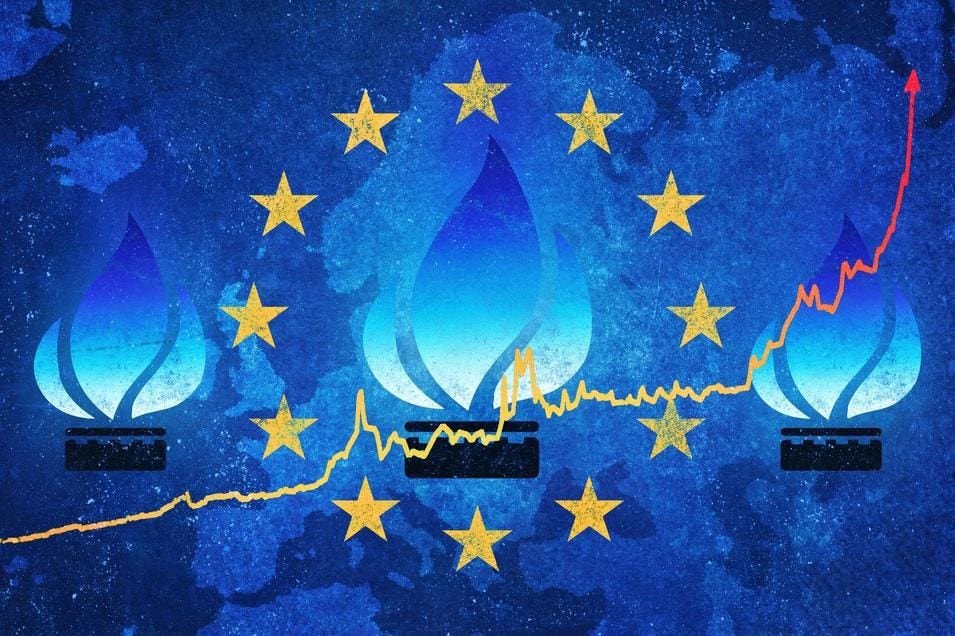
There is alarm in Europe after weeks of natural gas price fluctuations. The fears are down to – believe it or not – outages in Australia, a key liquified natural gas (LNG) exporter thousands of miles away. But this is now the old continent’s new reality – extreme vulnerability to energy shocks and a globalized market.
It all started earlier in August with the prospect of workers strikes at multiple LNG facilities in Australia and continues to rumble on. These outages are threatening to knock 10% of global LNG supplies offline; a commodity feverishly imported by the Europeans to avert an energy crisis in 2022. That’s when readily available piped natural gas imports from Russia became politically unpalatable in the wake of President Vladimir Putin’s decision to invade Ukraine.
Prior to the event, Asian gas market upheavals only had a limited impact in Europe, largely thanks to having cosied up to Moscow for energy imports. But as war raged in Ukraine, LNG’s share of Europe’s energy mix rose to around 40%. According to data aggregators such as ICIS, that’s roughly at par with the share of the energy mix Russia’s piped gas had prior to the Ukraine war.
It has led to the Europeans potentially squaring up to prolific Asian LNG buyers such as China, Japan and South Korea when it comes securing cargoes. While its doubtful any Australian cargoes head to Europe in meaningful volumes (given the poor economics related to shipping costs), a bidding war could (and is) breaking out for U.S. cargoes that make their way quite competitively to both Asia and Europe. And more so in the event of Australian ones not reaching Asian terminals.
Using the European gas benchmark – Title Transfer Facility (TTF) – as a measuring gauge, prices rose by around 50% earlier in August. Currently, European prices are averaging €35 ($38) per megawatt hour, versus an average just north of €20 in the previous decade. For intraday context, at the time of writing (21:15 BST, August 29, 2023), the Natural Gas EU Dutch TTF came in at €35.20, down 3.22 or 8.38%.
Indeed, the only thing keeping prices relatively honest in Europe is lower industrial activity and storage which is above 90% full, and deemed critical for meeting winter demand. But should the approaching European winter be particularly harsh, this strength will be tested.
Of course, elevated premiums in European natural gas markets are a relatively new development. However, anxieties over supply security and their impact on natural gas prices have been years in the making.
Addicted to seemingly cheap and plentiful Russian gas, Europe’s policymakers were incredibly short-sighted on three counts: (1) not building enough spare capacity in the supply chains to ease unexpected winter burdens, (2) an overt reliance on a single supplier, and a failure to seek and establish relations with alternative suppliers, and (3) using predictive supply/demand analytics to aid risk mitigation planning.
They should have been jolted out of their comfort zone in 2014, when Russia annexed Crimea. Around the time, the U.S. natural gas market was oversupplied by approximately 1 bcf/day, with upcoming LNG export terminals stateside desperately looking for long-term supply deals staring at sub-$2/mmbtu domestic gas prices.
Yet the Europeans neither proactively sought alternatives nor deployed available predictive analysis technologies for worst-case scenario planning should Russian imports fall to zero. Now that the scenario has materialized, the Europeans are finally reacting based on anecdotal evidence and the focus of several industry events, including the industry’s own annual jamboree Gastech – an event that has been running for 50-odd years. Wider industry dialogues also point to a newfound impetus on tech-driven procurement and planning.
This is imperative with natural gas destined to serve as a bridging fuel for power markets over the medium-term. The only regret being that this shift is coming 10 years too late for the Europeans. Unlike Asian counterparts who listened to their own market wake-up call after the Fukushima Nuclear meltdown in 2011, the Europeans put theirs on ‘snooze’ after Crimea and have been rudely awakened ironically by the actions of none other than their previous major natural gas supplier.
Read the full article here

