


Party like it’s 1999? Sorry, Prince fans—that year isn’t the most relevant precedent for 2023, even though we’re coming off the best first half for megacap tech stocks in history.
With equity valuations stretched and interest rates on the ascent, it may be more apt to recall 1987. Now that may be ancient history to many Barron’s readers, receding so far into the mists of yore as to be only one year removed from the last time the Mets reigned as baseball’s world champions. Not even a hedge fund wizard throwing around Monopoly money seems to be able to change that doleful skein.
Be that as it may, the Strategas technical and macro research team led by Chris Verrone tallied up the record of the
Invesco QQQ
exchange-traded fund (ticker: QQQ), which tracks the
Nasdaq 100 index
of the biggest Nasdaq nonfinancial stocks and is dominated by technology titans.
They found the first half’s huge 38.8% rise in the QQQ topped that of all the biggest winning years of the 1990s, even the 35% surge in the first half of 1998 as the dot-com daffiness took flight. Trailing only slightly was the 33.1% jump for the QQQ in the first half of 1995.
In those years, it paid to continue to ride the winners. In the second half of 1998, the triple-Qs did even better, with a 37.3% gain. In 1995, however, the first-half surge was followed by a mere 7.1% advance in the second half. And in the legendary year of 1999, the first-half QQQ rally of just 25.1%, only sixth best in the record books, was followed by the legendary fin-de-siècle surge of 61.4% in the final six months of that year.
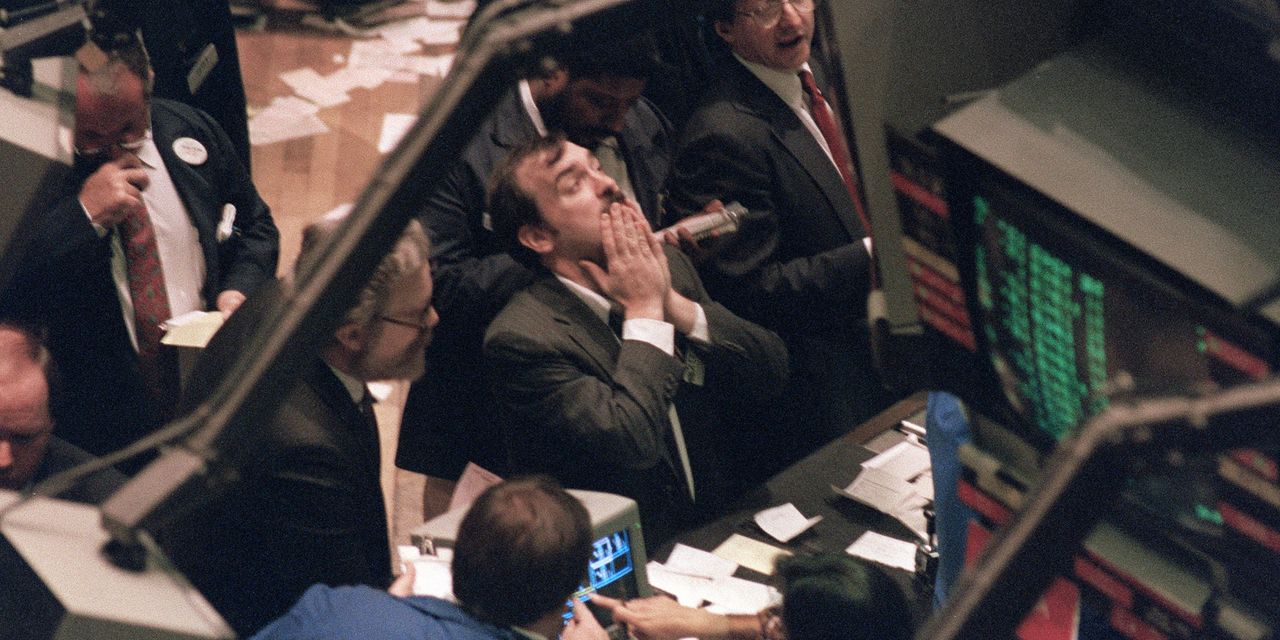
And then there was 1987. A 33.8% first-half gain in the Nasdaq 100 gave way to a 17.4% decline in the second half. That was highlighted by Black Monday, Oct. 19, 1987, when the Dow Jones industrials plunged 22%, a one-day record that will stand owing to the circuit breakers that were installed in the wake of that crash to prevent such a recurrence.
What separates the past years of superstrong equity returns are distinctly different interest-rate backdrops. “Yields fell sharply in 2H ’95 and ’98 and equities continued to charge ahead, while rates exploded higher in summer ’87 and trouble soon followed,” the Strategas team wrote in a client note.
This past week, long-term Treasury yields broke sharply above key technical levels on Strategas’ charts. Most notably, the benchmark 10-year note yield topped the 4% mark Thursday, breaking a pronounced downtrend line and exceeding the highs of early March. At the same time, the two-year note—the coupon maturity that reflects most closely the Federal Reserve’s expected rate moves—topped 5%, just shy of its March high, before the bank failures highlighted by Silicon Valley Bank, and its peak before the 2008-09 financial crisis. The rise in yields has been in real terms, that is, adjusted for inflation. The real yield on five-year Treasury inflation-protected securities has more than doubled, to over 2%, from its early April low.
Nevertheless, the rise in borrowing costs has had a surprisingly small impact on what have been the most interest-sensitive sectors of the real economy.
Housing appears more constrained by the supply of homes for sale than demand being crimped by the rise in mortgage interest rates. Sales of existing homes are being limited by the unwillingness of present homeowners to give up historically low mortgage rates in the 3% range for new loans costing upward of 7%.
But sales of new homes are up 20% from a year ago, which has been reflected in the jump in home builders’ shares, which has even topped tech stocks. The
iShares U.S. Home Construction
ETF (ITB) returned 41.45% in the first half and more than 64% in the 12 months ended June 30, according to Morningstar data.
New sales of automobiles also are booming, defying predictions of declines with a 13% jump in the U.S. during the first half. June’s auto and light-truck sales ran at a boomlike 15.7% annual rate, while incentives were far less prevalent than industry analysts had expected.
These results suggest the main threat from higher interest rates remains for inflated asset prices, rather than to the real economy. Treasury yields of 5% on the short end of the market, while up sharply from the previously depressed levels, still fall short of inflation.
The most recent reading on the consumer price index showed a 5.3% increase in May from a year earlier. By that criterion, the Fed’s key federal-funds target rate range of 5%-5.25% essentially means money is free in real terms after inflation. That is supportive of an
S&P 500
that trades at roughly 20 times optimistically forecast earnings, which may be subject to revision lower after companies start releasing results and forward guidance in the coming weeks.
The history of 1987 suggests that stretched valuations and rising interest rates make for an unpleasant recipe for equity bulls—maybe almost as unfavorable as the prospects for the Mets.
Write to Randall W. Forsyth at [email protected]
Read the full article here

