


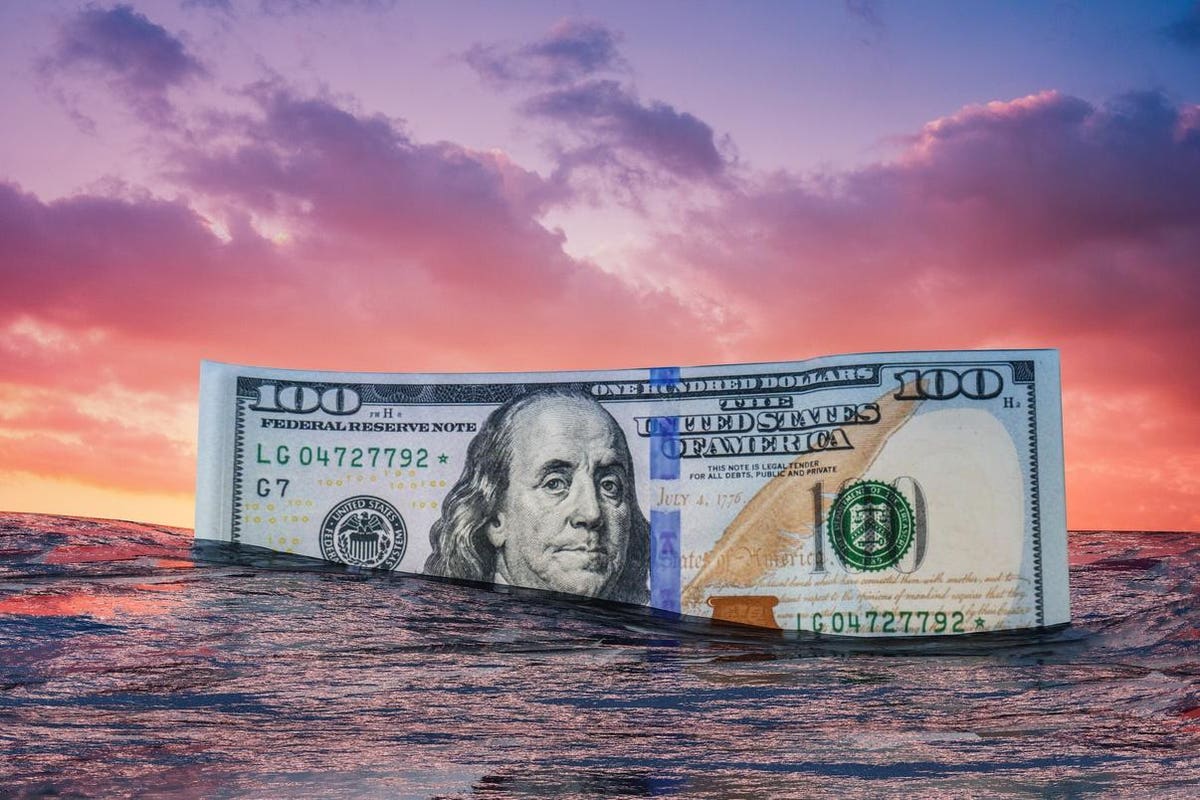
Behold the great illusionists of the federal government: they pull money out of thin air. They make red ink disappear before your eyes. And if you listen to their chatty patter and don’t watch too closely, you will think the American dollar is still sturdy as stone.
But the strength of the dollar – the world’s reserve currency and thus a source of power and wealth for the United States – is a matter of perception. It depends on the world’s investors trusting that America is secure and well managed and, above all, that we always pay our debts in full and on time. It also depends on there being no viable serious global competition for the dollar.
Unfortunately, our leaders in Washington don’t understand just how tenuous this trust is, and how difficult it is to get it back if we lose it. For evidence, look no further than their continued willingness to court disaster and default by threatening to not raise the federal debt ceiling.
If we’re not careful, the U.S. could find ourselves having to explain how we lost the trust of global investors, much like how Mike Campbell explained how he went bankrupt in Ernest Hemingway’s The Sun Also Rises:
“Gradually and then suddenly.”
The dollar is theoretically built on a strong foundation: the U.S. government and its ability to generate tax revenue allows us to guarantee investors in our debt that we will return their principal plus interest.
In 1971, President Nixon stopped the convertibility of the U.S. dollar to gold. Ever since, the dollar’s value has been set by market forces and by the machinations of the U.S. Federal Reserve. Even though the dollar-gold peg has been uncoupled for over 50 years, the dollar is still considered the most stable storehouse of value thanks to America’s reputation – cemented over hundreds of years – that we have and will always pay our debts. That is why almost 85 percent of inter-country transactions worldwide are conducted in US dollars. And it is why the U.S. is often able to borrow money at much lower rates than other countries.
But what happens if and when global investors don’t believe that anymore because of the size of America’s debt and the instability of our politics? What happens if a viable dollar alternative actually emerges?
It could happen. Russia recently floated the idea of creating a new currency that could be used for cross border trade among the “BRICS” nations, which is an acronym for Brazil, Russia, India, China and South Africa. Although discussions are early, the new BRICs currency would reportedly be backed by gold and other precious metals, which might represent an attractive and diversifying alternative for investors.
These BRICS countries are major economic forces in their geographic areas of influence and two of them are arguably America’s chief adversaries in the world today.
The best way for the U.S. to forestall the emergence of a reserve currency alternative is to ensure global investors don’t want to abandon the dollar in the first place. And the way to start is by getting a handle on our nation’s debt, which has grown from $5.6 trillion in 2000 to $32 trillion today and is now a larger as a share of our economy than any time since we mobilized our entire country and economy to World War II. There is currently no sign of this growth slowing down.
For the last few decades, the budgetary magicians from both parties have assured us we could give ourselves tax cuts, tax credits and new spending programs and still maintain our unquestioned fiscal leadership. The Bush tax cuts, creation of Obamacare, the Trump tax cuts and COVID relief bills, the Biden COVID relief bills and other spending extravaganzas – almost all of it was put on the national credit card. Lower revenue and higher spending is not a good long-term strategy.
Washington’s response to COVID may also have created a new baseline of permanently higher spending. Before COVID, Washington was spending a bit over $4 trillion per year. Now it’s spending $6 trillion annually. President Biden’s own budget projects the U.S. debt will exceed $50 trillion within the next decade.
This year, the U.S. Treasury will spend about $400 billion on interest payments alone, which according to the Committee for a Responsible Federal Budget, equates to about $3,055 per household. It could get a lot a worse, especially if interest rates move higher.
The Congressional Budget Office already projects U.S. debt held by the public as a share of our economy to rise from 98 percent now to 181 percent by 2053. But if interest rates are just slightly higher than CBO projects (growing by 0.05 more percentage points per year), federal debt could reach 231 percent of GDP over the same time period.
Over time, these interest payments will also make it harder for Washington to fund defense, education, health care, food safety, research and everything else we have come to expect and need from government.
Every recent attempt to address the federal budget deficit has failed because nothing actually forces Congress to tackle the problem and vote on a solution. Washington has simply lost its will to protect our children from a potential future economic apocalypse. But there is one approach from the past that could help secure America’s fiscal future.
Toward the end of the Cold War, as the U.S. sought to change our military structure and posture, Washington had to figure out how to close unnecessary military bases. But there was a problem: No member of Congress wanted to close a base in their district or state. So as any base-closing legislation moved through Congress, members would inevitably try to remove bases located in their district from the chopping block. These predictable and parochial moves would hollow out the legislation.
To get past this problem, Washington in 1988 instituted the first of five rounds of Base Realignment and Closing (BRAC) commissions. Under the BRAC process, an independent nine-member panel was appointed by the president to take testimony from interested parties, visit bases, and send a report to the president recommending which bases to close. The president, in turn, could decide whether to approve the list and then send it to Congress.
But here is the crucial trick: Congress had to give a thumbs up or a thumbs down, with no local carveouts. It could disapprove of the whole list within 45 days but it could not pick and choose which individual bases to close. If Congress did nothing, the base closures went into effect. Since 1988, the BRAC process has enabled the closure of over 350 military installations, with the last round occurring in 2005.
Many policy thinkers, noting the success of this program, have suggested a BRAC-type process to stabilize our country’s finances. It would entail appointing a commission to look holistically at how and what we tax and how and what we spend. They would develop recommendations that must be approved by the president before it is sent on to Congress. And then Congress would choose between accepting or rejecting the whole reform plan in its entirety. Or they could simply do nothing and the legislation would be deemed passed.
The alternative is more of the same. More of our leaders in Washington peddling fiscal illusions and ignoring our debt problem until global investors
“gradually and then suddenly,” abandon the U.S. dollar.
Our fiscal house is not in order because of the deep divides in our political system that force the two parties to be in constant war with each other. Let’s open a dialogue in Washington that seeks to provide solutions to so many of the issues that will do us great harm if left unchecked.
Inevitably, no one would be completely happy with the outcome of a BRAC-style fiscal commission. But that’s a fair description of something we rarely see in Washington: a good compromise.
Read the full article here

