


Tesla
‘s agreements to open its EV supercharging network to
Ford Motor
and
General Motors
are tanking charging stocks like ChargePoint and
EVgo
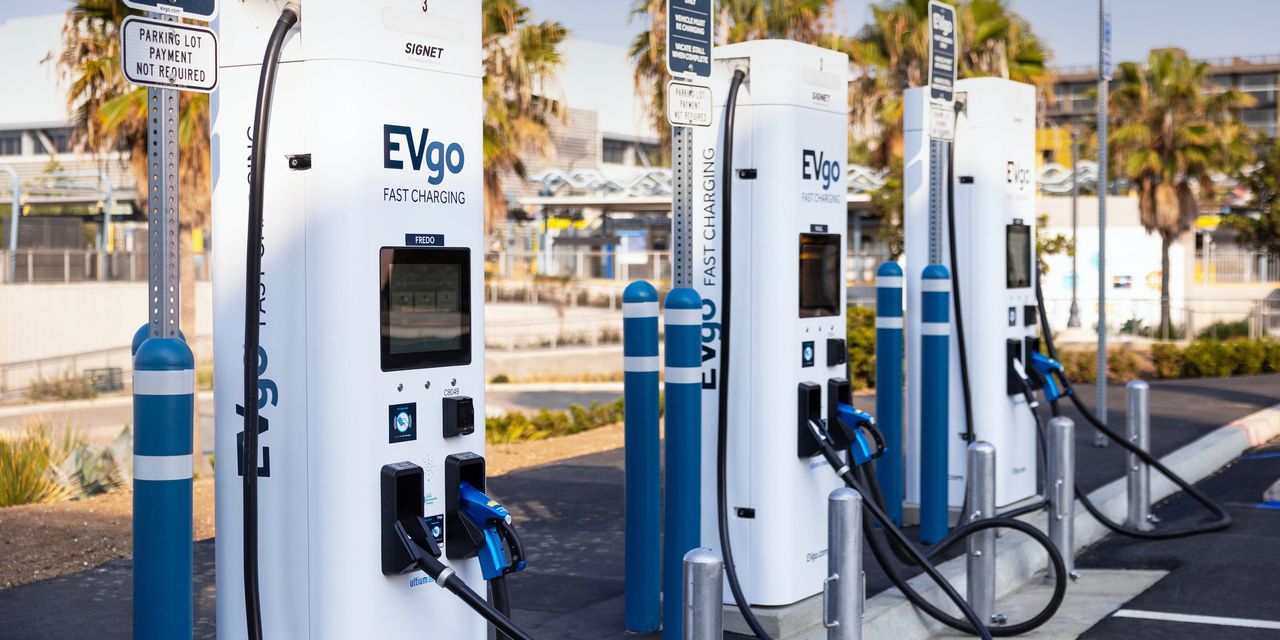
on concerns Elon Musk’s company will monopolize the business. The standardization of charging, however, could be good news if it makes drivers more comfortable with electric vehicles.
Tesla already has the largest network of fast EV chargers in America, with roughly 17,000 ports in operation. And the announcements from GM and Ford mean Tesla’s will become the charging standard. That is hitting publicly traded charging players. Shares of
ChargePoint
(ticker: CHPT) and
EVgo
(EVGO) were down more than 13% and 14%, respectively, Friday morning. The
S&P 500
and
Nasdaq Composite
were up 0.2% and 0.4%, respectively.
That seems like an overreaction. For starters, the U.S. is seriously deficient in EV charging infrastructure. At the end of 2022, the country had roughly 50 EVs on the road for every fast-charging plug. That number in China is closer to 12, according to Bloomberg BNEF and Barron’s calculations. There is room for many players.
The charging plug is the most likely reason shares are falling. Along with announcing its EV drivers will have access to Tesla’s charging network, GM said it would adopt Tesla’s charging plug, based on Tesla’s North American Charging Standard, or NACS.
Non-Tesla EVs in North America use a combined charging system, or CCS, plug. So it’s CCS is dead, long-live NACS? Not really—and even if that is the case, the next best question for investors is who cares?
Charging cables aren’t like VHS and Betamax videotapes, or even old standards-related patent battles between Qualcomm (QCOM) and Apple (AAPL). The situation is more akin to what consumers face with Apple lightning cords and Samsung’s C-port connectors. Engineers might disagree. That is also the answer to who cares—It’s the engineers.
Car hardware is larger and more robust than that for phones. And EV charging wires are delivering a lot more juice to a car than a 120-volt wall socket is to a phone. A warm iPhone charger isn’t that big a deal to anyone. A warm EV charging cord is another matter.
Phones also can’t power your home in a blackout or provide power back to the grid on a hot day. Most EVs should do both one day. That will also require standards for bidirectional charging. That’s more plug technology.
To be sure, there is a cost to switch and retrofit. “If you’ve ever wondered why you have to bring a plug adapter when you travel to Europe, this divergence in standards is repeating itself before our eyes with EV charging,” says Scott Case, CEO of EV research and resource provider Recurrent. The CCS systems will have to evolve, he said.
Retrofitting and an industry consolidation around a standard doesn’t have to be an existential threat for existing players, though. What is more, Tesla doesn’t appear to want to be the gatekeeper for EV charging tech, ‘charging’ a toll for anyone to play.
The company didn’t respond to a request for comment , but Tesla opened up its charging standard in 2022. Providing access to its EV chargers to other auto makers allows Tesla to tap federal money for building charging infrastructure. There is every indication Tesla plans to play nice, as far as charging goes.
Eventually, a standard plug should make things easier. The industry could use a unified standards-setting body. Don’t forget there is no standard location for charging ports or length of charging cords. It isn’t unusual to see an EV perpendicular to a charger at a mall just so a cord will reach.
Don’t forget that while Tesla owns the largest charging network in the U.S., Tesla vehicles can and do charge at other stations. There are adapters.
“This is obviously big news, and EVgo continues to be a big proponent of Electric For All and welcomes all EV drivers on our network,” says Jonathan Levy, EVgo’s chief commercial officer. “In terms of charging standards going forward, we hope that NACS will be published in a way that suppliers across the industry will have access to deliver more charging options for EV drivers.”
That’s the thing for investors to watch for. Just make sure charging equipment suppliers have all the specs and tech needed to produce what they need so operators such as EVgo don’t have hassles or added costs.
“In fact, there are a number of standards bodies and we encourage them to consider partnering with the companies making the switch [to NACS],” says a GM spokesperson. “Ultimately, it’s about access to a common standard and more seamless access for consumers.”
GM likes NACS. And North America might be going the way of the Tesla plug, but Tesla vehicles use CCS connectors in Europe. Oh, in China, the connector is different. EVs are still the new thing. It takes time.
Investors should worry less about standards and more about profits. Goldman Sachs analysts estimated $1 billion to $3 billion in annual charging revenue for Tesla when the idea of opening up its network was floated about a year ago.
For EV charging stocks, investors should worry less about Tesla competition and more about the number of EVs on U.S. roads. The GM-Ford-Tesla access agreements are meant to increase that number. Other companies will probably start using Tesla chargers, too.
Many gas station companies have managed to exist. None made it because of fuel dispenser design innovation. There is one head design for gasoline dispensers in the U.S. (Plus another for diesel.) And that little arrow beside the pump on your fuel gauge tells you which side your tank access port is on. Simple, unified standards are a good thing—for everyone.
Write to Al Root at [email protected]
Read the full article here

