


Stocks risk slumping in the debt-ceiling showdown, but investors probably will still want long-term Treasurys if 2011’s battle over the U.S. borrowing limit is any guide, according to Sevens Report Research.
“If the debt ceiling is hit and the Treasury department can’t sell additional Treasuries, it does not mean the U.S. is bankrupt or in default,” said Tom Essaye, founder of Sevens Report Research, in a note Thursday. “What it does mean, is that the Treasury department then has to ‘ration’ its existing cash and decide who to pay, and who not to pay.”
In theory, “Treasury could pay interest on existing Treasury debt, soldiers’ salaries, social security, and not pay federal workers’ salaries and federal contractors,” he said.
The U.S. is potentially just three weeks away from bumping up against its borrowing limit, which would prevent the Treasury Department from selling additional Treasury debt, according to the note. That’s a problem because the U.S. government funds its day-to-day operations through regular sales of Treasurys, Essaye explained.
With much of its analysis based on the debt-ceiling “drama” in 2011, Sevens Report suggested the risk of hitting the debt ceiling might drive investors into long-term Treasurys.
“Longer-dated Treasuries performed very well, and if there’s a place to ‘hide’ during the debt ceiling drama, longer-dated Treasuries was it,” Essaye said in the note. “This makes sense because regardless of what happens in the next three weeks, no one credibly thinks that interest payments won’t be made on 10-year Treasury debt, nor that this short-term Washington fiasco will materially degrade the credit worthiness of the U.S.”
Read: Debt-ceiling standoff: Here’s what could go into a bipartisan deal
Also see: Debt-ceiling solution? The 14th Amendment, explained.
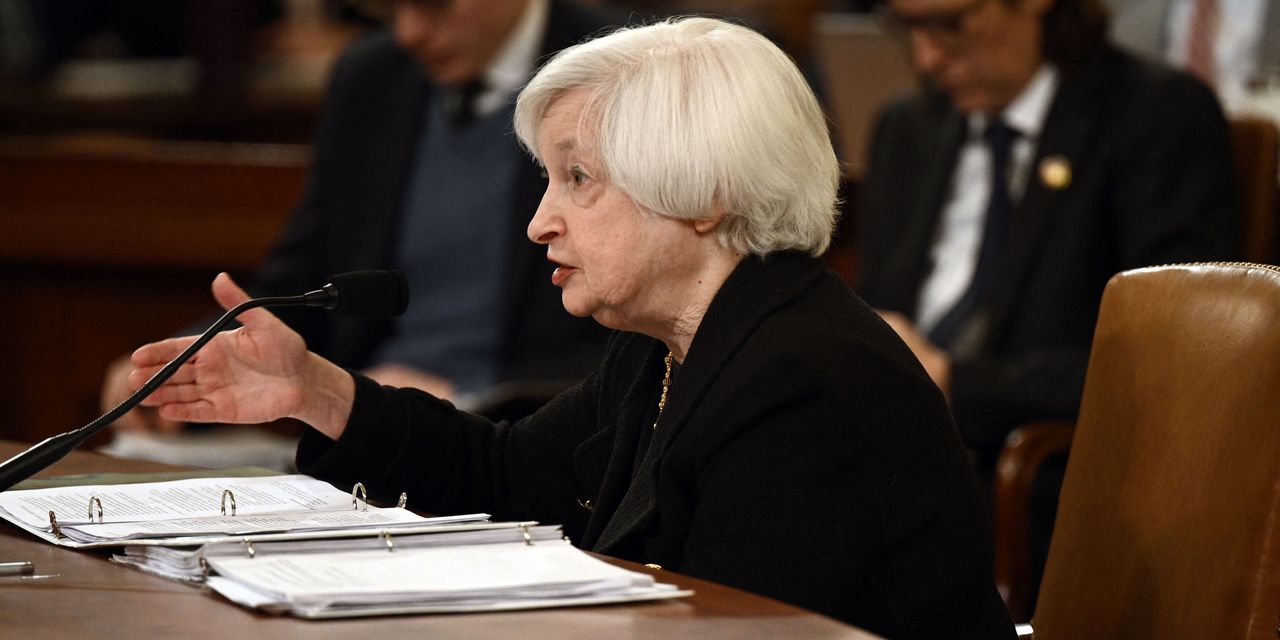
Treasury Secretary Janet Yellen has warned the so-called X-date for the U.S. government hitting its debt ceiling may be as soon as June 1.
In 2011, the yield on the 10-year Treasury note fell in the runup to the U.S. coming up against its borrowing limit, according to the report. When investors pile into Treasurys, prices of the debt rise while yields fall.
“The 2011 debt ceiling drama really intensified in May 2011, and the 10-year yield was around 3.2%,” Essaye wrote. “By the time the U.S. got to the eve of hitting the ceiling,” or around late July and early August, the yield on the 10-year Treasury note had declined to 2.7%.
In other words, “the 10-year Treasury rallied,” he said.
What’s more, by the time the market bottomed in late October 2011, “the 10-year yield had dropped to 1.80%,” according to the report.
On Thursday, the yield on the 10-year Treasury note
TMUBMUSD10Y,
fell 3.4 basis points to 3.396%, according to Dow Jones Market Data.
While “hitting the debt ceiling doesn’t mean the U.S. automatically defaults on its debt,” said Essaye, “it does mean it’ll have to direct cash to essential services and payments and not pay ‘less essential’ services.” The Treasury restricting payments could “create a huge headwind for economic growth and make a hard landing more likely,” he warned.
Read: Stanley Druckenmiller warns of U.S. hard landing at Sohn conference, says debt-ceiling debate ‘really depressing’
Still, some investors may be eyeing the debt-ceiling debate “almost like a pothole in the road,” according to Essaye.
“Yes, if we hit the pothole, it can cause some damage and discomfort, but it won’t derail the entire journey,” he said. “And bond investors are avoiding this pothole by selling one-month Treasuries
TMUBMUSD01M,
hard,” recently driving their yield to more than 5.5%, “and buying longer-dated debt.”
Gold as a hedge?
During “the height of the debt ceiling drama” in 2011 gold saw a strong rally, with SPDR Gold Shares
GLD,
rising 20% from early May through mid-August, according to the report.
But the yellow metal “gave back those gains over the remainder of the year,” Essaye cautioned.
“Gold
GC00,
did prove a useful hedge against debt ceiling uncertainty and likely will again this time,” he wrote. “But remember,” he said, “it’s a trade as a hedge, not a long-term hold” for debt-ceiling protection.
What about stocks?
As for the stock market, equities don’t fare well following debt-ceiling “dramas,” even if the issue is finally “resolved at the last minute,” according to the report.
“The S&P 500 fell 6% from May through August 2011,” said Essaye, which is when “the debt ceiling drama really intensified.” And after a debt-ceiling extension, the index dropped another 15%, tumbling more than 20% from peak to trough from May until October, the report says.
In 2011, defensive sectors, including utilities, consumer staples and healthcare, “handily outperformed” with double-digit gains, according to Sevens Report Research. But “financials and materials both dropped sharply.”
Other analysts who have considered 2011 as a reference for how the latest debt-ceiling debate could shake out in markets have highlighted Europe’s debt crisis at the time.
For example, in a report earlier this week, CreditSights analysts warned that pressure risks building in the high-yield credit market due to the uncertainty surrounding the U.S. borrowing limit, drawing comparisons to 2011’s debt-ceiling showdown. They said 2011’s macroeconomic backdrop was challenging, as the U.S. was still recovering from the global financial crisis while Europe was grappling with weakness in its banking system and a sovereign-debt crisis.
And in an interview earlier this week with MarketWatch’s William Watts, David Lefkowitz, head of equities for the Americas at UBS Global Wealth Management, said that in the stock-market’s sharp selloff in 2011 it’s hard to “disentangle” debt-limit fears and the Eurozone’s debt crisis.
See: Will stock-market investors panic as debt-ceiling standoff intensifies? Here’s what to watch.
U.S. stocks were trading lower Thursday afternoon, as investors digested fresh data showing that wholesale inflation rose in April slightly less than expected as well as a report from the Labor Department saying initial jobless claims in the week ended May 6 rose to the highest level since October 2021. Still, the U.S. unemployment rate remains historically low, at 3.4% in April.
The Dow Jones Industrial Average
DJIA,
was down 0.8% Thursday afternoon, while the S&P 500
SPX,
fell 0.3% and the Nasdaq Composite
COMP,
edged up 0.1%, according to FactSet data, at last check.
Read the full article here

