


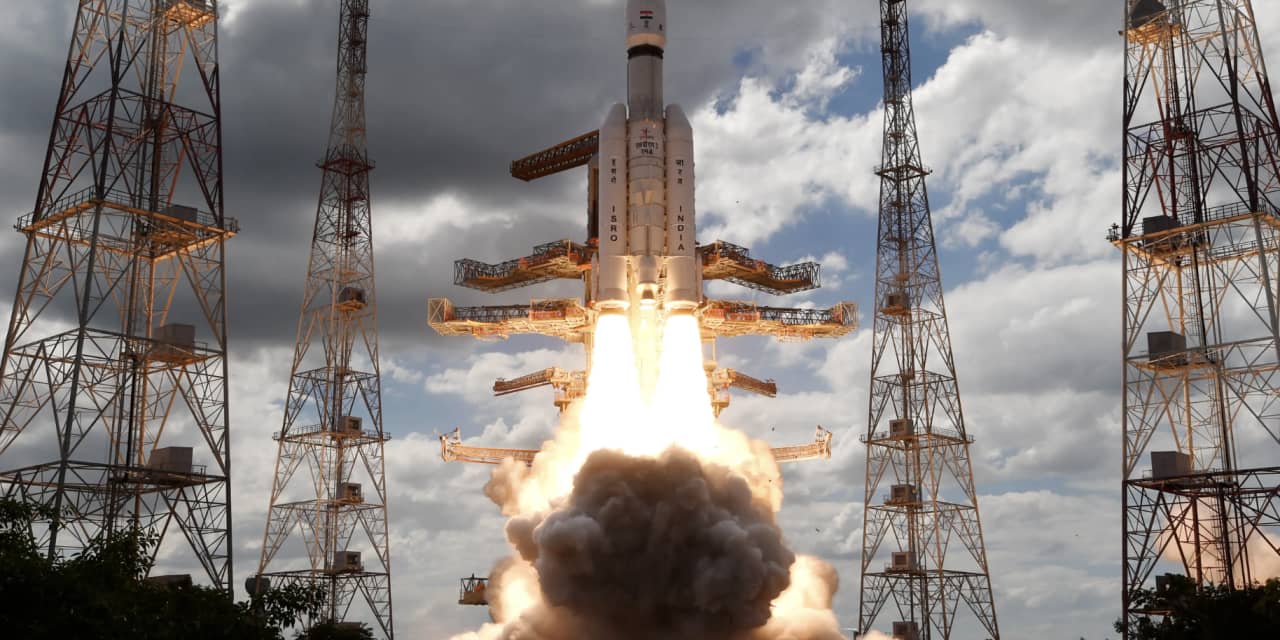
India took a giant leap into the ranks of advanced industrial nations when its Chandrayaan-3 unmanned spacecraft landed near the moon’s south pole on Aug. 23. At least to hear Prime Minister Narendra Modi tell it. “Science and technology are the foundations of a bright future for our nation,” the 72-year-old Modi, who is favored to win a third term next year, told ecstatic staff at the Indian Space Research Organization, or ISRO.
That remains to be proved.
Chandrayaan-3’s unprecedented touchdown on forbidding, crater-filled terrain did spark an Apollo-esque moment of pride and unity in the polyglot nation of 1.4 billion—the more so as a competing Russian mission crashed and burned days earlier. “What landed on the moon was the hopes and aspirations of a billion and a half people,” says Ravi Chaturvedi, Indian-born co-founder of Tufts University’s Digital Planet program.
All key systems for Chandrayaan-3 were domestically built. ISRO gathered an all-star team of Indian conglomerates, like Godrej Aerospace, which provided the Vikas engine, and Tata Consulting Engineers, which pitched in with the propellant system. The official cost: $75 million—less, Modi pointed out, than the price of a Hollywood film about space exploration.
Shares in a handful of engineering start-ups have soared this year on their perceived potential for space contracting, including
Zen Technologies
(ticker: ZENTEC.India),
PTC Industries
(PTCIL.India), and
Centum Electronics
(CENTUM.India). More are coming, says Benjamin Silverstein, a space research analyst at the Carnegie Endowment for International Peace. “There are a huge number of space start-ups in India,” he says. “Some of them have actual products.”
None of that will move big roadblocks on India’s path to becoming a top industrial power, unfortunately. Modi rolled out the “Make in India” program to boost manufacturing as soon as he took office in 2014. It hasn’t done much. Manufacturing’s share of gross domestic product is stuck at about 18%, according to S&P Global. That compares with 28% for China.
Modi’s (not very realistic) target is 25% by 2025. One big obstacle is policy-related: His government remains keen on import tariffs, some of which hit inputs needed to raise exports. “The Indian government has consistently raised tariff and nontariff barriers to protect domestic suppliers across most sectors,” the United States Trade Representative wrote in a recent report.
Another is a lag in transport infrastructure. Indian ports can’t accommodate the biggest container ships, so freight has to be transshipped through Singapore or Hong Kong. “To become the global manufacturing destination of choice, India will need massive upgrades in rail, port, and freight corridors,” write S&P researchers. That won’t happen by gazing at the moon.
Email: [email protected]
Read the full article here

