


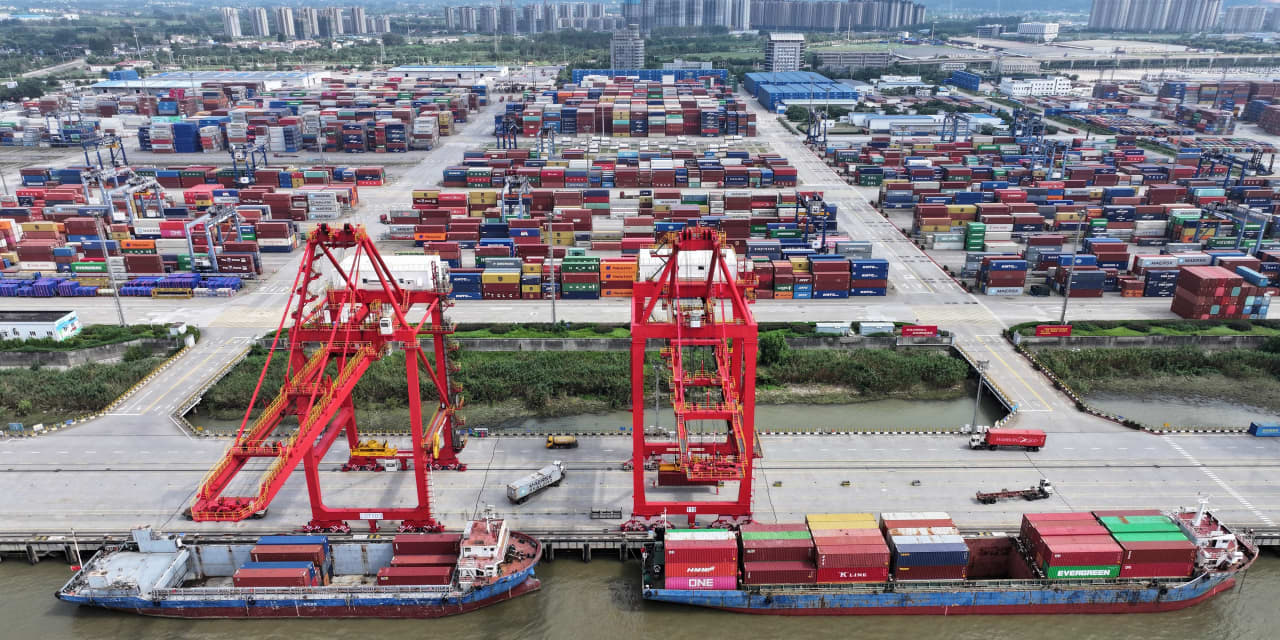
U.S. companies aren’t breaking up with China, but tensions between the two countries and China’s economic slump have contributed to a low point in confidence among American businesses operating there.
Companies and U.S. officials have shifted from talking about “decoupling,” or disengaging from China entirely to “de-risking,” or diversifying their businesses, a shift that emphasizes the difficulty in unplugging completely from a $1.8 trillion economy with 1.4 billion people. China is still a top trading partner for 120 countries and is the biggest buyer of a range of goods, not to mention an irreplaceable part of the supply chain ecosystems.
But pessimism about the trajectory for China’s economy and geopolitics is prevalent. Only 56% of members surveyed by the American Chamber of Commerce in Shanghai said they were optimistic about their five-year business outlooks, the lowest since the survey began in 1999.
Companies are trying to recalibrate as China’s economy slows and concern grows about policy as Xi Jinping has tightened control over the economy. An increased focus on national security in the U.S.-China relationship presents new risks and backlash for global companies.
While the Biden administration this fall has tried to reopen channels of communication with Chinese counterparts to avoid a geopolitical miscalculation and preserve critical business ties, it has strengthened restrictions on China’s access to critical technologies, as it did with export controls related to advanced semiconductors that could be used for military use. Congress is considering a spate of other restrictions, including increased scrutiny of outbound U.S. investment in certain areas.
Meanwhile, China has raided foreign firms, detained executives and intensified data control. It also revised an anti-espionage rule that has worried the U.S. business community in its ambiguity.
“China is becoming more challenging for foreign investors. What businesses need above all else is clarity and predictability, yet across many sectors companies report that China’s legal and regulatory environment is becoming less transparent and more uncertain,” said Sean Stein, chairman of the American Chamber of Commerce in Shanghai in a statement.
More than a fifth of companies surveyed by the American Chamber of Commerce in Shanghai said they plan to decrease investment in China, citing the U.S.-China relationship as a main reason. Only 17% of companies ranked China as their top investment destination, 10 percentage points lower than in 2021. China has fallen the most out of favor among industrial manufacturers while retail-oriented companies still see huge potential in the market.
Some of the growing wariness among U.S. companies is showing up in other data. Foreign direct investment has fallen from about $100 billion quarterly five years ago to $5 billion more recently, notes Nicholas Lardy, who focuses on the Chinese economy and is a nonresident senior fellow at the Peterson Institute for International Economics.
“No one is doubling down anymore. Firms are very cautious and are repatriating profits, not reinvesting. That’s a marked change from when companies used to think China was a great place to invest,” Lardy adds.
Challenges facing companies are intensifying, with more than half of those surveyed reporting favoritism toward local rivals, nine percentage points higher than in 2020, as the Chinese government has required Chinese companies to buy local products in some instances and encouraged its citizens to favor locally made goods. It’s a trend that AmCham’s survey found most prevalent in sectors with heavy intellectual property, including pharmaceuticals, medical devices, technology hardware, software and services where Beijing is increasing investment.
Profit outlooks are dimming too. Only two-thirds of respondents said they were profitable last year, the lowest on record for the survey, and just 37% saw profit margins increase over the prior year, the lowest since 2008. Last year was brutal as companies navigated Covid-related lockdowns. But their outlook isn’t that much rosier, with only 52% of those surveyed expecting revenue to surpass last year’s levels—putting sales at levels lower than pre-COVID norms.
Despite the challenges, there’s no mass exodus. Just a fifth of respondents in the survey are considering a China exit over the next one to three years. But about a fifth of respondents were looking to formally cap investment in the country, with technology, education and banking companies among the most represented in this group.
About 40% of respondents said they were redirecting or planning to redirect investments that had initially been planned for China, up six percentage points from last year, with respondents citing the need for contingency planning, targeting growth opportunities and market changes in China. Favored destinations include Southeast Asia, the U.S., Mexico and Europe, which surpassed the Indian subcontinent for the first time.
The trouble companies are running into is that the alternatives to China just don’t have the same scale and breadth. Vietnam, a top destination for investment, is facing a talent shortage to bolster the semiconductor supply chain and is still heavily reliant on components from China. And often Chinese companies are setting up shop elsewhere to remain part of the supply chains.
While China’s exports to the U.S. have tumbled, China’s share of world trade is at an record high. For example, Mexico overtook China as America’s main trading partner for the first time since 2005, with Vietnam also seeing an increase, but the shift coincided with an increase in Chinese exports to these markets, according to Rhodium Group.
Write to Reshma Kapadia at [email protected]
Read the full article here

