


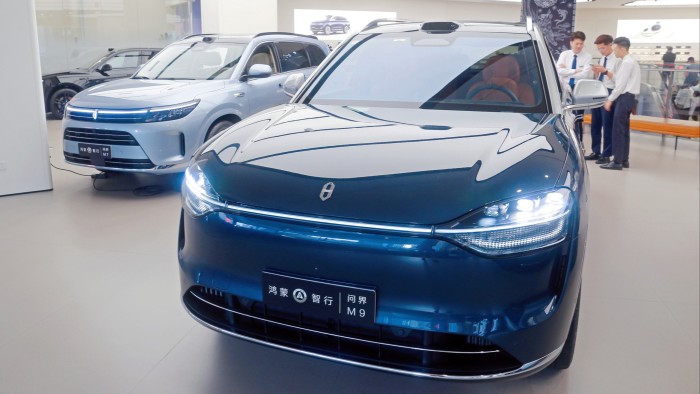
At Huawei’s electric vehicle division a giant screen highlights two of the biggest changes in human mobility in the past 150 years: from horses to cars, and from the internal combustion engine to driverless EVs.
Huawei was not around for that first automotive revolution, but despite being heavily targeted by US sanctions, the Chinese tech powerhouse is determined not to be excluded from the second.
The world’s biggest telecoms group and one of the biggest smartphone producers believe it can corner lucrative segments of the car industry as it is transformed by automation and electrification.
Its aspirations run from providing carmakers with hardware including telecoms gear, screens and infotainment systems, all the way to developing software for advanced driverless car systems and computer chips — but it has no plans to build cars itself.
“No matter how good Huawei’s cars were, at best they would be like mobile phones, accounting for 10 to 20 per cent of the market,” current chair Xu Zhijun told Chinese state media in a recent interview.
Instead, said Xu, Huawei’s automotive ambitions were to be the “Chinese version of Bosch”, referring to the German industrial giant that generated revenues of more than $50bn from its Mobility parts and services unit last year.
The Financial Times was able to visit Huawei in the southern Chinese city of Shenzhen, but the company declined on-the-record interviews.
Huawei’s entrance into the automotive market comes as China’s dominance of the resources, manufacturing and technology used to make EVs transforms an industry dominated for decades by companies from the US, Europe and more recently, Japan and South Korea.
Nissan and Honda are in exploratory talks about a merger, the latest sign of the threat to traditional carmakers from fast-growing Chinese manufacturers.
Vincent Sun, an equity analyst covering China’s car sector for investment research group Morningstar, said Huawei’s telecommunications, chip design and smartphone businesses had “a lot of synergies” with the technology underpinning increasingly advanced cars.
“Huawei is a different animal,” said Sun, adding that traditional car companies needed to boost research and development spending to avoid becoming obsolete “like Nokia”, referring to the Finnish phonemaker’s failure to adapt to the smartphone era.
As the EV transition gathers pace, global service revenues from robotaxis alone are forecast to reach as high as $1.2tn annually, according to IDTechEx, a UK research group.
However, Huawei’s EV foray also raises questions over how foreign markets will treat the company led by founder Ren Zhengfei, a former People’s Liberation Army engineer.
For years the company has been at the heart of US-China tensions amid accusations from Washington of national security risks stemming from alleged state and military links. Its global ambitions have been hammered by US-led restrictions on its telecoms sales and its access to cutting-edge chip technology.
Senator Marco Rubio, who is president-elect Donald Trump’s pick for secretary of state, alleged in October that one of Huawei’s “primary goals” was expanding the Chinese Communist party’s ability to spy on and disrupt other countries’ communications.
Huawei has spent five years and at least $5.6bn on research and development linked to EVs, part of a search for new growth drivers. Executives believe Huawei is poised to leverage dozens of Chinese technologies, from chips, radars and cameras to artificial intelligence, data centres, autonomous driving and infotainment systems.
The group reported revenues of Rmb4.7bn ($655mn) from its nascent automotive business unit last year, more than double those of the previous year but less than 1 per cent of the group’s total of Rmb704bn.
In January, the privately owned company moved to separate its EV business, registering a new entity, Yinwang, for marketing its main EV-focused systems and components, including its autonomous driving software.
Huawei has since sold two 10 per cent stakes in the company — to Avatr Technology, an EV start-up owned by state-backed Changan Automobile and the world’s biggest battery maker CATL, and to Chongqing-based carmaker Seres.
The deals valued Yinwang at $16bn, not far behind the market capitalisation of the listed unit of Geely, one of China’s biggest private-sector carmakers. And Huawei remains on the lookout for new strategic investors.
The group has established partnerships with a clutch of traditional Chinese carmakers, such as state-backed groups Chery, Seres, BAIC and JAC, and has been closely involved in car development and sales, including leveraging its massive retail network.
For the legacy Chinese brands, the Huawei tie-ups are a lifeline to transition to EVs following years of declining sales and massive overcapacity in petrol-powered cars.
Huawei has also clinched narrower but possibly more important deals, supplying software and hardware solutions. This includes selling its advanced autonomous driving system for some models made by BYD, the Warren Buffett-backed group that is challenging Tesla as the world’s biggest EV maker.
Despite the geopolitical backdrop, foreign companies in Chinese joint ventures, including Germany’s Audi and Japan’s Toyota and Nissan, are also collaborating with Huawei on advanced driving technology as they try to survive the onslaught from Chinese competition.
Bill Russo, the former head of Chrysler in China and founder of the consultancy Automobility, said Huawei was among a group of Chinese internet giants and device makers — which also includes Baidu, Alibaba, Tencent and Xiaomi — unlocking new and “recurring” revenue streams linked to EVs.
In the first 10 months of this year, sales of models jointly developed by Huawei and its four main partners — Chery, Seres, BAIC and JAC — have totalled 353,600, according to data supplied to the FT. A fifth partner, state-backed GAC, was announced in late November.
Sales have been dominated by Aito cars, made by the Seres-Huawei venture, which have captured nearly 4 per cent of the market for battery and plug-in hybrid EVs. By comparison, Tesla had 6 per cent of the EV market with just over 500,000 cars and BYD had 35 per cent with 2.9mn.
Huawei is also targeting growth through the surge in automation in commercial vehicles for use in mines, ports and other logistics hubs. The group is touting its ability to link transport and logistics fleets to its global data centres.
Christoph Weber, who leads the China business for Swiss engineering software group AutoForm, said Huawei had demonstrated how tech groups with little experience in the car industry could rapidly grow market share and pose an existential threat to incumbents.
“Clearly, the tech and automotive industries are merging,” he said. “It puts everyone else under even more pressure.”
Additional reporting by Harry Dempsey in Tokyo
Read the full article here

