


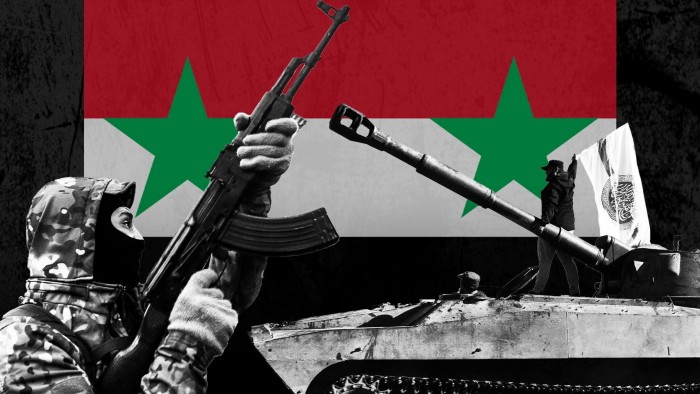
President Bashar al-Assad’s regime has fallen in Syria, almost 14 years after an uprising against it began and more than half a century after his father launched the family’s brutal dictatorship.
Rebels led by the Islamist Hayat Tahrir al-Sham movement took control of Damascus early on Sunday after sweeping through the country over the previous 12 days.
The rapid end to an enduring tyranny has triggered jubilation from many Syrians — but deep uncertainty about what will follow in a country at the Middle East’s strategic heart.
How did we reach this moment?
The extraordinary scenes of rebels and civilian opponents of the regime celebrating across the country are the end of a long arc in the “Arab Spring” uprisings that began in late 2010.
In early 2011, Assad dismissed the possibility that revolutions like the ones seen in Tunisia and Egypt would engulf Syria. He was wrong. In March of that year, a protest began over the torture of children accused of painting anti-regime graffiti in the southern city of Deraa. The regime responded by opening fire on demonstrators, triggering a wider uprising that soon spread nationally and developed into a civil war.
Assad’s rule came under severe pressure during the early years of the conflict. But support from Iran, its Lebanese militant group affiliate Hizbollah and — from 2015 — Russia helped turn the conflict in the regime’s favour.
The regime’s calculated release of imprisoned militants helped fuel the rise of jihadist movements, notably Isis. Western countries launched military action including air strikes against Isis after the videoed beheadings of western hostages and deadly terrorist attacks in European nations.
The combination of events helped Assad regain control over the majority of Syria’s territory, with Sunni insurgent groups pushed into north-western Idlib province under Turkey’s protection. Turkey also deployed troops to other northern areas, controlling enclaves where other rebel factions were based, as Ankara sought to push Kurdish militants back from its border.
Why is Syria so important in the region?
Syria lies at a regional crossroads, with Turkey to its north, Iraq and Iran to the east, Jordan and the Gulf states to the south, and Lebanon, Israel and the Mediterranean Sea to its west. The capital, Damascus, and the second city of Aleppo in the north have both been inhabited for millennia, making them among the world’s longest continuously settled urban centres. Syria has long been attractive to and occupied in whole or in part by foreign powers, including the Romans, Crusaders and Ottomans.
The country gained independence from France after the second world war but political instability followed, with multiple coup attempts as rival factions battled for control.
A 1963 putsch established one-party rule by the Ba’ath party. Bashar’s father Hafez al-Assad, defence minister and former commander of the air force, seized power in 1970. He presented himself as an Arab socialist, nationalist and secularist, but ran Syria as a security state.
Hafez al-Assad ruthlessly crushed dissent, most notoriously in the massacre of tens of thousands in the central city of Hama in 1982. Syria had close ties to the Soviet Union before its collapse, with many officials and military officers training there.
How did Bashar al-Assad rule?
On Hafez al-Assad’s death in 2000, his 34-year-old son, Bashar, took power. Bashar, a UK-trained eye doctor married to a British-Syrian banker, projected an image of modernity and reform. He was welcomed by western leaders such as British prime minister Tony Blair, who hosted Assad and his wife Asma at Downing Street in 2002.

The international reaction did not reflect events in Syria. The regime stifled a brief surge of freer political activity after Hafez al-Assad’s death known as the Damascus Spring. It continued to hold the country in a tight grip — until the pent-up opposition spilled out in 2011.
What was Assad’s power base and what will happen to it now?
The Assad family is part of a sect known as Alawites, whose heartland is in the western region of the country including its Mediterranean coast. Alawite beliefs are similar to those of Shia Islam, Iran’s official religion. The dominance of Alawites in the regime and lucrative crony businesses caused deep resentment among many Syrians.
A majority of the population are Arab Sunni Muslims, but the country has many ethnic and religious minorities. Up to 10 per cent of the population are estimated to be Kurds, mostly in the north-east. Christians were also thought to make up as much as 10 per cent of the population before the war.
Many Alawites, including regime opponents, fear the possibility of reprisals now Assad has gone. Other Syrians from many backgrounds are waiting nervously to see how the Islamist victors will rule.

What are the wider effects of the rebel takeover?
Syria’s conflict has had a global as well as a regional impact, drawing in world powers and triggering an international refugee crisis.
Russia’s military support for Assad allowed Moscow to consolidate and expand its presence in Syria, a vital Middle Eastern foothold for President Vladimir Putin. It has a Mediterranean naval base at Tartus, plus an air base at Khmeimim. The fate of those facilities, plus other Russian operations in the country, is unclear.
Syria’s conflict has displaced more than 14mn people, according to the UN. Almost 5mn Syrian refugees are registered in Turkey, Lebanon, Jordan, Iraq and Egypt alone. More than half of those are in Turkey.
The exodus caused political tensions in Europe, especially during the peak years of asylum-seeker flows in the mid-2010s. By 2021, Germany was hosting well over half a million Syria refugees, the UN has said. Far-right parties in many European countries have grown in popularity by campaigning against the arrival of Syrians and other asylum seekers.
During the war, Syria has been a big source of a stimulant drug popular in the Middle East called captagon. This is estimated to have generated billions of dollars for the regime and its allies during the conflict. That is one of many assets up for grabs now the Assad era is over.
Why are US troops in Syria?
The main US military intervention in Syria came in the 2014 campaign to force Isis out of the caliphate it had declared spanning large swaths of Iraq and Syria.
US troops worked with the rebel Kurdish-dominated Syrian Democratic Forces in the country’s north and east. An American military contingent remained in Syria after Isis was driven out.
Other US soldiers are stationed at the Tanf garrison close to the Iraq and Jordan borders. About 900 US troops are now in Syria in total, according to the Pentagon.
The US military presence will depend not only on political developments in Damascus, but on the return of Donald Trump as US president next month.
In 2018, during Trump’s first term, he called for US troops to be pulled out of Syria — but a full withdrawal never happened, in part due to concerns about whether Russia and Iran would take advantage.
Cartography by Steven Bernard
Read the full article here

