


Fencing via online platforms such as Amazon (NASDAQ:AMZN) has become a societal problem and it is only a matter of time before society makes it an Amazon problem.
When society does act, which I think is becoming increasingly inevitable, it will hurt Amazon via:
- Direct costs of monitoring and prevention
- Sales volume
- Reputation
This conclusion comes from the following logical chain:
- Shrinkage is a massive problem
- Shrinkage impact will go beyond company profit margins and hit everyday consumers.
- When consumers get hit, the government will be compelled to act
- Tying Amazon and other online platforms being used as fences to the consequences is the most cohesive and publicly palatable solution
Shrinkage is a bigger problem than you think
According to the National Retail Federation, shrink in 2021 was $94.5B in the U.S. That number is much higher now.
Target (TGT) noted a 120% increase in theft in 2023 and CEO Brian Cornell estimates Target’s shrinkage reaching $1.2B this year.
Macy’s (M) and DICK’S Sporting Goods (DKS) each just reported earnings and got walloped by theft.
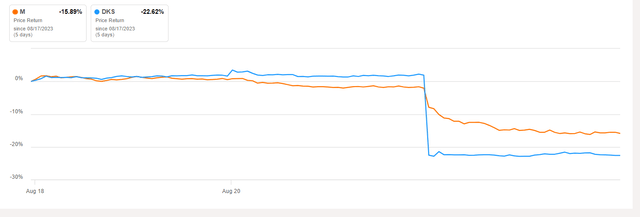
SA
Navdeep Gupta, Dick’s CFO, said:
“The biggest impact in terms of the surprise for Q2 primarily came from shrink. We thought we had adequately reserved for it. However, the number of incidents and the organized retail crime impact came in significantly higher than we anticipated”
The word “shrink” appears 39 times in the 2Q23 Dick’s conference call.
Macy’s (M) uses the term “shortage” in place of shrinkage and in 2Q23 they reported a $0.04 per share hit from shortage relative to expectations.
Keep in mind that EPS was just $0.26 so that is a 15% profit hit largely from retail theft. The word shortage appears 19 times in the conference call.
The general public doesn’t really care about the profitability of Dicks or Macy’s. These numbers aren’t going to cause the outcry required to get the government to act. However, the ripple effect is starting to really hurt consumers in a more direct way.
- Retail deserts
- Goods inflation
In areas where the theft is severe, retailers are closing up shop leading to areas where consumers have to travel far just to buy basic goods.
Retail gross margins are rather low, especially on things like groceries. If the gross margin is 5%, a single theft eliminates the profits from the next 19 sales. Shrinkage is approaching 3% of all sales and it is wreaking havoc on profit margins. Retailers have had to increase prices. I believe this is a major driving force behind the high inflation of the last few years. It may also explain why inflation seems to be higher in low margin goods like groceries than in other categories.
The general public does not like inflation.
The general public does not like retail deserts.
As a result, public opinion is moving toward forcing the government to act on the issue of organized theft.
How does one know stolen goods are being sold online?
The easiest way is to look at goods that can only be produced by the original company such as gift cards. You can only buy a legitimate Target gift card through Target. If a third party unaffiliated with Target is selling Target gift cards, they are probably stolen. Most of these are sold online.

National Retail Federation
Amazon is only one of many online platforms used for fencing, but it is by far the biggest offender in terms of absolute volume.
Shoplifting isn’t what it used to be
Retail theft used to be significantly more innocent in nature. Back in the day, shoplifting consisted of a misguided teen taking an article of clothing they wanted but couldn’t afford, or perhaps a kleptomaniac with a legitimate problem.
In both cases it is still theft, but there is an innocence to it that softens it a bit. As a society we want to prevent that sort of crime but don’t necessarily want to punish the offenders all that hard. To be clear, I’m not referring to my view here, but rather my estimate of what the general views of society are. There is of course a spectrum of opinions on such matters.
Today’s shrinkage is an entirely different thing.
It is premeditated, organized and exploitative. Criminals go in with intent to steal an exact set of items that is easy to re-sell through online platforms like Amazon. They specifically tailor the volume of theft to stay under certain thresholds:
- Felony versus misdemeanor
- State specific thresholds
- Prosecuted or not
Each state has minimum thresholds for theft to be considered a felony.
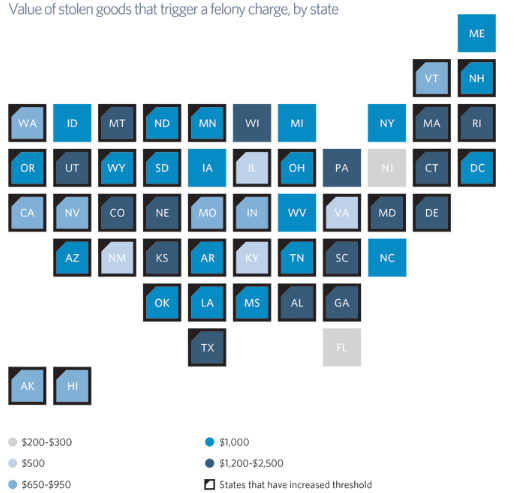
Pew Charitable Trust
So, in a $1200 threshold state, someone goes in and steals $1100 worth of products, sells them, and if they didn’t get caught, goes back in for round 2 of theft.
States and even cities differ significantly in their willingness to prosecute retail theft. Crimes of this nature seem to be significantly more concentrated in the jurisdictions that are least likely to prosecute.
Why Shrink has increased so much
There are three main reasons for the spike in theft.
- Ease of fencing
- Legal
- Social
The legal and social aspects are hot button political issues so I don’t want to go too deep into them as the politically charged nature would distract from the point of this article. As always, when dealing with political issues, I try my best to refrain from stating my opinion or having it inferable from my writing. This is meant to be financial analysis and the conclusions drawn are meant to estimate the future financial impacts to the companies discussed.
Fencing is the biggest reason for the spike in theft. 20 years ago, thieves had to sell their goods through criminal fencing organizations or directly themselves on the street. Both methods are extremely dangerous and low margin.
Then along comes Amazon which has accidentally become the best fence in history.
One can quickly and easily sell stolen goods on Amazon for as much as 95% of value. It is basically zero physical danger and until laws or regulations change it involves minimal legal danger. Note that Amazon does not allow this, but they also don’t do much to stop it.
Here is Amazon’s statement in an email to CNBC about stolen goods.
“Amazon does not allow independent sellers to list stolen goods in our store, and we work closely with law enforcement, retailers, and brands to stop bad actors and hold them accountable, including withholding funds, terminating accounts, and making law enforcement referrals.”
There is a big difference, however, between fencing being against terms of use and actually stopping it.
Being against terms of use only matters to those who actually care about getting kicked off the platform. Thus, this is primarily a burden to the mid-size businesses. When a medium size business accidentally sells stolen goods they get in trouble. Amazon will kick them off the platform and their business will be ruined.
This is further discussed in the CNBC article linked above.
The true criminals, however, do not care about violating Amazon’s terms of service. If they get caught and Amazon kicks them off the platform, they simply make a new account and sell through the new account. They don’t have brand equity or reputation to maintain. There is no lost business.
What could change
So far, the legal burden falls on the seller of stolen goods. Amazon is not held accountable for being used as a fence.
If Amazon is held accountable for the sale of stolen goods on its platform it will actually put into place policies that stop the fencing from occurring.
As it stands today, online fences and the criminal sellers are the causes of the shrinkage epidemic, yet the burden of shrinkage epidemic falls on everyone but the fences and the criminals.
- Retailers are suffering massive losses.
- Legitimate third party selling businesses are being shut down.
- Retail deserts are popping up, burdening honest shoppers who want to buy goods.
The problem is accelerating and there are increasing pushes to get something done at a societal level.
The solution
Incentives are a powerful thing. The way to reduce shrinkage is to align the costs of shrinkage with the causes of shrinkage. This means that society must somehow either punish/deter the criminals or punish/deter Amazon from allowing itself to be used as a fence.
The first is much harder to pull off. The cost of prosecuting at the individual level is much higher than the actual value of goods stolen. Beyond the direct costs of prosecution, the prosecuted individuals will become less employable making them less economically productive members of society. This is why most states have implemented thresholds below which theft is only considered a misdemeanor and frequently goes unprosecuted.
As such, the legal side has to strike a balance in which it strongly deters people from committing such crimes while also not jailing too many people. Any action is going to have trade-offs ranging from social impacts, economic impacts and the costs of implementation. It could probably be done better, but it is a tough problem with no perfect solution.
Dealing with the fencing side strikes me as the more plausible solution.
It is already illegal to sell stolen goods, but that law was written well before there were online platforms that facilitated the sale of stolen goods. It has become outdated.
A simple tweak to make the platform (Amazon in this case) legally responsible for sale of stolen goods would be one means of holding them accountable.
In the event Amazon becomes legally accountable, their actions to prevent fencing will go far beyond a terms of use statement.
Costs of implementation will be enormous and the unfortunate side effect would be that the new procedures would make legitimate, legal, good business significantly more difficult to conduct on the platform.
Investment implications
Much of AMZN’s value comes from AWS rather than the retail division and that portion of the business would still be strong.
The damage in the event Amazon is held accountable for preventing fencing on its platform would come in the form of lost sales and higher costs on its retail business.
It is certainly not enough to crash AMZN, given the magnitude of the company, but it is a bear thesis that I do not think is being factored into the price at all.
Read the full article here

