


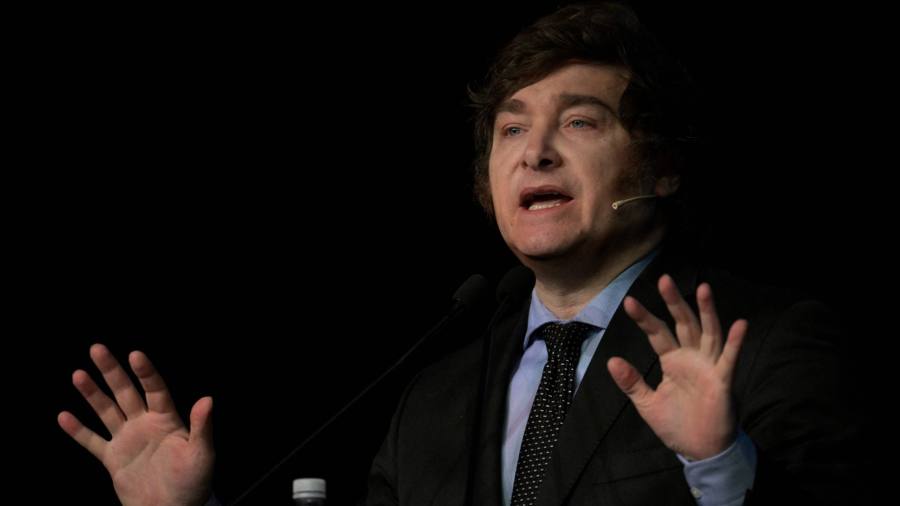
Argentina’s radical rightwing presidential candidate has claimed the austerity imposed by the IMF is “tiny” compared with what the country needs, as he accused the fund of acting in its own interests in maintaining support for Latin America’s third-largest economy.
Javier Milei, an economist and congressman, told the Financial Times the IMF, which has provided Argentina with a total of 22 bailout packages — most recently in 2022 to replace a failed 2018 deal, “doesn’t care” about the country’s deep-rooted challenges.
“The IMF are just a bunch of bureaucrats who know that a bank’s business is to charge interest,” he said. “If I’m elected it will be to solve Argentina’s problems.”
The South America nation and the IMF reached a deal last week to prevent its economy entering into arrears with the fund after months of intense negotiations.
The IMF agreed to release $7.5bn on condition that Buenos Aires weakened the artificially-inflated peso and imposed spending cuts to hit a budget deficit target set before this year’s drought damaged exports.
However, Milei claimed what the IMF had called for was “tiny compared to the austerity package I’m proposing”. He also said he would “overshoot all the targets” of the country’s troubled $44bn IMF programme if elected.
Milei, who rose to prominence as a television panellist railing against economic mismanagement by Argentina’s political class, is running in October’s high-stakes presidential election on a promise to dramatically shrink the state and dollarise the economy in order to stamp out inflation, which hit 115.6 per cent in June.
Milei believes his austerity and dollarisation plans would “slash Argentina’s country risk”, boosting demand for government debt and removing the need for the fund’s lifelines to keep the economy afloat.
Though his momentum has cooled — Milei’s Freedom Advances party is trailing both the ruling populist Peronist coalition, United for the Homeland, and pro-business opposition bloc Together for Change — analysts said Milei has had a significant impact on these elections.
He has, they said, dragged Argentina’s debate to the right after two decades of leftward drift under the influence of former Peronist president Cristina Fernández de Kirchner.
“Milei has made it okay for politicians to talk about things that had become politically incorrect in Argentina: cutting social programmes, fiscal responsibility, government waste,” said Ana Iparraguirre, a Buenos Aires-based political consultant and partner at Washington strategy firm GBAO. “That impact will be lasting.”
Milei’s outsider image and controversial views, from climate denial to support for legalising the sale of human organs, have prompted comparisons to the US’s Donald Trump and Brazil’s Jair Bolsonaro.
But Milei, whose campaign has focused more on the economy than nationalism or social conservatism, played those down. “We agree that the enemy is socialism. After that, each of us has their own particularities.”
Some polls have shown particularly strong support for Milei among young voters. At a surprise campaign appearance in a Buenos Aires shopping centre in early August, dozens of teens and twenty-somethings crowded Milei for selfies.
“Everyone my age tells me they want to leave Argentina,” said 20-year-old Silvina Sanchez. “Milei is the only candidate who really wants to change this country so we can stay.”
Argentina’s business community, however, is wary of Milei’s irascible persona — even friends say he has a short temper and he repeatedly raised his voice in frustration during an interview with the FT — as well as his extreme vision of a market-driven society.
Milei — who has four dogs named Milton, Murray, Robert and Lucas, after US economists — argued that “market failures do not exist” and ruled out state subsidies to stimulate nascent industries such as green energy. He also advocates for all infrastructure to be built by private companies.
Gustavo Weiss, president of Argentina’s construction business association, said “only 15 to 20 per cent” of projects can be delivered solely by the private sector, citing the long horizon for returns or lack of profit in areas like paving city streets. “The market can’t solve everything. Even the most liberal countries in the world know that.”
Argentina’s sovereign bond prices have risen in recent months largely on growing expectations that a centre-right candidate will win in October. Candidates for Freedom Advances have averaged just 4 per cent of the vote in recent provincial elections, which Milei blames on the difficulty of “translating voters’ trust in [him] to others”.
A surprise success for Milei at the first date in the electoral calendar, a mandatory nationwide primary poll on August 13, “would be chaos” for the market, said Fernando Marull, founder of Buenos Aires-based economic consultancy FMyA.
Milei’s commitment to dollarisation is a concern for investors. “The Argentine economy isn’t closely linked to the US, so the decisions the US makes about monetary policy will often not be appropriate for Argentina,” said Alejandro Werner, a former IMF western hemisphere director.
Milei dismisses a scenario in which Argentines are hit by US rate increases during a local economic downturn. “If you are afraid, you should get a fixed-rate loan, or if you are on a variable rate, you cover yourself from the risk using derivatives.”
Milei cited a “menu” of options to raise the $40bn he claims are necessary to convert pesos at the market exchange rate.
One is to offer government debt held by public sector entities to the market, which critics say could send bond prices plummeting. Another is to establish a trust in the US holding Argentine assets, such as shares in state energy group YPF, to use as collateral to back new bonds.
Milei is an anglophile — a fan of Margaret Thatcher and Winston Churchill, and was a singer in a Rolling Stones tribute band in his teens.
But as an economic role model for Argentina he cited Ireland, whose low tax regime has lured big multinationals to post profits in Dublin. “They did reforms, and their per capita GDP [gross domestic product] has more than sextupled in the last 30 years,” he said. “I’d like [Argentina] to look like Ireland.”
Read the full article here

