


Unlock the Editor’s Digest for free
Roula Khalaf, Editor of the FT, selects her favourite stories in this weekly newsletter.
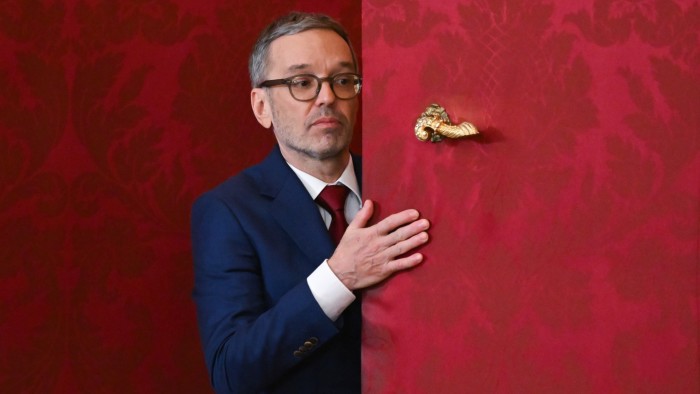
“No games, no tricks, no sabotage.” Herbert Kickl sounded like he was beginning a ransom negotiation rather than coalition talks last week after receiving the go-ahead from Austria’s president to try to form a government three months after winning parliamentary elections.
The far-right leader undoubtedly has the whip hand in negotiations with the centre-right People’s party (ÖVP), whose own coalition efforts collapsed earlier this month. Any messing around, Kickl threatened, would lead to a fresh vote and, the polls suggest, a crushing victory for his Freedom party (FPÖ) over the conservatives.
Kickl won’t have it all his own way. The ÖVP insists on him agreeing to safeguards to protect press freedom, maintain a constructive relationship with the EU and keep up support for Ukraine. But the centre-right is not showing much backbone. Christian Stocker, the new ÖVP leader, last autumn described Kickl’s FPÖ as “not only a threat to democracy, but an equally great threat to Austria’s security”. A few months on, there is no such compunction.
Austria is on course for its first far-right chancellor since the second world war. It would be a logical development for the country, where Kickl’s party has already taken part in three federal governments with the centre right, although never in the lead. But it would still be a historic breakthrough for the FPÖ, with reverberations well beyond Austria.
It would normalise and embolden other populist nationalist movements in Europe. The far-right Alternative for Germany (AfD) has often taken its ideological cue from its more established Austrian counterpart. Alice Weidel, the AfD candidate for chancellor, has recently embraced the concept of “remigration” — the mass deportation of immigrants deemed to have failed to integrate, never mind their citizenship status. The idea was first espoused by Austrian nativist ideologue Martin Sellner, taken up by Kickl and his party and then adopted by the AfD’s extremist wing. When it emerged that a group of AfD politicians and activists had attended a meeting with Sellner in November 2023 to discuss “remigration”, Weidel in effect disowned them. Now she has made the policy her own.
Kickl would strengthen the growing squad of nationalist, Eurosceptic leaders in central Europe who, orchestrated by Hungary’s Viktor Orbán, seem determined to challenge the EU’s liberal establishment and its pro-Ukraine foreign policy. They could be joined by Andrej Babiš, the billionaire on track to win parliamentary elections in the Czech Republic later this year. The nationalist Călin Georgescu could be elected Romania’s president in a rerun after his bid was cancelled in December by the country’s constitutional court due to what the Romanian authorities alleged was a Russia-backed influence campaign. The Mitteleuropa troublemakers might not always act in unison but they are becoming impossible to sideline, let alone ignore.
Kickl’s probable rise to power also underscores the fragility of the political centre in Europe at the beginning of 2025. Mainstream parties averse to co-operating with the far-right or populist right are struggling to find common ground among themselves to govern effectively. Strained public finances only make the problem harder.
In Austria, Kickl was invited to form a government because the centre-right could not agree with the centre-left and the liberals on how to reduce the yawning public deficit. In France, the new minority government of François Bayrou hangs by a thread, pending a budget deal. Fundamental differences over debt rules first paralysed and then detonated Germany’s “traffic light” coalition, propelling the AfD to new heights.
The mainstream German parties’ firewall against sharing power with the far-right remains intact — for now. But their ability to work together in office will be sorely tested. The Christian Democrats, who have shifted markedly to the right under Friedrich Merz, are set to win, but will have to team up with either the Social Democrats or Greens, and possibly both, to form a coalition. Yet some of Merz’s allies are bent on vilifying the Greens.
“Austria is an example of how things should not go,” said the Greens’ chancellor candidate Robert Habeck. “If the centrist parties are unable to form alliances and dismiss compromises as the work of the devil, that helps the radicals.”
“If we do not show the willingness to form democratic alliances, we face instability and an inability to act. Germany cannot afford that and we cannot expect Europe to accept it.”
Habeck is right. Compromise has become a dirty word in European politics. One that will surely never pass Herbert Kickl’s lips.
Read the full article here

