


Receive free US banks updates
We’ll send you a myFT Daily Digest email rounding up the latest US banks news every morning.
The largest US banks would lose $541bn in a hypothetical doomsday economic scenario but still have more than enough capital to absorb the losses, according to annual stress tests conducted by the Federal Reserve.
The passing grades given by the Fed on Wednesday to banks including JPMorgan Chase and Goldman Sachs lent support to claims from Wall Street executives and regulators that systemically important banks can withstand heavy losses.
The results come just months after three of the largest bank failures in US history — Silicon Valley Bank, Signature Bank and First Republic — triggered a regional banking crisis. Smaller banks that have come under pressure from investors following the collapse of SVB, including PacWest and Comerica, were not included in the stress tests.
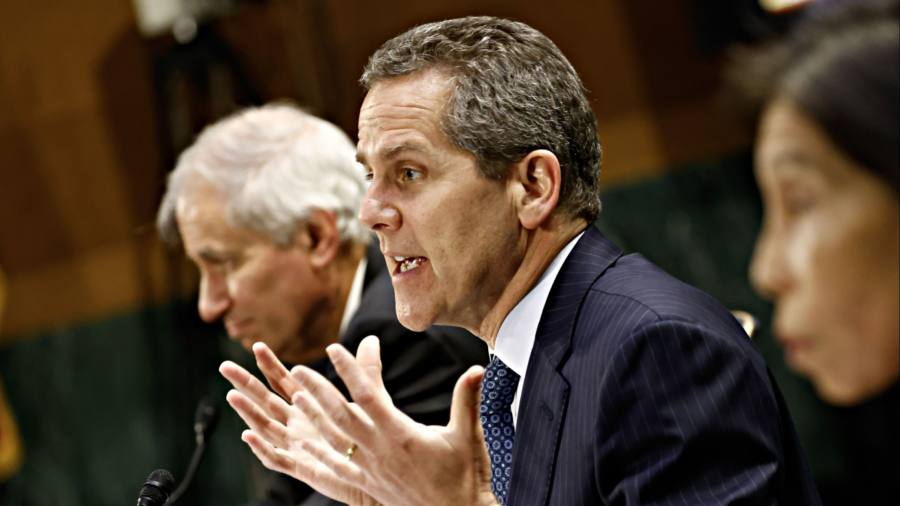
“Today’s results confirm that the banking system remains strong and resilient,” Fed vice-chair for supervision Michael Barr said in a statement.
In a nod to the recent crisis, Barr warned the stress tests were “only one way to measure that strength” and said regulators “should remain humble about how risks can arise”.
The Fed stress tests are an annual exercise required under the post-2008 crisis Dodd-Frank financial regulations that gauge whether banks’ loss-absorbing capital ratios would remain above minimum requirements in the event of an economic catastrophe.
This year, banks needed to show they could withstand unemployment rising to a peak of 10 per cent, commercial real estate prices plunging 40 per cent, house prices declining 38 per cent and short-term interest rates falling to almost zero.
Of the 23 banks tested, Deutsche Bank’s US subsidiary suffered the biggest capital hit, followed by UBS Americas.
Goldman’s capital levels fell the most among the banks headquartered in the US, followed by Morgan Stanley. Both banks’ businesses skew more than peers towards trading, which is classified as riskier by the Fed.
The tests showed that all of the banks tested, including Bank of America, Citigroup, State Street and Wells Fargo, would meet minimum capital requirements despite projected losses of $541bn. Of the losses, $424bn came from loan losses and $94bn from trading and counterparty losses.
The eight largest banks would suffer nearly $80bn of trading losses in a scenario with persistently high inflation necessitating steep interest rates, an environment not dissimilar to the current economic outlook.
The stress test results will help determine the so-called stress-test capital buffer for each bank. This is the amount of common equity tier one capital they must hold in excess of regulatory minimums relative to their risk-weighted assets.
The stress capital buffer is a combination of the maximum losses of CET1 capital during the stress test and the bank’s capital return plans for the next 12 months to shareholders through dividends.
The banks tested will be able to publicly confirm their indicative stress-capital buffer starting from Friday, when they may also reveal potential buyback or dividend plans.
Later this summer, the Fed and other US banking regulators will publish new international standards for calculating risk-weighted assets, known as the Basel III endgame rules.
Analysts and bank executives anticipate these rules, which will bring the US in line with international standards, will mean American banks will have to hold more CET1 capital.
The Financial Services Forum, a Washington lobby group for the largest US banks, said the results underscored that lenders had sufficient capital and more stringent requirements were not needed.
“The reforms of the post-Dodd-Frank period have achieved the goals of a stronger, safer banking system,” the FSF said in a statement.
US regulators are also expected to expand the new Basel rules to include midsized banks of similar size to Silicon Valley Bank, Signature Bank and First Republic.
The list of banks subject to the Fed’s stress tests has come under intense scrutiny in the wake of SVB’s demise due to its exposure to outsized interest rate risk stemming from its stock of unhedged bond holdings.
Under the current rules, which were imposed in 2019 following legislation that loosened regulations on midsized lenders, SVB’s first official stress test would not have taken place until 2024.
However, even if SVB had been subject to the Fed stress tests, it might have passed because the scenario did not model the kind of sharply higher interest rates that sparked the lender’s downfall.
Additional reporting by James Politi
Read the full article here

