



Within the past few weeks, a growing number of airlines including all of the big 4 U.S. carriers, American (AAL), Delta (DAL), Southwest (LUV) and United (UAL) as well as a number of foreign airlines have reported that they have found unauthorized parts in the engines of aircraft in their fleets. The U.S. Global Jets ETF (NYSEARCA:JETS) contains more than 50 airlines with each of the big 4 making up approximately 10% of the JETS ETF.
Illegitimate Parts
While the global airline industry uses very careful procedures and protocols to ensure that only authorized parts are used in commercial aircraft, recent reports all point to a London-based parts broker, AOG Technics as the source of illegitimate parts. All of the parts involve CFM or General Electric (GE) jet engines. CFM is a joint venture of GE and Safran (OTCPK:SAFRF), formerly known as Snecma, a French aerospace company. The CFM engines involved power Boeing (BA) 737NG and Airbus (OTCPK:EADSY) A320CEO family aircraft, both previous generation models of those airframe manufacturer’s current products. There is evidence that some AOG parts might also be installed on certain larger widebody aircraft powered by the GE CF6 engine. None of the at-risk parts contain manufacturer certifications and FAA (Federal Aviation Administration) documentation which are required for every part on every aircraft part on U.S.- registered aircraft; most countries either have similar regulations through their own aviation authorities or defer to the home country of the manufacturer.
British authorities are attempting to assist the engine manufacturers involved obtain the documentation to show where AOG’s parts have been installed. Although airlines have sophisticated databases showing where every part is installed along with each part’s history, aircraft components are often moved. GE and Safran are suing to force AOG (which is also an airline industry acronym for Aircraft on the Ground) to provide documentation including to whom they sold their parts as well as the source of the parts and additional documentation that might have been attached to those parts at one time. GE and Safran allege that AOG falsified documentation of authenticity on an industrial scale. Because there is missing documentation, it is unclear if the parts themselves meet necessary technical requirements.
While the European Union Aviation Safety Agency received reports from an engine overhaul company in Portugal during the summer that they had found parts sourced from AOG without the required documentation, the British Civil Aviation Authority also began an investigation.
The majority of U.S. airlines operate the previous version of the Boeing 737 which is powered by the version of the engine with the suspect parts. Each of American, Delta, Southwest and United have determined that they found the illegitimate parts on some of their aircraft but all acknowledged a small number of aircraft were involved; given that each of those airlines operate over 800 aircraft, the number of aircraft that are involved is small. All four of those airlines immediately grounded the aircraft involved; however, because the problem involves engine parts which could be installed deep within the engine, requiring an overhaul to replace them, airlines can swap out the suspect engines with spare engines to allow the aircraft to return to service. Some smaller airlines including Alaska ALK and Sun Country SNCY operate aircraft with the suspect engines but have not indicated that they have found any suspect parts. It should be noted that the engine parts in question are not used on the Boeing 737 MAX, the latest generation of the popular domestic aircraft or on the Airbus A320NEO family which is also in service with a majority of U.S. airlines. Tens of thousands of CFM engines have been installed on multiple aircraft platforms although the engine in question or its related parts are not used in new Airbus or Boeing models.
JETS 1 year chart 9 Oct 2023 (Seeking Alpha)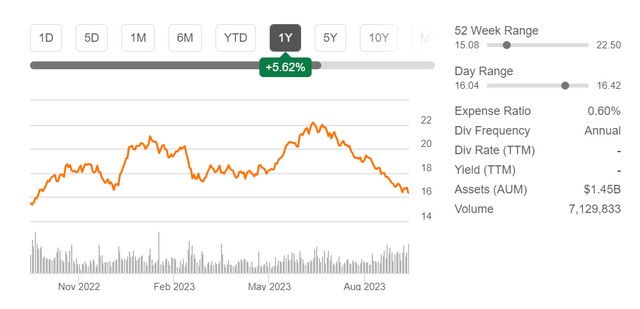
Nemesis or Nuisance?
The question for investors is whether there is or will be a significant impact on the airline industry, esp. in the USA. The JETS ETF contains some of the largest airlines in the world that use CFM engines including the largest U.S. airlines. In addition, a number of major foreign airlines that use CFM engines include U.S. traded Ryanair (RYAAY), the European mega low cost carrier, and Gol (GOL) of Brazil indicating how widely the CFM engine is used throughout the world.
Despite the large number of potential engines, the number of suspect engine parts is currently quite small based on information from the big 4 U.S. airlines. Although it is possible that there will be many more parts found esp. among foreign airlines, parts tracking systems used by U.S. airlines must meet federal approval and so were able to fairly quickly identify the suspect parts. It is not likely that there will be a significant increase in the number of affected aircraft among U.S. airlines or even among foreign airlines that are traded on U.S. stock exchanges.
The timing of the bogus parts scandal might be favorable for minimal impact even if more engines are found to contain the suspect parts. U.S. airlines are in the seasonally slow fall demand period which is likely seeing even greater reductions in travel demand because the post-covid fall period is seeing less business travel. In addition, weakness in the U.S. domestic market, as indicated by investor updates from many U.S. airlines, make it more likely that airlines have undeployed aircraft which could be substituted if necessary. In addition, many airlines have new generation aircraft on order and deliveries of those aircraft continues, even at slower-than-expected rates due to production delays on new aircraft and engines. There is no indicated shortage of authentic parts that can be used to replace illegitimate parts; the challenge for airlines is identifying where the suspect parts have been installed and removing and replacing them.
JETS 1 month 9 Oct 2023 (Seeking Alpha)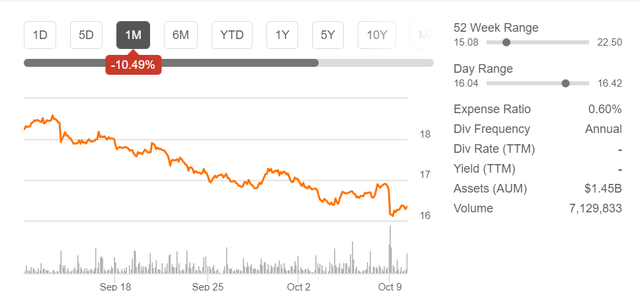
Bigger issues threaten
The bogus aircraft engine scandal appears that it will be much smaller than a number of other issues facing the global and U.S. airline industry. One of the most significant issues facing airlines is the fall in demand as the industry heads into the typically slower fall and winter months. After a very busy eighteen months of intense domestic demand, indications of weakening domestic demand began to appear early in the summer as predominantly domestic low-cost airlines updated their investor guidance to show weakening domestic demand. A number of factors might have driven the decline but, by late spring 2023, a full year had passed since covid restrictions fell within the U.S. and the amount of “revenge travel” appeared to be winding down. At the same time, there were indications that many travelers were booking long-haul international travel since Europe opened up too late in 2022 for many passengers to rebook long-delayed vacations even though summer 2022 transatlantic traffic was very strong. In the summer of 2023, many Asian countries were open again for their first major post-pandemic travel season. In addition, fare data for the second quarter of 2023 indicates that the legacy/global carriers were being less impacted by the reduction in travel as a growing number of travelers were upgrading their travel experiences by paying for premium travel. In addition, there have been concerns since early in the summer that low-cost carriers might be more vulnerable to macroeconomic concerns that are reducing discretionary price-sensitive travelers. Given that major discount retailers also report weaker sales, it is not surprising if airlines that cater to discount passengers are also seeing reductions in travel demand.
After months of relatively low oil prices following significant gyrations post-pandemic, fuel prices started to head up during the summer, leading a number of airlines to trim their third quarter guidance, even among the big 3 global airlines that reported that demand degradation was not taking place in their markets.
Crude Oil Futures 9 Oct 2023 (Seeking Alpha)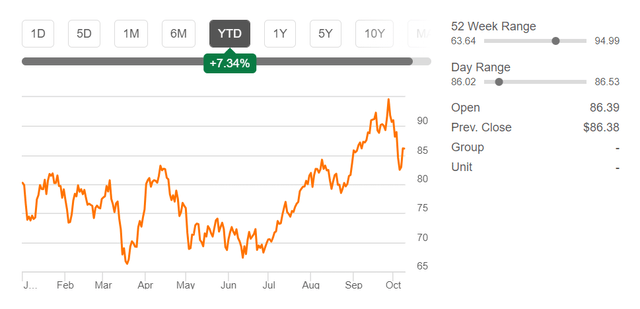
The other shoe regarding demand might have dropped this past weekend with the Israel-Hamas war. Global airlines were still seeing strong demand heading into the fall season and they expected to be able to operate their transatlantic summer seasonal schedules much later into the fall and to be able to begin their 2024 summer season much earlier in the spring. However, most airlines have suspended service to Israel due to genuine airspace security concerns. All of the big 3 U.S. global carriers serve Israel; United is the most exposed with more than 1.5% of its global capacity dedicated to serving Israel while American is least exposed with just a single daily flight. The larger demand concern is that war and the threat of terrorism causes a certain segment of the traveling public to decide to stay closer to home or to cancel travel plans altogether.
Although fuel prices had briefly retreated last week, they headed back up on Monday amidst a number of energy-related concerns that are common when geopolitical flareups occur in the Middle East. Many analysts had expected supply shortfalls that would be exacerbated later this year and into 2024 as a result of Saudi and Russian production reductions and a continued return of demand particularly in Asia.
There have been long-standing concerns regarding aviation supply chains including the ability of engine manufacturers to deliver new engines and thus for Airbus and Boeing to deliver new aircraft. These concerns have been amplified by round after round of problems with the Pratt and Whitney RTX Geared Turbofan GTF engine that either exclusively or as an option powers most narrowbody aircraft models except the Boeing 737 MAX. Pratt and Whitney is still advising airlines of the number of engines that might be impacted by poor-performing materials used in the manufacture of the GTF engine but says that hundreds of engines will have to be removed from service for inspection and replacement of defective parts in a process that could take up to nine months per engine. Thus, the bogus parts issue appears now to be much smaller in comparison. In addition, if demand continues to deteriorate, many airlines might be less interested in flying aircraft at low margins and instead receive compensation from manufacturers such as RTX for grounded aircraft.
Airline stocks fall out of favor
Always cyclical, the airline industry enjoyed an eighteen month run of strong demand which included periods of favorable fuel pricing after two years of pandemic reductions in demand. Large government infusions of cash helped keep economies from collapsing but more recently have created spiraling inflation throughout the world which threatened to undo the post-pandemic recovery. Increasing oil prices further pressured airline industry profits and now an unfolding war in a country with strong connections to the United States ensures that the remaining rosy outlook for at least some airlines will come back to earth while other airlines might find the culmination of all these factors pushing them into losses.
The JETS ETF, by nature of its large number of holdings, represents the best cross-section of the industry. While it will be possible to find opportunities to invest in the airline industry even based on short-term basis, investors should probably not expect to see significant appreciation in JETS anytime soon.
Delta opens the earnings season not just for the U.S. airline industry but as one of the first airlines in the world when it reports its third quarter performance before the bell Thursday. Its commentary often serves as the canary in the coal mine for airline investors.
Editor’s Note: This article discusses one or more securities that do not trade on a major U.S. exchange. Please be aware of the risks associated with these stocks.
Read the full article here

