


Unlock the Editor’s Digest for free
Roula Khalaf, Editor of the FT, selects her favourite stories in this weekly newsletter.
The chief executive of Brunello Cucinelli has hit back at short sellers’ claims that it is violating EU sanctions by continuing to sell luxury goods in Russia, as the Italian brand moves to reassure investors its operations in the country are within the rules.
In a note to clients this summer London-based hedge fund Pertento Partners, which holds a short position in Brunello Cucinelli, alleged the Milan-listed group’s three Russian stores remain open and sell current collections for “prices many times higher than sanction ceilings permit”.
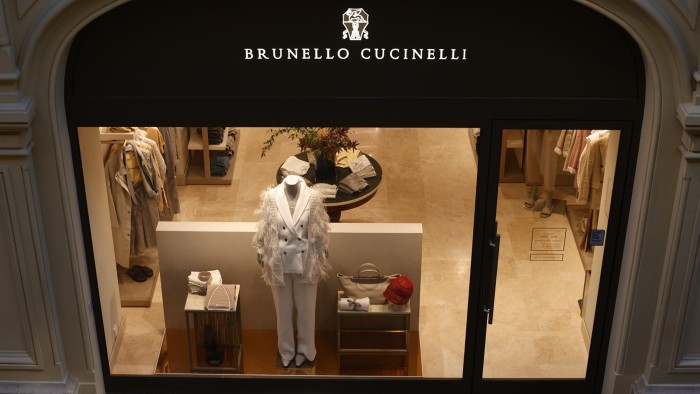
Cucinelli chief Luca Lisandroni told the Financial Times that its Russian boutiques were shut. He added, though, that staff are “currently engaged in one-on-one sales activities in our showroom and the product on sale is limited to what can legally be sold”. Cucinelli’s showroom is located close to its store at Moscow’s Red Square.
In 2022 the EU imposed a ban on the export of luxury goods valued at more than €300 to Russia, in the wake of its invasion of Ukraine. The outbreak of war left western companies with a dilemma of whether to cut all ties with Russia or attempt to continue trading there in line with sanctions, and potentially expose themselves to criticism.
Brunello Cucinelli, founder of the eponymous brand, is renowned for his advocacy of “humanistic capitalism” — whereby economic and environmental sustainability and the wellbeing of workers are prioritised over profit.
Pertento, which holds the largest disclosed short position in Cucinelli, said Russian import records showed $6.1mn of the brand’s apparel was imported to the country in 2024. Each item was “priced just below €300, regardless of its nature,” said the hedge fund, which also claimed items priced above €300 were being sneaked into Russia via intermediaries in other countries.
Lisandroni disputed Pertento’s claims and said that the company was not aware of any triangulation: “internal checks as well as the Italian and foreign customs agency never highlighted anomalies”.
Cucinelli had “opted to maintain our local structure unaltered [in Russia],” Lisandroni said, justifying the move on the basis that it guaranteed full salaries to employees and that it would honour its lease agreements.
“Our [Russian] activities are based on shipments within the price limits allowed by the European Union, and on our residual stock in the country which was delivered to Russia before the outbreak of the war,” he added.
Lisandroni acknowledged that Cucinelli continues to supply department stores in Moscow but said the company was acting “in full observance of EU rules, only supplying items of our collections within the price caps fixed by the EU”.
Cucinelli has this month attempted to reassure investors that Pertento’s allegations — concerning its activities in Russia, as well as its substantial levels of inventory and the health of its brand — were a misinterpretation of reality, according to people with knowledge of the private exchanges.

The €300 limit on the value of goods refers to the value disclosed in the export declaration, which is typically the same as the wholesale price. For luxury goods, this can be as little as one-third of the retail price, according to industry insiders.
Cucinelli would therefore be able to legally sell goods with a retail value of about €900 in Russia, although that would still exclude a considerable proportion of its overall product range. Only a limited number of Cucinelli products, including T-shirts and belts, are available for less than €900.
Short selling reached 3.2 per cent of Cucinelli’s shares outstanding this month, nearly a record high, according to data disclosed by the Italian regulator and compiled by data analytics company Breakout Point.
Other short sellers of Cucinelli shares, besides Pertento, include London-based Kintbury Capital and US quantitative hedge fund AQR. Shorting a company’s stock involves borrowing the shares and selling them, in the hope of buying them at a lower price in the future and pocketing the difference.
The Pertento report also alleged Cucinelli is using its Russian channels to “dump” excess inventory.
Cucinelli has previously told investors that an ordinary inventory level for the group is about 28 to 29 per cent of revenue — its latest disclosed inventory position was €378.6mn, equivalent to 29 per cent of its 2024 revenues. Lisandroni called Pertento’s claims “entirely inappropriate and not representative of its business model”.
At the time of Russia’s invasion of Ukraine, Cucinelli’s sales in Russia had peaked to 9 per cent of the group total, from an average of 4 to 5 per cent before 2020, as more wealthy Russians stayed in the country during the pandemic, according to the company’s annual report.
“Russia now makes up 2 per cent of our revenue and exports to our subsidiary there have dropped from €16mn in 2021 to €5mn last year,” said Lisandroni. “We think these figures can help put this whole story, including claims we might be dumping excess inventory into the country, into perspective”.
With additional reporting from Costas Mourselas and Dan McCrum in London and Laura Dubois in Brussels.
Read the full article here

