


Stay informed with free updates
Simply sign up to the Science myFT Digest — delivered directly to your inbox.
The writer is a science commentator
Last month, researchers at the Yale School of Public Health issued a disturbing report on the lost children of Ukraine. The school’s Humanitarian Research Lab found evidence that 314 Ukrainian children had been subjected to “coerced adoption” in Russia.
That might be an underestimate: nearly 20,000 Ukrainian children have been forcibly taken to Russia since the 2022 invasion. Many will be missing identity papers and some have been given new Russian identities with no mention of their Ukrainian heritage.
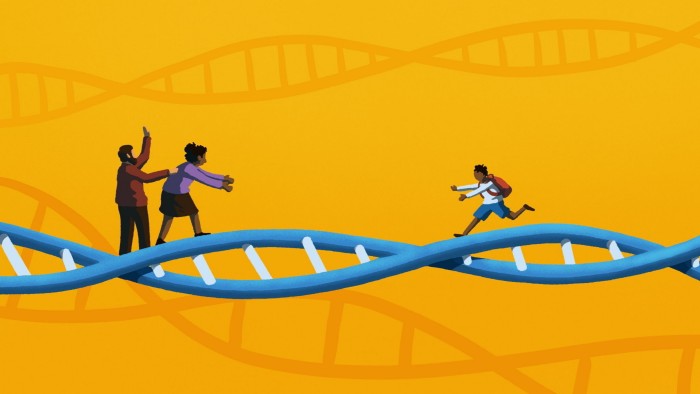
Now, a group of researchers is calling for a specialist DNA database to reunite separated families — and, in so doing, collect evidence of possible war crimes. As well as identifying children snatched during the war in Ukraine, the database could help to reunite migrant families separated at the US-Mexico border under Donald Trump’s original “zero tolerance” policy, as well as those divided by repression, armed conflict and climate migration elsewhere.
“I absolutely see this science as moving health forward,” says Sara Huston, a genetics ethicist who leads the Genetics and Justice Laboratory at Northwestern University’s Feinberg School of Medicine in Chicago. Huston, also based at the city’s Lurie Children’s Hospital, is a co-founder of DNA Bridge, a US non-profit organisation set up to campaign for an international humanitarian-run genetic database to reunite living family members. Her appeal was published in Nature last week.
“Child-taking” has long been a feature of war and oppression. A generation of Chilean mothers, many of them of indigenous Mapuche heritage, lost children under the Pinochet regime in the 1970s and 1980s, with some stolen infants sent for adoption abroad. Similar abductions happened in Argentina and El Salvador. Organisations such as Chilean Adoptees Worldwide have been set up to help those children, now adults, to reconnect with their birth families decades later.
For the thousands of Ukrainian children now in Russia, Huston says, a kinship database would start that important reunification work now: “For a child who is separated, every day matters.”
The database, independent of governments, would work like this: parents or other relatives who have lost children would provide a DNA sample (usually a cheek swab) to a local clinic, charity or other trusted organisation; the sample would be de-identified and submitted to an intergovernmental organisation for inclusion in a searchable database. If children are found, for example by a liberating army, they can also have their DNA taken and submitted to the database for cross-referencing.
A set of about 20 to 25 “polymorphic” markers are used to identify close genetic relatives; the odds of a match are, Huston says, on the order of around one in a trillion unless two people are closely biologically related, for example parent and child, or full siblings.
A match, handled by social workers, will not always end in repatriation: for a child taken as a toddler who has spent several years with a new family, that could be traumatic. Contact with birth relatives might instead resume through regular phone calls. But the genetic match can still be logged as evidence of human rights violations.
There are logistical hurdles: funding; consent; protecting sensitive genetic material in disputed territory; how to ship saliva samples across borders without flouting customs and data laws. But genetic testing is relatively cheap and, through the International Commission on Missing Persons, protocols already exist to identify the dead after mass-casualty events such as the 2004 Boxing Day tsunami in Indonesia.
In that light, the lack of a front-line humanitarian DNA tool to reunite the living looks like a glaring omission. As she argues in her article, it is neither expensive nor that difficult. Huston says that both the ICMP and Ukraine are keen to see the idea progress.
But speed matters. Trump has promised to end the war in Ukraine, a move that, counter-intuitively, could hinder family reunification and evidence-gathering. Humanitarian organisations will pull out, losing access to disputed children. Ukrainian relatives, fearing persecution or reprisal, may drift away before their DNA can be collected. Relatives of orphans, such as grandparents and aunts, will eventually die off, taking valuable testimony with them.
Global attention will shift to the next conflict. All the while, a stolen child’s birth ties to family and geography will be loosening, their Ukrainian roots diluted, forgotten or erased in the mists of time.
Read the full article here

