


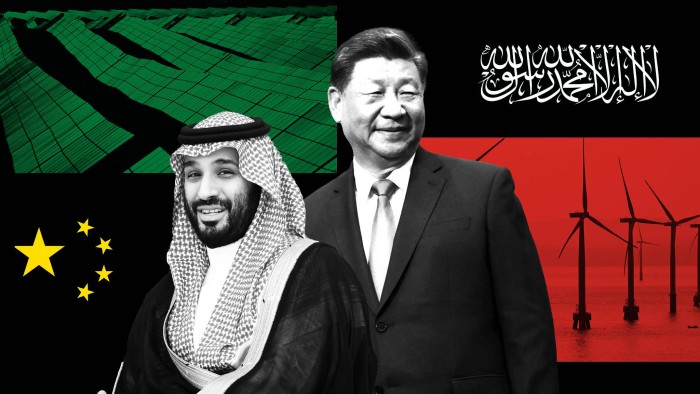
Chinese exports and investment are pouring into Saudi Arabia as the kingdom’s demand for green tech deepens a relationship once defined by oil sales and challenges business ties with its traditional western partners.
Bilateral trade has for many years been almost totally dominated by Chinese purchases of Saudi oil. But now, Chinese exports to Saudi Arabia are tracking towards a record high, at $40.2bn in the first 10 months of the year, up from $34.9bn for the same period last year, according to Chinese government data.
China has also become the kingdom’s largest source of greenfield foreign direct investment, with investments from 2021 to October this year totalling $21.6bn, about a third of which were in clean technologies such as batteries, solar and wind, according to investments tracked by fDi Markets. This compares with $12.5bn from the US, the next highest.
The figures herald a sea change, with China eclipsing the kingdom’s traditional investment partners, the US and France. Many of the Chinese deals have yet to show up in official Saudi figures, indicating the capital has yet to be deployed.
A “major shift” was under way, said Camille Lons, an expert on China and the Middle East and policy fellow at the European Council on Foreign Relations.
“When the Saudis look at the map of the world, they increasingly see themselves as this ‘middle power’,” she said. “They try to be less dependent on the US. Deepening their relationship with China is a way to do exactly that.”
Stronger Saudi-China ties could complicate the outlook for the incoming Trump administration in any dealings with Riyadh, said Lons. “If Trump decides not to deliver what they really want in terms of security guarantees, tech co-operation, they can agitate with the Chinese ‘card’, saying ‘we have other options’.”
Analysts said the deepening economic co-operation followed high-level political and diplomatic efforts, including Chinese President Xi Jinping’s late 2022 trip to Riyadh, his talks with Saudi Arabia’s Crown Prince Mohammed bin Salman and Beijing’s intervention in March 2023 to help restore ties between Saudi Arabia and Iran.
“The [2022] meeting of the two heads of government basically triggered meetings down the chain,” said Charles Chang, greater China lead for corporate ratings at S&P Global Ratings. “The relationship between China and Saudi Arabia began to diversify very rapidly.”
For Xi, trade with Saudi Arabia is strategically important to deepen China’s influence outside the US and Europe, where it faces rising threats of sanctions and tariffs, analysts said. China’s focus on trade and investment also marks a change from the debt-led Belt and Road infrastructure plan.
For Prince Mohammed, the kingdom’s day-to-day ruler who co-chairs the China-Saudi Arabia High-Level Joint Committee, Chinese investment supports his efforts in achieving his so-called Vision 2030 modernisation drive, designed to diversify the economy, transition to cleaner energy and project the kingdom on to the global stage.
Riyadh has so far been careful to balance relations with the US, its most important military partner, and has limited trade with China in sensitive industries such as defence and artificial intelligence, according to Saudi officials.
Saudi investment in China’s oil and gas industry as well as Chinese investment in the Saudi renewable energy sector is powering the expansion of trade. Ken Liu, head of China renewables, utilities and energy research at UBS, forecasts $432bn in additional energy-related annual trade between the Middle East and China by 2030.
There has been a flurry of new deals in recent months highlighting the deepening ties. Backed by Saudi investment, ageing Chinese oil refineries are diversifying towards more downstream petrochemical products including diesel, methanol and ammonia.
Saudi Aramco in September expanded its Chinese refinery and chemical partnerships with Rongsheng and Hengli, two of China’s biggest petrochemical groups. Saudi Aramco also announced a plan with China National Building Material Group to build clean tech manufacturing facilities in Saudi Arabia.
Investment group EWPartners, which is backed by the kingdom’s sovereign wealth fund PIF, in mid-October announced a $2bn plan for a so-called KSA-Sino special economic zone at Riyadh’s King Salman International Airport and for more Chinese companies to localise manufacturing there.
A bid to better integrate the two countries’ financial systems is also gaining traction. In June, China approved exchange traded funds that track the performance of the FTSE Saudi Arabia Index, allowing Chinese investors to gain exposure to top-tier Saudi stocks, including Saudi Aramco and Saudi National Bank. In return, Saudi Arabia’s Capital Market Authority allowed the listing of the country’s inaugural ETF tracking Hong Kong-listed Chinese stocks.
In August, PIF signed memorandums of understanding worth a total of $50bn with six of China’s biggest state-owned banks. And in November, China picked Saudi Arabia as the venue for its first sale of US dollar sovereign bonds in three years.
Beijing is also trying to leverage deeper Saudi ties to promote broader international use of the Chinese currency. The kingdom, like most other international oil producers, has long been reluctant to accept payment in renminbi because of a limited ability to use the proceeds.
Still, in a research note, S&P analysts pointed out that while meaningful renminbi-denominated oil trading between China and Saudi Arabia might still be decades away, the more comprehensive Saudi-China ties could over time support the so-called petroyuan.
Ultimately, said Chang of S&P, the ground was prepared for the relationship to increasingly “go beyond oil”. “If Saudi Arabia looks for countries that have been able to industrialise in a centrally planned way very rapidly, China is probably the best example. That puts the long-term interests of the two countries in alignment.”
Additional reporting by Wenjie Ding in Beijing
Read the full article here

