


Unlock the Editor’s Digest for free
Roula Khalaf, Editor of the FT, selects her favourite stories in this weekly newsletter.
Chinese companies are accelerating a purge of foreign components from their supply chains, as trade tensions with the US threaten to hasten the decoupling between the world’s two largest economies.
In the weeks since President Donald Trump hit China with steep tariffs, more than two dozen companies listed in Shanghai and Shenzhen have told investors that they were increasing efforts to source domestic inputs to replace foreign products or expected to benefit as their peers localised purchasing.
The financial filings, reviewed by the Financial Times, were issued by companies spanning the semiconductor, chemicals and medical devices sectors. They demonstrate the potential lasting impact of Trump’s trade war by effecting a permanent reordering of supply chains.
Beijing has long pushed for industrial self-sufficiency with policies dubbed Made in China 2025 and President Xi Jinping’s “dual circulation” strategy, which aims to strengthen economic independence while maintaining selective global ties.
That drive had been supercharged by Trump’s tariffs, which have created further impetus for Chinese companies to try to insulate themselves from geopolitical blowback, as well as by Beijing’s retaliatory levies on imports from the US, which are as high as 125 per cent.
The tariffs would only increase Beijing’s desire for Chinese companies to become more self-sufficient, said Camille Boullenois, analyst at Rhodium Group and author of a recent report on the Made in China 2025 programme. “They’re clearly feeling the urgency,” she added. “This will signal to them to accelerate as much as possible.”
People familiar with Chinese officials’ thinking said Beijing viewed the trade conflict as a validation of its self-reliance policies. They added that officials thought such initiatives had equipped China to weather the latest wave of US pressure.
“They believe China can now survive without anything from the US or the west and it has given the country the strength to resist Trump’s trade demands,” one of the people said.
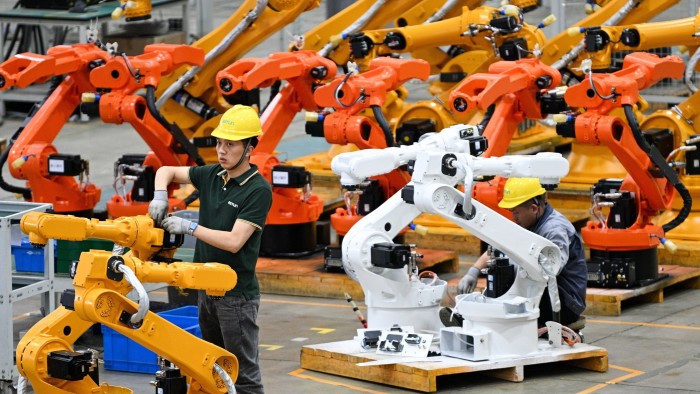
Estun Automation, one of China’s leading industrial robot makers, told investors in its annual report last month that it was “rapidly capturing the major clients previously held by foreign brands” as well as optimising its own supply chain to “increase the domestic substitution of raw materials”.
Increasing localisation “cuts costs”, said one manager at the company. “[It’s] not just the trade war — the entire global economy is unstable. We want to be able and ready to switch [suppliers],” they said.
State-owned emergency equipment maker China Harzone Industry Corp told investors last month that while it had already been “vigorously promoting domestic substitution” for years, in response to the tariffs it would raise its share of local suppliers to replace the handful of components it still sourced from North America.
The company added that it would also develop a dual circulation model focused on exports to south-east Asia, Africa and South America.
Some analysts have argued that the Made in China 2025 plan, which was launched in 2015, helped spark the trade war during Trump’s first term by setting explicit targets for domestic businesses to dominate strategic sectors.
A recent report by the EU Chamber of Commerce in China said the policy had succeeded in industries such as electric vehicles, shipbuilding and rail equipment — where Chinese manufacturing now leads — but warned that it had also encouraged inefficient investment and overcapacity in some sectors and had stoked tensions with trading partners.
China’s strengthened push to prioritise domestic sourcing also could affect suppliers in third countries.
Thinkon Semiconductor, a Liaoning-based silicon materials provider, told investors it would cut out foreign suppliers to “boost risk resilience”. A manager at the company said it did not import US products and was working to replace chemical reagents from Japan, South Korea and Europe.
“To avoid further risks, we will continue to advance our localisation efforts,” the person said, asking not to be named.
Estun Automation and Thinkon Semiconductor did not respond to requests for comment.
He Zhixing, who works in corporate affairs at bearing maker Hunan SUND Technological Corp in central Hunan province, said China’s retaliatory tariffs were driving manufacturers to abandon American bearings used in steam and gas turbines.
“They are reaching out to us, asking us to ramp production,” he said.
“Right now, everyone’s talking about substitution,” he added. Over the long term, he predicted, many customers would switch for good. “It will be a gradual replacement process.”
Read the full article here

