


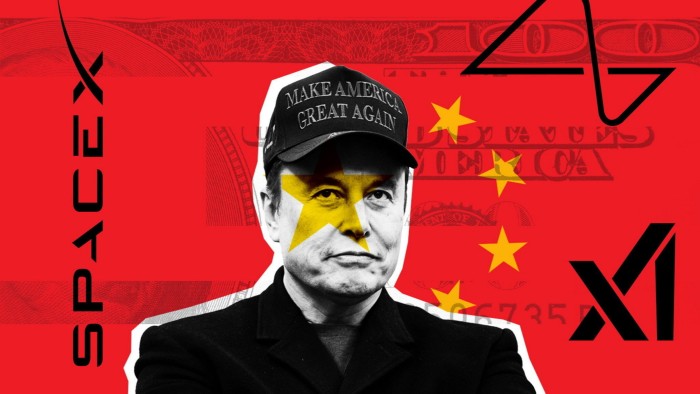
Wealthy Chinese investors are quietly funnelling tens of millions of dollars into private companies controlled by Elon Musk using an arrangement that shields their identities from public view, according to asset managers and investors involved in the transactions.
Since Musk was named a key figure in US President Donald Trump’s drive to remake the US government, China-based asset managers have been promoting the pair’s relationship as an enticement to raise capital from rich Chinese. The money is flowing into Musk’s non-public ventures including xAI, Neuralink and SpaceX, the world’s most valuable private company.
The investments are being placed through opaque structures known as special-purpose vehicles, which have the benefit of concealing the investors’ identities, to avoid the ire of US authorities and companies wary of Chinese capital during a nadir in relations between the two countries.
Asset managers behind the deals have told investors that the entities are specifically designed to avoid disclosure.
The use of special-purpose vehicles in financing is commonplace and there is nothing illegal about the arrangements. Still, it raises concerns about the potential for undue influence and conflicts of interest at a time when Musk has unprecedented involvement in US policy, politics and business.
“How can someone in Musk’s position have so many connections to China but still be a good person to reform the US government?” said Derek Scissors, a senior fellow at the American Enterprise Institute. The influx of Chinese money into Musk’s business empire “adds to this picture that he is more interested in his reputation and his brand in China than he is in American interests”.
The opaque nature of the structures makes it difficult to assess the full scale of Chinese capital flowing into Musk’s private ventures. But three Chinese-backed asset managers told the Financial Times that over the past two years, they had sold Chinese investors more than $30mn worth of shares in SpaceX, xAI and Neuralink, three Musk-controlled private technology companies whose valuations have surged.
All told, SpaceX has raised more than $10bn from investors around the world since its inception in 2002, according to PitchBook.
The inflow of Chinese capital into Musk’s business empire is primarily profit-driven and has little to do with technology transfer or influencing public policy, according to people involved in the transactions.
With a sluggish domestic economy, wealthy Chinese are looking abroad for investment opportunities.
But the structure means that Chinese investors receive limited, if any, information about the company’s financials and performance, unlike the details that are shared with main investors.
While Musk enjoys a warm relationship with Beijing, it has been difficult for the company to take direct investment from China, financial advisers said. Beijing security hawks have criticised SpaceX for its ties to the US military.
“It is not easy for Chinese entities to invest in a prominent US high-tech company like SpaceX,” said Kevin Chen, chief economist of Horizon Financial, a New York-based financial advisory group. “Chinese money is not welcome in many sectors.”
Representatives for Musk, SpaceX, xAI and Neuralink did not respond to repeated requests for comment.
On a recent Wednesday afternoon, hundreds of Chinese investors tuned in to a webinar to hear a representative from Homaer Financial, an asset manager in eastern China, pitch an opportunity to invest in SpaceX for as little as $200,000 per person.
The Homaer official said she expected SpaceX’s valuation to almost triple to $1.1tn within three years, thanks in part to “comprehensive” support from the US government and military that continued placing procurement orders to the space technology company even “in times of distress”.
China’s wealthy began funding Musk’s private ventures in the late 2010s, when the Tesla founder started building an electric-vehicle factory in Shanghai in 2019 to take advantage of the country’s efficient and low-cost supply chains.
The early investments paid off. Homaer said in a social media post in October that a group of its clients had made a 530 per cent return by investing in SpaceX in June 2018, cashing out six years later.
An investor in Homaer confirmed the figure, adding that he regretted not having invested more. “I knew Musk was a good businessman,” he said. “But I didn’t expect him to be so successful within such a short timeframe.”
In the past two years, Homaer launched three funds to invest in SpaceX and was able to meet its capital raising targets within a few weeks, said a person with knowledge of the matter.
When Beijing imposed restrictions on private companies — including cancelling Jack Ma’s Ant Group IPO and requiring ride-hailing group DiDi Global to delist in the US — the value of Musk’s ventures continued to grow.
“I have more faith in Musk than in most Chinese start-up entrepreneurs, who are struggling to cope with an increasingly state-dominated economy,” said an investor who bought shares in SpaceX through Homaer last year.
Some Chinese have paid a price for openly buying stakes in Musk’s ventures. Leo Group, a Chinese company, made headlines in 2021 when it announced plans to invest $50mn in SpaceX through Tomales Bay Capital, a California-based private equity fund. Less than a week later, Leo’s US partner revoked the transaction, citing SpaceX’s discomfort with public disclosure of the Chinese stake, according to a subsequent legal battle between the two firms.
In response, Chinese have turned to special-purpose vehicles. Asset managers pool investors’ funds into a Cayman Islands-registered entity, which invests the money in US-based funds managed by western private equity firms, which are already existing investors in Musk’s ventures.
The presence of the Chinese funds is not visible in public records of the holdings.
A person close to Homaer said the firm asked its US partners if they accepted Chinese money. Typically, the terms also require the US partner to liquidate the investment in extreme scenarios such as a military conflict between the two countries.
“Risks do exist because we are not sure how bad US-China relations will become in the next few years,” the person said.
The uncertainty has not stopped wealthy Chinese from taking the deals. While Beijing’s stringent capital controls have limited Musk’s China investors to those with foreign bank accounts, some wealth managers have found options to overcome the barrier.
“China is facing an oversupply of capital and a shortage of high-quality projects,” a New York investment manager seeking to raise capital from China for such investments said. “That is where we fit in.”
Read the full article here

