


Unlock the White House Watch newsletter for free
Your guide to what the 2024 US election means for Washington and the world
The writer is author of the forthcoming book ‘Hayek’s Bastards: The Neoliberal Roots of the Populist Right’
For years, rightwing populist parties have used forms of direct democracy to pursue their goals. From the referendums banning minarets in Switzerland to the Brexit vote, the idea has been to short-circuit the establishment and tap straight into popular will. In the United States, Maga is now experimenting with something different: direct economics.
Similar to plebiscites and referendums, direct economics seeks to do an end run around experts and incumbents and communicate straight to individual citizens and voters. It tries to demystify what have long been naturalised processes captured in stock market indices, interest rates and even fiat currency, to expose these as mere tools of the elites in further oppressing the true people.
We can see direct economics in action in three different ways. First is the centralisation of executive power in US President Donald Trump’s tariff policy. The arbitrariness of his tariff announcements is taken as a demerit by many. Yet arguably, from the point of view of direct economics, it is this very arbitrariness that is their strength.
When European traders have to wait until Trump wakes up to know what the flow of the markets will be for the day, this is not a sign of weakness for him but of power. It shows that the abstract ideas of “most favoured nation” treatment or multilateral sovereignty pooling were always shadows on the face of US omnipotence and the president’s capacity to shift action at a global level.
A second form of direct economics is cash transfers, which were rolled out by Trump during the pandemic. The prominent signature on the front of the stimulus cheques that landed in Americans’ mailboxes was a sign that the state’s beneficence did not have to flow through the supposedly corroded pipes of the Social Security Administration or Medicare, let alone the indirect provisioning of Health and Human Services or the Department of Education. This was a public good as a private account bump.
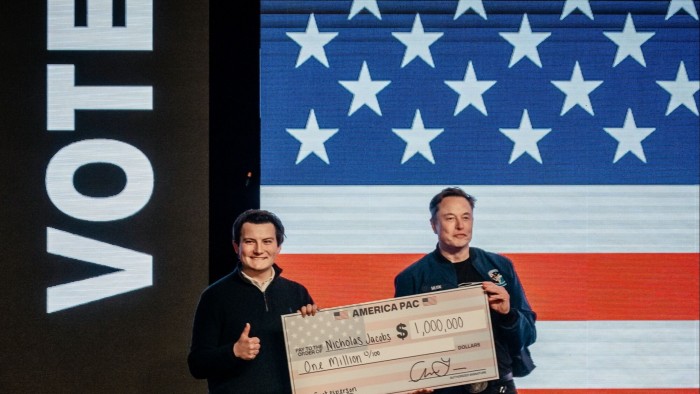
Trump megadonor and zealous Maga convert Elon Musk has picked up on this approach in his attempts to influence elections, giving away novelty-size $1mn cheques at random to people who support his particular candidate. Most recently, Musk gave away two such cheques in Wisconsin in an election that his preferred candidate ultimately lost. Seemingly angry that this tactic came to naught, he posted petulantly afterwards that the corruption of the judiciary was the “long con of the left”. One might wonder whether a version of direct economics where a ballot doubles as a lottery ticket could be seen as a form of corruption itself.
The third form of direct economics is more esoteric. It revolves around the shiny metal of gold. Since the seizure of private gold by Franklin D Roosevelt in the 1930s and the outlawing of the holding of private gold by individuals until the 1970s, a small subsection of economic thinkers has cultivated a belief that the US government seeks to hoard gold. They say the aims is to prevent people from being able to fend for themselves after the inevitable monetary collapse brought about by welfare spending and attempts at what they think of as social engineering.
A subplot of this is that the gold held by the US government is actually not there. The mediation of value through paper money is seen as the greatest trick ever played on humankind and one that will inevitably come to an ugly conclusion. Since the 1980s, the leading goldbug in the US, former Republican Texas senator Ron Paul, has been calling for an audit of the gold at Fort Knox, even filing legislation to this effect in 2011.
Musk has picked up on this idea and called for Paul himself to be part of his so-called Department of Government Efficiency. “Who is confirming that gold wasn’t stolen from Fort Knox? Maybe it’s there, maybe it’s not,” Musk posted in February. There is now discussion of a gold audit, supported by Paul’s son, Senator Rand Paul.
There is in fact a precedent for this approach. In 2012, a precious metals consultant and former Booz Allen employee from Munich started a similar campaign that picked up momentum in Germany, eventually culminating in the transfer of a large quantity of gold bars from the US back to the Bundesbank and their public display. “We’re doing this to show citizens that the gold bars are here,” a Bundesbank board member told reporters. The precious metals consultant was Peter Boehringer, who has now represented the Alternative for Germany (AfD) in the Bundestag for two election cycles.
Direct economics constitutes a powerful attack on existing institutions and people that stand between the citizens and their leaders. Whether its tactics, gimmicks and whims can outlast their tumultuous effects on the conventional markets is something that the next weeks and months will show. So far, the interest rate on US Treasury bills is sliding downwards, and consumer confidence is plummeting too. The gamble of direct economics is that none of this will matter.
Read the full article here

