


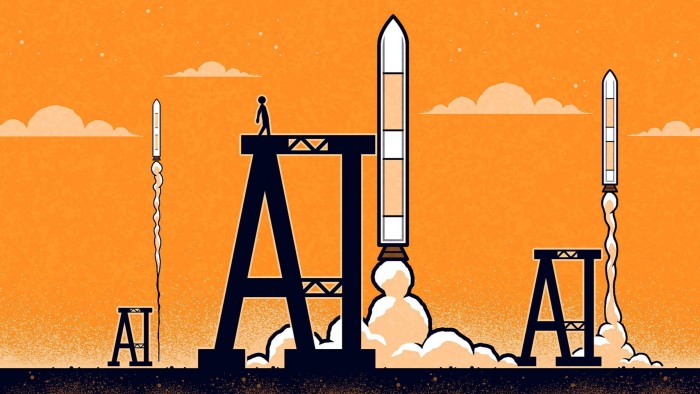
Business deployment of artificial intelligence has reached a tipping point. UBS is deploying virtual research analysts to brief staff on market trends. The chief executive of Anthropic is warning that AI could wipe out half of entry-level white-collar jobs in one to five years, with major lay-offs by companies such as IBM, Microsoft, Google and others. Nvidia’s profits and revenues soared last week, even as Maga politico Steve Bannon warned that AI-related job disruption will be a major issue in the 2028 presidential elections.
I’m betting he’s right, given new research showing higher youth unemployment may be linked to AI rollouts. We knew the disruption was here, but suddenly you can really feel it. Industries like finance, healthcare, software and media are at the epicentre of the change, as is pretty much any sales and marketing department. But in terms of geography, it’s the US that is shifting fastest, in ways that may create a huge tailwind for American business, even as it creates political and social tension.
US business has long been ahead in terms of technology adoption. More spending on tech research and development as well as stronger growth of intangible capital investments — such as industrial design, innovation, organisational structures and data sets — are two big reasons why US productivity surged ahead of Europe’s in the mid-1990s with the advent of the consumer internet. It surged again in the mid-2000s, with the introduction of the iPhone and development of the app economy.
American business is ahead on AI investment, too. In 2024, private expenditure in AI grew to $109bn, nearly 12 times China’s $9.3bn and 24 times the UK’s $4.5bn, according to Stanford University research. US-based institutions produced 40 “notable AI models, significantly surpassing China’s 15 and Europe’s . . . three”, according to the Stanford researchers.
“The US isn’t just inching ahead in AI,” says technologist Jim Clark, founder of the New York based The Future of Employment and Income Institute, which studies AI based innovation and disruption. “It’s breaking away. Europe, by contrast, is stuck in a holding pattern: fragmented markets, slower procurement, tighter labour regimes, and more caution than momentum.”
Many companies have sped up plans for the rollout of agentic AI this summer. This backs up my anecdotal sense, from talking to corporate executives, that workers are starting to use AI not just for simple questions and answers, but for more complex research and analysis tasks, which is where the big productivity gains will be made.
Donald Trump’s “big, beautiful” budget bill has a provision to keep states from regulating AI individually, which will probably make it easier for companies in the US to move forward with AI deployment relative to Europe. This could, in turn, lead to yet another productivity divergence between the two, mirroring what occurred in the 1990s when US companies adopted software and web-based technologies faster.
So far, the US has enjoyed deep structural advantages when it comes to AI deployment, from a labour market flexible enough to absorb disruption, tidal waves of capital from tech giants betting big on infrastructure, a fast and hungry start-up ecosystem and a regulatory environment that mostly gets out of the way. “These are being operationalised right now, primarily by US firms with the scale and culture to move in a big way,” says Clark.
The co-ordinated surge in corporate deployment and research spending is a dynamic not seen elsewhere, even in China, according to an Apollo economic outlook from late 2024. So what about China’s DeepSeek? It has since upended conventional wisdom about whether the US can continue to lead in AI, especially with its open-source approach. I spoke about this past week with Taiwanese technology investor Kai-Fu Lee, whose China-based company is building applications off the back of DeepSeek’s algorithmic models and marketing them internationally.
The popularity of DeepSeek underscores a vulnerability in US-China tech decoupling. While the White House may be able to control the flow of chips between countries, it will be far more difficult to stop businesses, universities and individuals from using open-source models or downloading AI apps. Ultimately, that may favour an open-source, China-first technology stack.
Still, as Lee, the author of AI Superpowers, pointed out, while Chinese companies excel in building consumer AI apps, enterprise spending still lags far behind that of the US. “Chinese companies simply aren’t used to paying millions of dollars for software.”
Whoever’s technology wins, business deployment is what will fuel widespread productivity gains of the sort that lead to stronger overall economic growth. AI is, in this sense, one of the few bright spots (aside from the possible end of Trump’s trade wars, depending on the outcome of the court battle over the legality of his tariffs) that could buoy US corporate profits and give investors a reason to stay in American stocks.
But the speed and scale of AI disruption could also bring a white-collar backlash; surveys show the public wants its deployment to slow down. A new Oxford Economics study found that higher college graduate unemployment is due in part to AI labour substitution. That could hit growth as young people can no longer afford rents and consumer goods. What technology gives it can also take away.
Read the full article here

