


Stay informed with free updates
Simply sign up to the Global Economy myFT Digest — delivered directly to your inbox.
Does the arrival of migrant workers depress the wages of those who are already in the country, or doesn’t it?
For years, mainstream economists have told people who worry that migrants are undercutting wages that they are wrong. Yes, they have said, new people increase the supply of labour, but they also increase the demand for goods and services, so in the end it more-or-less washes out. The theory is backed up with a large number of empirical studies which have found only small, if any, effects from immigration on the wages of native workers.
Yet many economists are now warning that president-elect Donald Trump’s plan to deport millions of undocumented migrants will create labour shortages, push up costs and increase inflation in the US economy. Can those statements both be true? Doesn’t the idea that deportations will fuel inflation implicitly acknowledge that migrant workers had indeed been holding down wages all along? People aren’t stupid: I suspect they notice the apparent intellectual inconsistency, and it makes them more likely to mistrust or simply ignore what economists have to say on the topic.
And yet, I don’t think these two statements are necessarily mutually exclusive, but only because the economics profession (with some honourable exceptions) has done a bad job of trying to understand the way immigration has reshaped labour markets. Most economists have looked for impacts on the wages or employment levels of native workers. But that is too narrow a lens.
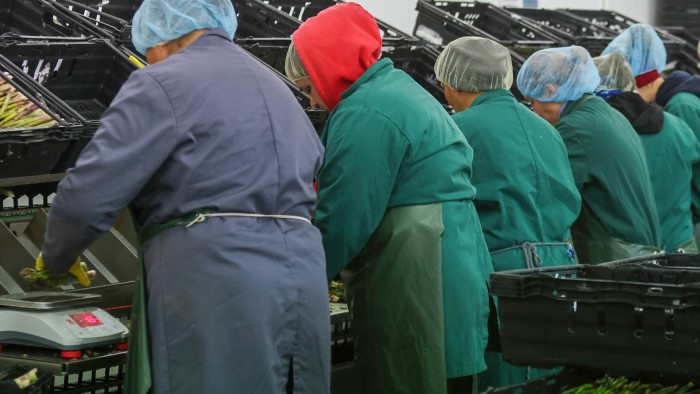
I realised this when I was reporting on the implications of Brexit and the end of freedom-of-movement in the UK. As an example, consider the vantage point of a woman I once interviewed who worked in a food factory in Sheffield. She had watched as a rising share of the expanding workforce became agency workers, mostly from eastern Europe, whose schedules could be chopped and changed with no notice and who did not receive the same benefits as her. Her wages and conditions weren’t undercut, but she thought her migrant colleagues were exploited and the sector was no longer a good place for new entrants. Over time, people like her retired and the sector became dominated by migrant workers.
The point is that economies are dynamic, and employers in some sectors respond to the availability of migrant workers by changing or expanding in certain ways they might not otherwise have done. Meat processing plants in the UK shifted gradually to 12-hour shifts and remote locations because they could find temporary migrant workers to fill these roles, even though they wouldn’t work well for settled workers who might have families and prefer to live in bigger towns with more amenities. As the head of the British Meat Processors Association once told me: “If we’re honest, the working patterns have evolved around having non-UK labour.” Farmers in the UK had responded to the availability of seasonal workers from eastern Europe after 2004 by planting more labour-intensive soft fruits.
Because migrants are so embedded in an economy which has reshaped itself around them, it does mean that should those migrants suddenly leave or be deported, the short-term economic dislocations can be severe in some sectors. Employers irritate me when they imply that native workers are too soft or lazy to do these jobs, but are right that it’s hard to recruit non-migrants — for the very good reason that they’re extremely tough jobs, and native workers (as fluent speakers of the native language) have better alternatives.
It is surely possible that — if you raise wages and improve conditions enough — native workers would step in. But many of these sectors work on fine margins and sell their produce to grocery chains which try their best to push down on prices. In the UK after Brexit, the hope that employers would raise wages and an army of British workers would fill the gaps didn’t really work out. Farmers complained about fruit rotting in the fields and pig farmers said they were having to slaughter healthy pigs because of labour shortages in abattoirs. Before long, the government relented and gave them more visas to recruit migrant workers.
Whether through higher wages or a simple shortage of production, it is indeed likely that prices in the US for products like vegetables and milk would rise if Trump followed through on his plan for deportations. It is also possible that certain US-produced goods, if they become more expensive, could be swapped for imports instead. That might be a trade-off Trump voters are happy to make. But neither side has done a good job of explaining it.
Read the full article here

