


Receive free Euro updates
We’ll send you a myFT Daily Digest email rounding up the latest Euro news every morning.
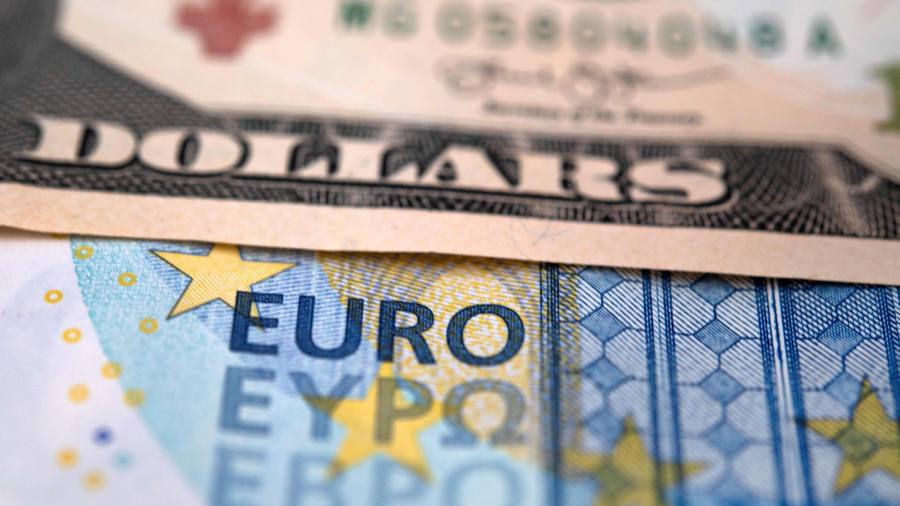
The euro is on course for an eighth straight week of losses against the dollar, as investors respond to a widening gulf between a faltering economy in the eurozone and more robust growth in the US.
The currency has lost more than 5 per cent since mid-July to trade at $1.0707 on Friday afternoon. The steady grind lower reflects intensifying doubts over whether the European Central Bank will raise interest rates again at its meeting next week amid widespread signs that the eurozone economy is heading for a downturn.
Industrial production in Germany — the eurozone’s traditional growth engine — fell for a third month in a row in July, figures on Thursday showed. Meanwhile, US jobless claims fell unexpectedly, the latest sign of resilience in the labour market. That is likely to encourage the US Federal Reserve to hold rates at a high level for longer, boosting the appeal of the dollar. European stocks were flat on Friday, following a seven-day losing streak.
“The US data is relentless and it’s coming at a time when the European manufacturing sector is very weak,” said Chris Turner, head of FX strategy at ING. “There are doubts about whether the ECB can squeeze in one final hike.”
Derivatives markets imply a roughly 35 per cent chance of the ECB raising its deposit rate from 3.75 per cent to 4 per cent on September 14.
Those chances have fallen after a string of weak economic data in recent weeks. The eurozone’s official second-quarter growth figure was revised down from 0.3 per cent to 0.1 per cent, and business surveys point to a further slowdown in August.
“It is not looking good for the economy and that should bring more disinflation,” said Dirk Schumacher, a former ECB staffer now working as an economist at French bank Natixis.
He predicted the ECB would opt for a “hawkish pause” in which it does not raise rates but makes it clear that it is still very concerned about inflation and is ready to resume tightening if price pressures become more stubborn. “That would keep the market more on its toes, rather than a hike, which investors would instantly assume was the last,” Schumacher said.
Some investors think the looming recession signs in Europe will make it hard for the ECB to lift borrowing costs one more time, even if it thinks it is necessary to bring inflation down to its 2 per cent target. Core inflation, which excludes more volatile energy and food prices and is closely watched by the central bank, remains far above target at 5.3 per cent.
“[A further rate rise] could actually be counterproductive because if they hike into a recession it means they will have to cut much more going forward,” said Tomasz Wieladek, chief European economist at T Rowe Price. “This is a serious risk and I think they might have built themselves a trap, recent data has been unashamedly dovish.”
Further euro weakness could complicate the ECB’s task of fighting inflation by pushing up the cost of imports, such as energy and food products.
A rise in the oil price after Saudi Arabia and Russia extended production cuts this week has also added to inflationary pressures. Brent crude rose above $90 a barrel this week, its highest level since last November.
Some investors are now talking about the euro area experiencing a period of stagflation — high inflation combined with stagnating economic growth.
“With eurozone inflation still above average and growth well below, it’s clear that by most definitions the eurozone is suffering from stagflation,” said Michael Metcalfe, head of macro strategy at State Street Global Markets.
Investors expect the dollar to continue its rebound from a period of weakness earlier this year, as the robust US economy provides little incentive for the US to cut rates any time soon, a move Fed chair Jay Powell has consistently pushed back on.
“There’s been too much negativity around the dollar and I think it will continue to reassert itself,” said Greg Peters, co-chief investment officer of PGIM Fixed Income. “The central driver of rates continues to be growth.”
Investors expect the Fed has likely finished raising interest rates, but traders are now betting that it will not start cutting rates until the middle of next year. As recently as June, swaps markets were pricing in rate cuts before the end of this year.
Read the full article here

