


Unlock the Editor’s Digest for free
Roula Khalaf, Editor of the FT, selects her favourite stories in this weekly newsletter.
Time was when dominance of the networks of global trade turned on the firepower of mighty navies and the control of vital waterways. These days it’s increasingly about who supplies your broadband.
In the eyes of many governments, Starlink — Elon Musk’s internet satellite company — is increasingly indivisible from US foreign policy. Musk wants to negotiate with the president of Italy (probably the wrong person, he’ll need the prime minister) amid the government’s doubts about buying a military communications system from him. Doug Ford, the pugnacious premier of the Canadian province of Ontario, has ripped up a Starlink contract in retaliation for US tariffs on Canada.
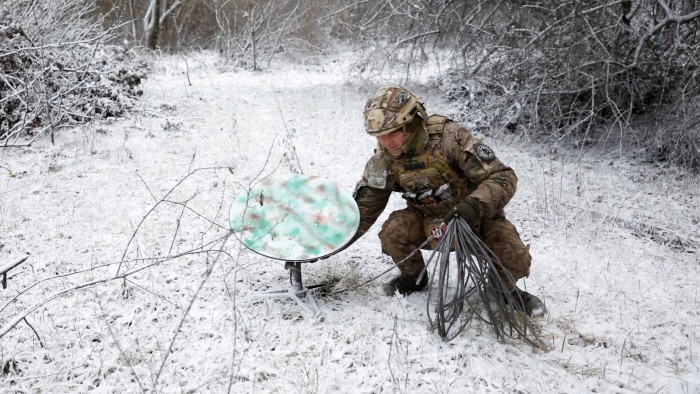
Most urgently, as President Donald Trump threatens to abandon the western alliance, European governments are alarmed at the Ukrainian armed forces’ reliance on Starlink for communications and combat.
For multiple networks — satellites, 5G mobile, undersea cables, payment systems — the difference between military and strategic uses has become blurred and the world’s economic plumbing increasingly politicised. The bifurcation of technologies between the US and China may become a trifurcation or even higher multiples. Antoine Grenier, a partner at Analysys Mason, told me the technology consultancy is increasingly being approached by governments and regulators concerned about relying on foreign space capabilities and satellites.
Clearly, three or four systems cost more than one. But while having to pay extra for capacity in communications and value networks to cope with geopolitical fragmentation isn’t a good thing in itself, resilience and diversity is likely to be well worth the cost.
The EU, which has relied on superior US technology for satellites if not for 5G, is having to work the hardest to create alternatives to Starlink. Its IRIS² project to create a fleet of low-earth and medium-earth orbit satellites was held up in typical but unseemly squabbling between France, which stressed the need for European autonomy, and Germany, which regarded it as an expensive handout to the French aerospace industry.
The EU declared an approach of “open strategic autonomy” in 2020 to reduce dependence on other powers, but the debate over resilience often ended up being sidetracked into familiar discussions dominated by manufacturing and agricultural protectionists. Trump has helped move the EU from “costs too much” towards “whatever it takes”. IRIS² was given the go-ahead in December, with the EU set to contribute €6bn of public money towards the total cost of €10.6bn over 12 years. The French satellite operator Eutelsat, which owns the internet satellite system OneWeb and is a key part of IRIS², has seen its share price quadruple this month as the EU announced a new €150bn rearmament fund.
The problem is that IRIS² won’t be launching its satellites until 2030 and even then won’t match the size and coverage of Starlink’s fleet. An expansion of coverage in Ukraine based on the current satellite fleet is likely to come too late for the conflict with Russia, if a complete replacement for Starlink’s tens of thousands of terminals is needed. Eutelsat is in talks to provide an alternative to Musk’s company but has many fewer satellites and clunkier terminals which could take months to deploy on a large enough scale.
Fortunately, the issue of relying on a single satellite company is less urgent for global economic networks than it is for military operations. Except in remote areas, companies and individuals generally have alternatives to satellite in the form of cable and mobile. And while the cost of building alternative systems is not negligible, it is dwarfed by their economic benefits in preserving global trade.
The idea of maintaining global competition through government-supported companies somewhat resembles the Airbus-Boeing duopoly, where the EU and US fought an inconclusive 17-year legal battle over their respective state subsidies to the companies. The dispute attracted some ridicule for its length but the outcome was genuine competition in the global civil aircraft market.
The costs involved in launching and renewing fleets of low-orbit internet satellites are not trivial: it will cost multiples of the more than €10bn being spent on IRIS² to come anywhere near matching Starlink. But compare that with the amount of economic activity and trade that it facilitates — EU GDP was €21tn in nominal terms last year — and the case for paying generous insurance premia is evident.
Other forms of communication networks cost less to build resilience. The risks of data communications relying on undersea cables have attracted a great deal of attention, especially given incidents such as the recent mysterious damage to a cable in the Baltic Sea. But building in redundancy is not cripplingly expensive. When the US excluded Chinese suppliers from a new undersea cable from Singapore to France, Chinese companies built their own, at a relatively low cost of less than $600mn. It would cost more than that to buy the first-team squad at Brighton and Hove Albion FC, one of the less glamorous teams in the English Premier League.
The EU has moved too slowly and in the wrong direction to promote economic security and, ahem, “strategic autonomy”. It’s focused too much on the goods and services going through the plumbing of the world economy and not enough on the infrastructure itself. As with so many other issues, the two months since Trump’s inauguration have revealed the neglect of many years. Realisation having now dawned of the need to catch up, Europe needs to adapt the watchword of Silicon Valley — to move fast and build things.
Read the full article here

