


Unlock the White House Watch newsletter for free
Your guide to what the 2024 US election means for Washington and the world
Europe’s biggest military powers are drawing up plans to take on greater responsibilities for the continent’s defence from the US, including a pitch to the Trump administration for a managed transfer over the next five to 10 years.
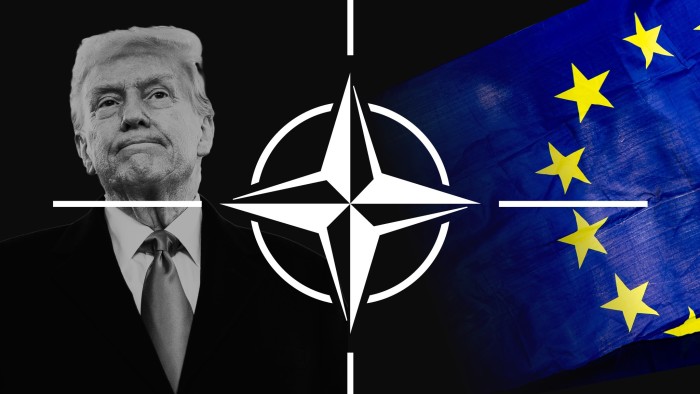
The discussions are an attempt to avoid the chaos of a unilateral US withdrawal from Nato, a fear sparked by President Donald Trump’s repeated threats to weaken or walk away from the transatlantic alliance that has protected Europe for almost eight decades.
The UK, France, Germany and the Nordics are among the countries engaged in the informal but structured discussions, according to four European officials involved. Their aim is to come up with a plan to shift the financial and military burden to European capitals and present it to the US ahead of Nato’s annual leaders’ summit in The Hague in June.
The proposal would include firm commitments on increasing European defence spending and building up military capabilities, in an effort to convince Trump to agree to a gradual handover that would allow the US to focus more on Asia.
The US, which spends more on defence than all other Nato allies combined, is indispensable to European security.
In addition to its nuclear deterrent, which is committed to the defence of Europe with several European air forces carrying US nuclear weapons, it provides military capabilities that continental allies do not possess, runs air, naval and troop bases and has 80,000 troops stationed in Europe.
Countries including Germany, France and the UK have moved to increase their defence spending or accelerate already planned increases since Trump’s election, while the EU has rolled out initiatives for its member states to speed up increased military investments.
It would take an estimated five to 10 years of that increased spending to raise European capabilities to a level where they could replace most US competences, the officials said, not including the US nuclear deterrent.
“Increasing spending is the only play that we have: burden sharing and shifting the dial away from US reliance,” said one of the officials. “We’re starting those talks but it’s such a big task that many are overwhelmed by the scale of it.”
While US diplomats have reassured their European counterparts that Trump remains committed to Nato membership and its Article 5 mutual defence clause, many European capitals are nervous that the White House could decide to scale back quickly its troop or equipment deployments or disengage from shared Nato tasks.
Some capitals were unwilling to engage in the burden-shifting talks for fear of encouraging the US to move faster, officials said, in the belief that — despite the rhetoric — Trump does not intend to make significant changes to the country’s presence in Europe. Others are sceptical that his administration would even agree to a structured process given its unpredictable nature.
“You need a deal with the Americans and it’s unclear if they will be willing to do it,” said another of the officials. “Can you even trust them to hold to it?”
Officials point to the ongoing and regular discussions, led by France and the UK, about forming a “coalition of the willing” to support Ukraine in its war against Russia and invest in European defence, as indicative of the direction of travel. Those discussions between more than a dozen European defence powers do not involve the US.
Asked what a European pillar within Nato meant and whether it was possible, a third senior western official replied: “We’re seeing it right now: the UK and France taking the initiative [on a reassurance force for Ukraine] without the Americans.”
Nato officials argue that retaining the alliance with less or no US involvement was far simpler than creating a new structure, given the difficulty of recreating or renegotiating its existing military plans for the defence of the continent, its capability targets and rules, its command structure and Article 5.
The basic defence of Europe would always require the UK and other Atlantic naval powers, the Nordics for the continent’s north and Turkey for the south-eastern defence, officials said: membership that Nato already has.
“Even without the United States, Nato provides a structure for security co-operation in Europe,” said Marion Messmer, senior research fellow for international security at Chatham House.
“There are aspects that would need to be replaced should the US disengage. However, it provides a structure and infrastructure framework that Europeans are really familiar with . . . It does a lot of the work that you would need to do from scratch if you were to set up a different kind of structure just for European members,” Messmer added.
Read the full article here

