



The EWZ iShares MSCI Brazil ETF (NYSEARCA:EWZ) aims to mirror the MSCI Brazil Index’s performance, providing exposure to the broader Brazilian stock market (Ibovespa).
The bullish trend in EWZ, which peaked at $34 by the end of July, appears to have halted. August 2023 saw an unprecedented decline in Brazil’s Ibovespa, marked by 13 consecutive drops, similarly impacting EWZ.
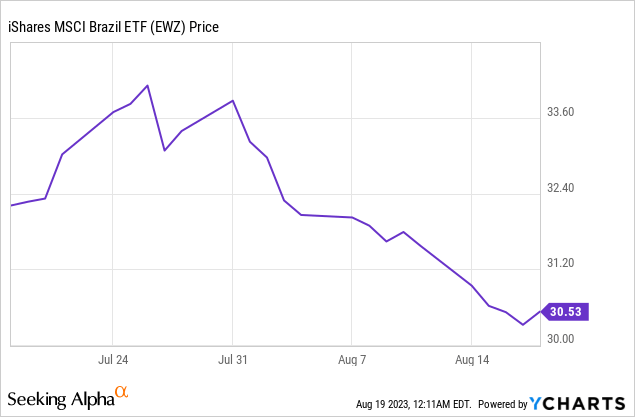
However, the Ibovespa didn’t experience such a significant decline during those 13 consecutive falls; it totaled a 6% decrease. A negative flow of foreign investors fueled the drops in the first half of August. Until the 15th, R$ 5.8 billion in foreign capital was withdrawn from the Brazilian stock market for the month. This negative balance coincides with a heightened global risk aversion sentiment from concerns about the Chinese economy and rising Treasury yields.
Despite this setback, the EWZ continues to deliver substantial returns to its investors, maintaining a positive performance for the year. However, this notable disruption in the previously experienced bull market hints at its potential conclusion for Brazilian stocks.
Brazilian inflation is ticking higher
Brazil’s CPI (IPCA) recorded an inflation rate of 0.12% in July. The twelve-month variation accelerated to 3.99%, driven by excluding the deflation recorded in the same month of the previous year from the calculation base. Year-to-date, the increase stands at 2.99%, nearing the inflation target of 3.25%. In contrast, the National Consumer Price Index (INPC) continued to display deflation in July, accumulating at 2.59% for the year and 3.53% over the past twelve months.
The monitored core inflation levels by the Central Bank experienced a cooling effect in July. Industrial goods increased by 0.12%, primarily influenced by durable and non-durable segments. Conversely, service prices slowed to 0.25%, with notable changes in underlying, labor-intensive, and miscellaneous services.
Although July’s inflation rate reached the upper limit of the Central Bank’s projections, the composition of the data presents a more favorable outlook. The decrease in core inflation and significant service metrics indicates the impact of monetary policy.
The IPCA outcome aligns with the Central Bank’s strategy of cutting interest rates (Selic) by 50 basis points. However, the upcoming months may accelerate inflation due to removing months with deflation, warranting a cautious approach. Heightened inflation risks persist, influenced by commodity prices and potential fuel price adjustments. There’s a possibility of a more aggressive interest rate cut in the year’s final quarter due to potential GDP contraction in Q3. Despite these dynamics, the Selic rate is anticipated to conclude the year at 11.75% after three additional 50-basis-point reductions.
Macroeconomic pressures
China’s struggling economy significantly impacts the macro situation and weighs heavily on Brazilian equities.
Economic indicators from China have been disappointing, prompting several banks to revise their growth forecasts downwardly. The initial projection of a 5% growth in China’s economy for the year has been revised to 4.7%.
To stimulate economic growth, the Chinese government took steps such as reducing interest rates through its Central Bank to boost GDP and injecting additional funds to prevent a potential crisis in the real estate sector. The warning from giant real estate company Country Garden about potential bankruptcy raised concerns.
Meanwhile, another Chinese bank is undergoing a liability restructuring due to substantial losses in investments, and Evergrande, the second-largest real estate firm in China and the cause of the 2021 crisis has filed for bankruptcy in the United States, citing an inability to repay $340 billion in debts, despite being smaller than Country Garden.
Besides the broader macroeconomic impact, Vale (VALE), 12.25% of the EWZ, has witnessed a significant 25% decline this year. This drop is attributed to iron ore prices, affected by Chinese demand, which could potentially affect import levels.
The strength of the U.S. economy is another crucial factor in the current situation.
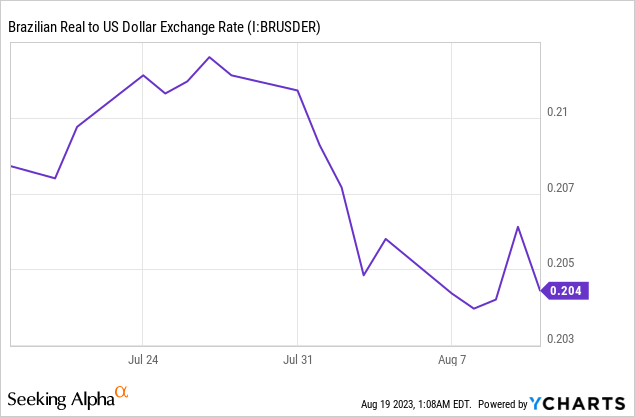
This economic resilience has challenged previous expectations of a rapid decline in inflation in the country. Consequently, the likelihood is increasing that the U.S. Federal Reserve, the central bank, will raise its baseline interest rate in its upcoming meetings this year. This potential scenario, coupled with the rise in interest rates in Japan and the reduction in liquidity due to the U.S. Treasury’s bond sales, has led to an uptick in long-term bond interest rates in the U.S. This, in turn, has exerted pressure on the exchange rate in Brazil.
Petrobras and fuel prices
Commencing in May of this year, Petrobras (PBR), which constitutes 15% of the EWZ, chose to depart from the international price parity (IPP) for oil. This decision led to a notable 30% difference in fuel prices. Subsequently, the company readjusted gasoline and diesel prices, with gasoline experiencing a 16% surge and diesel prices rising by 25%. Despite market expectations of an increase, Petrobras’ price adjustments fell short of closing the international price gap.
The primary concern arising from Petrobras’ new pricing approach is the emerging shortage of diesel in certain parts of Brazil, exacerbating the risk of supply insufficiencies due to the nation’s lack of oil self-sufficiency. Notably, no one was importing diesel to sell at a lower cost.
Petrobras’ recently appointed CEO, former politician Jean Prates, refuted any notions of the company subsidizing fuel prices. He also emphasized that Petrobras could yield profits without adhering to the traditional pricing policy. He further stated that government interference did not hinder the state-owned company’s readjustments – an unfavorable development for Petrobras shareholders.
It’s crucial to underscore that approximately 60% of freight transportation in Brazil relies on road transport, implying that Petrobras’ novel policy could substantially impact inflation. This chain reaction sets a cycle where product scarcity fuels price hikes, ultimately pressuring demand. This intricate process is why the perceived risk linked to a potential slowdown in the interest rate cycle has been compromised.
Political noises on reforms and fiscal framework
Tensions have emerged between the Brazilian Ministry of the Economy and the Chamber of Deputies, causing disruptions to the economic agenda in the past few weeks.
Political discord has impeded progress on the proposed new fiscal framework, encompassing expenditure expansion. Amidst ongoing internal deliberations surrounding tax reform, strained communication between the Ministry of the Economy and the Chamber of Deputies further compounds the unsuitable state of affairs for the Brazilian economy.
Moreover, a growing perception has taken root that the predetermined targets for the primary surplus are increasingly elusive within the prevailing fiscal framework. The government’s struggles in securing approval for necessary tax hikes, coupled with indications of tax collection falling below projections, raise doubts about the attainability of these fiscal objectives. This predicament can impact the country’s debt-to-GDP ratio, casting a more concerning light on its trajectory.
Brazil’s debt-to-GDP ratio (Trading Economics)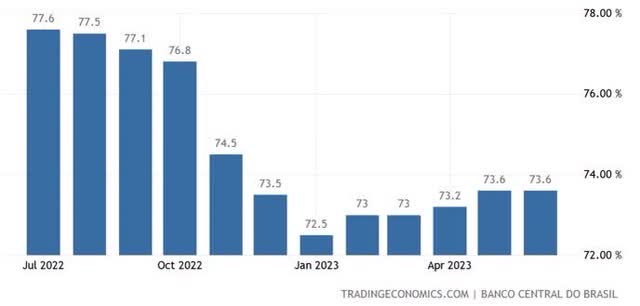
EWZ valuations are still cheap, but there’s a reason
Brazilian stocks are presently trading at a notably discounted valuation, clearly reflected in the low price-to-earnings (P/E) ratio of the EWZ, standing at 5.5 times. This starkly contrasts the much higher P/E ratio of 23x observed in the S&P 500.
Additionally, when compared to other emerging markets ETFs, such as the iShares MSCI Emerging Markets ETF (EEM), which holds a P/E ratio of 10.8x and is primarily composed of Asian equities, and the iShares MSCI Mexico ETF (EWW) with a P/E ratio of 12.7x, the disparity becomes even more evident.
However, the Brazilian economy is weakening despite the outlook of reduced inflation and an impending low-interest-rate cycle. The recent conclusion of this year’s second-quarter earnings season has revealed a lackluster performance. On average, holdings in EWZ witnessed a substantial 40% contraction in profits and a 15% decline in revenues compared to the previous year. According to Bloomberg data, only 34% of Ibovespa companies surpassed consensus earnings expectations, with 44% exceeding revenue expectations.
While I am optimistic about the Brazilian stock market’s latent potential as interest rates slow down, my optimism is tinged with caution regarding a significant upward trajectory for the EWZ throughout the year. Given the worrisome macroeconomic landscape and indications of domestic economic slowdown and inflation, a cautionary signal has been raised.
As a result, I am adopting a neutral stance for the time being.
Read the full article here

