


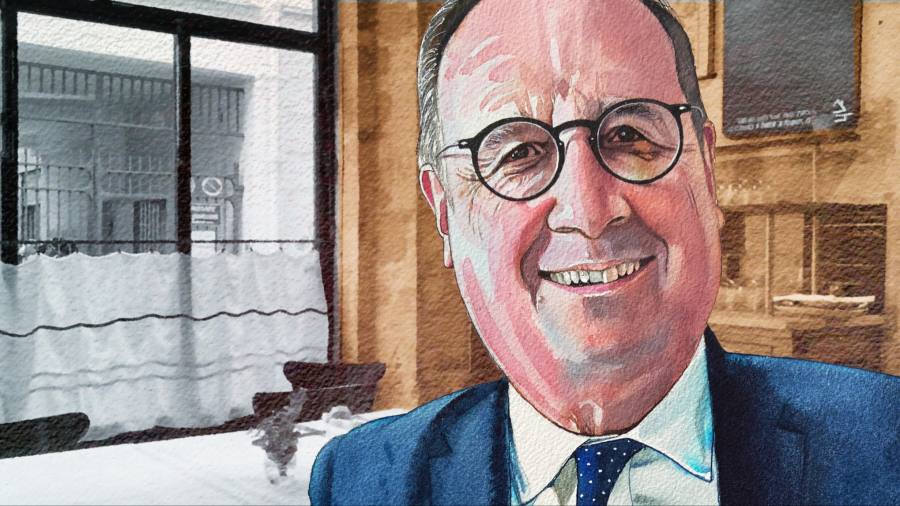
François Hollande has a ring on his finger, and he’s proud to show it off. Recently married for the first time, the former French president, whose colourful love life was among the many distractions in a spectacularly unpopular presidency, feels liberated. Six years have passed since his fateful decision not to seek re-election in the 2017 presidential vote. His successor, Emmanuel Macron, has had his fair share of crises, putting Hollande’s dismal record in a slightly better light. “I am no longer in retrospective analysis of my record. There’s a kind of newfound liberty,” he tells me as we sit for lunch in a Parisian bistro. “I’m happy, I’m married and I have a family and grandchildren.”
The only president in the history of the Fifth Republic to decide against seeking a second term, Hollande could have receded into obscurity. With popularity ratings that reached the low single digits, and a portly, slightly goofy image that never quite fitted, in the public imagination, with the grandeur of the Élysée Palace, he left his Socialist party battered, a state from which it has never recovered.
But, after three political books and two children’s books, the 68-year-old is ready to dabble again in politics. He claims to be a mere commentator on events, yet is less than emphatic when I ask whether he still harbours political ambition. He certainly rues the decision not to seek a second term in office. “I regret having said it at the time I did; I didn’t have all the elements I needed to make the right decision.”
France, he says, is in “dangerous” crisis, with the recent demonstrations and strikes over Macron’s decision to push through pensions reform that raises the state pension age from 62 to 64. With the traditional left captured by radicals and the traditional right crushed, the danger is that the social unrest benefits only the far-right party of Marine Le Pen. Even if he doesn’t quite admit to it, Hollande must be looking with satisfaction on the travails of Macron, whom he had brought into government only to see him declare a presidential run as an independent. Did Macron betray him? “At least he didn’t tell the truth about his intentions, you can put it that way.”
Hollande is certainly not sparing in his criticism of his successor, whom he has described as lacking any political conviction. “His compass at first was that the country suffers from rigidity, blockage, the left, the right. He said, I will liberate energies and I will break [things]. What has he broken? He broke a political system.”
The world is also far more turbulent than during Hollande’s presidential days: Russia’s full-scale invasion of Ukraine has upended the postwar international order, and the China-Russian axis is tightening. Hollande was always clear-eyed about Vladimir Putin, setting himself apart from a French political tradition that has often been more complacent about Russia. After Putin sent its “little green men” to destabilise eastern Ukraine in 2014, Hollande cancelled a controversial Russian order for two French-built Mistral helicopter carriers, pleasing his western allies — though he also helped push Ukraine into the Minsk II peace process that failed to recognise the nature of Russian aggression. “Putin cannot be seduced,” he tells me. “He respects force.”
Hollande has chosen Parcelles, a tiny bistro dating from 1936 in the classy Marais district, for our lunch. The restaurant has a feel of retro elegance, its main charm the original copper and wooden counter and the dusty bottles of glorious wines that line the shelves. The jazz music has been turned down to ease our conversation and the owner is excited to receive the ex-president for the second time.
The menu at Parcelles is as earthy and traditional as the decor. For starters, Hollande orders the terrine and jokes that he wants FT readers to know that the French have lost none of their taste for pork and foie gras. I choose a less adventurous option, a tartare de maigre. We both opt for the day’s special main dish: turbot with hazelnut sauce. Parcelles is known for its wine more than its cuisine, so I pick a Chardonnay from Bourgogne and Hollande a glass of Mondeuse from the Savoie.
Before heading to Parcelles, I’d spoken to several people about Hollande and two words were repeatedly used to describe him: “sympathique” (friendly) and “drôle” (amusing), adjectives that seemed to me to describe a pleasant lunch companion but a character who is perhaps not electrifying enough for the Élysée. Hollande was, indeed, something of an accidental leader, a longtime party secretary whose partner, Ségolène Royal, mother of his four children, was seen as the more able politician. After they split up, Royal raced ahead to become the Socialist candidate for president in the 2007 election but lost to the centre-right Nicolas Sarkozy.
Five years later, the French had tired of the “bling bling” presidency of Sarkozy, while the candidacy of the Socialist favourite, the former IMF managing director Dominique Strauss-Kahn, had collapsed after allegations of sexual assault. Enter Hollande, with a promise to be a “normal” president who would restore respect to the office.
He soon discovered that the role itself was anything but normal in a nation that wants presidents to be at once Jupiterian and close to the people. I start to ask why France expects presidents to be kings, and Hollande continues my sentence, “only to chop their heads off”. The French public, he explains, wants a difficult balance: “Someone who embodies authority, and in whom they can then trust. But authority is not authoritarianism. It is founded on wisdom, on firmness but through conviction and respect.”
Hollande didn’t quite fit the bill. His presidency was dogged by stubborn unemployment, and he was seen as hesitant and indecisive. He was also prone to faux pas, none as memorable as his 2014 secret escapade from the Élysée. He was captured in full-faced helmet on the back of a motor scooter on his way to meet his mistress, the actress Julie Gayet, who is now his wife. He was, at the time, living with a journalist from Paris Match, for whom he had left Royal. “I campaigned on scooter in 2012. It was tremendous,” he says, very matter of fact, when I bring up the episode.
The death blow for his political career was the publication of a book with which he had closely collaborated, allowing two investigative journalists from Le Monde to interview him regularly during his presidency. “Un président ne devrait pas dire ça . . .” (“A president shouldn’t say that”) was a stunner, replete with juicy Hollande quotes that enraged many in his own party.
Looking back, Hollande tells me that he doesn’t regret the book, only the title, which are words he had said in passing and was shocked to find on the cover. “It was historic; no one had done it before and there’s a need to explain what we do inside [the Élysée]. But it was used as a weapon against me. Even those who bought it didn’t read it. It was all about the title.”
The turbot slices off the bone and melts in the mouth, and the conversation turns to foreign policy, where Hollande showed more resolve and an appetite for foreign intervention. In his 2022 book Bouleversements (“Upheavals”), he describes his first encounters with Putin, when he was struck by a combination of cold determination, hostility towards the US and fury over the expansion of the Nato alliance. Hollande judged him then, and still does, as a rational actor who is a master in the elaborate art of lying.
How will the war in Ukraine end, I ask him. It will depend, he says, on the outcome of the 2024 US presidential election. “If Trump is elected, he will say, we stop here; whatever the Russians have they can keep. The war costs too much.” What has changed since Hollande’s days in office, he says, is that the shape of the new geopolitical order has become clearer, with the Russia-China axis consolidating and challenging the west.
I ask whether France is at risk of repeating the mistake with Russia, where it allowed economic interests to trump politics for too long. What did he make of the uproar over Macron’s April trip to China, and his remark that Europe should not be a “follower” of the US and risk getting dragged into a conflict over Taiwan?
Whenever the subject of Macron comes up, Hollande lowers his gaze and smiles, as if carefully weighing his words. “If you go to China only with economic interests in mind, and forget French political interests, you are less heard, and weaker,” he says. Then he heaps praise on Ursula von der Leyen, the European Commission president, who accompanied Macron after delivering a strong speech on China. She is, in Hollande’s words, a leader who “laid down principles that were right”.
Like Macron, Hollande is a true believer in the concept of European strategic autonomy and the necessity of developing common European defence. He argues that this autonomy must always be tied to the Nato alliance. Europe, he says, may need to prepare for a day when it must rely on itself for its security, but that should not mean it does not share the same objectives as the US. “If we suggest to European allies that we don’t have the same interests as the US, for peace at least . . . our allies cannot follow us.”
The best part of the meal, and trickier part of the conversation, arrives with dessert. Hollande is visibly keen on dessert but claims that he is indulging me by ordering his own chocolate tart. “I’m not letting Madame eat on her own.”
We are on the topic of France post-Macron. I tell Hollande that I am struck by the number of people who seem fatalistic about a Le Pen presidency in 2027. It’s a lazy analysis, says Hollande. Marine Le Pen could indeed win, having reached the second round of voting in presidential elections twice over the past decade, but France’s fate depends as much on whether the traditional right and left can regroup into governing parties. Macron won re-election, but he has not built a real political party that will necessarily survive him.
Hollande’s take is that Macronism is shortlived. “[Macron] didn’t want to build a party or a doctrine . . . no one knows the name of the party chief. I’m not trying to offend him by saying this, but no one knows the direction of this party.” The challenge for the left is not to dampen the current radicalism but to rebuild with new voters and new leadership. “François Mitterrand [the late French president] used to say, ‘it’s with civilians that you make military men’, and yes, it’s with people who don’t vote for you that you have to create a majority,” says Hollande. “If you stay in your usual camp and it’s narrower now and it’s more radical, well, you won’t gain anything.”
Two hours have passed, and we have feasted on the dessert. Before we leave, I ask him who has the kind of presidential authority the French crave? Charles de Gaulle, of course, but that’s tied up with his role in history, he says, and Mitterrand, who had a certain authority wrapped up in mystery. Then a curious name we’d briefly discussed earlier comes back: Joe Biden. “It’s true that he’s not a charismatic character in the sense that [Barack] Obama could be, but does he embody a form of authority based on wisdom and determination?”
As if speaking to himself, rather than to me, Hollande adds: “I can be more firm if I am wise. That means I don’t do things on impulse, I do them through reason and with conviction.”
Roula Khalaf is the editor of the Financial Times
Find out about our latest stories first — follow @ftweekend on Twitter
Read the full article here

