


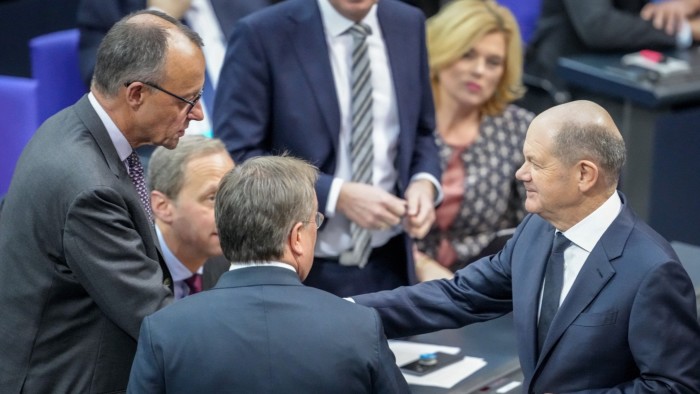
At war with Russia for more than 1,000 days, Ukraine has now been sucked into another contest raging 1,000 miles to the west — the race to be Germany’s next chancellor.
Olaf Scholz, the Social Democrat incumbent, and his rival Friedrich Merz, leader of the opposition Christian Democrats (CDU), have both put the war at the heart of their campaigns ahead of snap elections in February.
Last weekend Scholz accused Merz of “playing Russian roulette with Germany’s security” by issuing ultimatums to Moscow, while Merz said it was in the Social Democrats’ “DNA to mobilise fears of war”.
Then there was the small matter of the two men’s rival trips to Kyiv. Scholz travelled to the Ukrainian capital on Monday, the first time in two-and-a-half years. Merz is headed there early next week.
Some in the CDU claim Scholz only went because he got wind that Merz was going and wanted to beat him to it, a suggestion a Scholz aide dismissed as “pathetic and embarrassing”.
Although the campaign is still in its early stages, the battle lines on Ukraine are already drawn. Scholz, who has led a minority government since pulling the plug on his three-party coalition last month, presents himself as a level-headed statesman, committed to supporting Ukraine for as “long as it takes” while preventing nuclear escalation and paving the way for peace.
“The more [Vladimir] Putin fuels the war, the more we have to keep a cool head,” the chancellor said on Saturday at a Social Democrat (SPD) party conference in Berlin.
Scholz went on to warn of the “hotheads” — he meant Merz and the Greens’ candidate for chancellor, Robert Habeck — who he claimed would drag Germany into war with Russia.
Merz and the CDU, meanwhile, portray Scholz as a weak leader whose halfhearted support for Ukraine has only prolonged the suffering of Germany’s ally and benefited Russia.
The conservative chancellor candidate said in October that Germany should threaten to arm Kyiv’s forces with Taurus long-range cruise missiles unless Moscow stopped bombing civilian infrastructure in Ukraine.
The Taurus issue has become a clear dividing line between Scholz and his rivals. Kyiv repeatedly called on the chancellor to send it the German-made weapons, which are more potent than the US and British missiles it currently uses to strike Russian targets. The CDU and Greens back Ukraine on the issue.
But Scholz has refused to budge, saying that such a move would escalate the conflict and entail sending German troops to Ukraine to help operate the missile system.
While needling Scholz on Tauruses, Merz has also zeroed in on what he sees as one of Scholz’s key weaknesses — his neglect of Germany’s allies. This week he accused the chancellor of “going it alone” when he phoned Putin last month, his first call to the Russian president in nearly two years. Following the call, Putin had stepped up his attacks on Ukrainian civilian infrastructure, Merz pointed out.
“These unilateral moves [by Scholz] have led to a deterioration of the strategic situation” in Ukraine, Merz told a security conference in Berlin on Wednesday.
Scholz had also, Merz said, “hesitated” too long over providing Ukraine with certain categories of heavy weapons, initially warning they would cause an “impermissible escalation” of the war but then changing his mind and supplying them anyway.
“In our support for Ukraine we don’t act in a sufficiently strategic, decisive, or co-ordinated way,” he said.
It is unusual for foreign policy issues to loom large over a German election campaign. But Germans clearly care about the largest conflict on European soil since the second world war.
A poll by Forsa this month said 49 per cent of voters considered it the most important issue facing Germany apart from the collapse of the government, ahead of the US elections, the conflict in the Middle East and even the country’s ailing economy.
Meanwhile, Scholz’s cautious approach towards arming Kyiv with Tauruses is seemingly backed by voters. A poll by RTL/ntv found 63 per cent of Germans are against such a move, up from 56 per cent in April.
“Scholz is definitely hitting a nerve,” said Julia Reuschenbach, a political scientist at Berlin’s Free University. “There is a lot of scepticism in Germany about giving Ukraine long-range weapons, particularly among SPD voters.”
That partly explains the popularity of the far-right Alternative for Germany (AfD) and the hard-left Sahra Wagenknecht Alliance (BSW), both of which oppose German military aid for Ukraine and want more diplomacy to end the war.
Scholz has sought to court the anti-war constituency by burnishing his campaign persona as the “chancellor of peace”, occasionally angering allies in the process. Ukrainian President Volodymyr Zelenskyy criticised his call with Putin, saying it had given the Russian leader what he wanted — an end to Russia’s isolation.
However, Scholz balanced with his trip to Kyiv, which involved 2.5 hours of talks with Zelenskyy and a promise of €650mn in military aid before the end of the year.
Nils Schmid, the SPD’s foreign policy spokesman, said the Scholz-Zelenskyy talks were a crucial step in preparing the ground for Donald Trump’s return to the White House. The US president-elect has vowed to end the war in “24 hours”, prompting fears among European allies that he would force Kyiv to accept an outcome that favoured Moscow.
“Scholz has a plan and he wants the Europeans to be centre stage, and the Ukrainians to be involved,” Schmid said. “He doesn’t just want to leave it up to Trump and Putin alone to do a deal.”
But some commentators think Scholz has gone too far, in particular when depicting the opposition as warmongers.
“It’s irresponsible to run a campaign based on fear,” said Carlo Masala, a political scientist at the Bundeswehr university in Munich. “The only other parties that play on people’s fears of a possible military escalation are the AfD and the BSW.”
It remains unclear whether Scholz’s position on the war will help or hinder his re-election chances. But as the face of an unloved coalition that collapsed in chaos after just three years in office, he has precious little else to boast about, said Masala.
“One of the few things Scholz can actually sell to voters is his reputation as a level-headed chancellor who ensured Ukraine still exists and that at the same time we didn’t end up in world war three.”
Additional reporting by Laura Pitel in Berlin
Data visualisation by Jonathan Vincent
Read the full article here

