


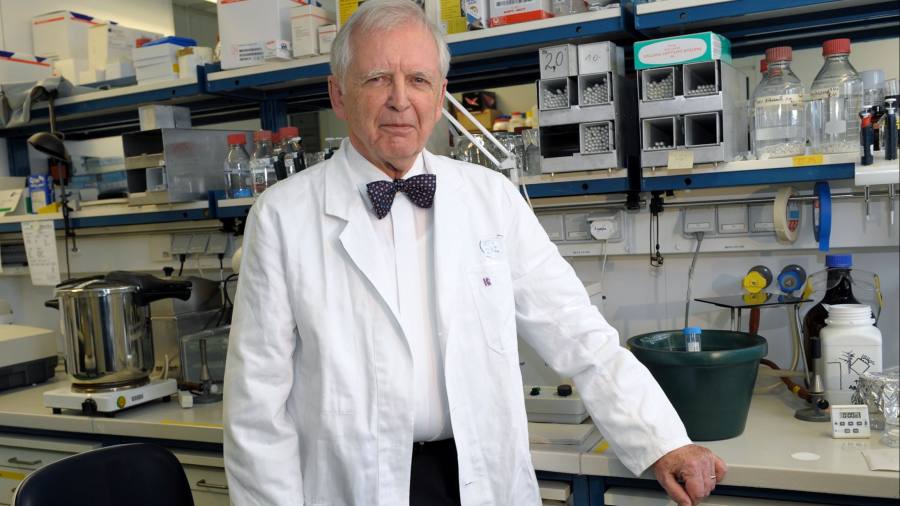
When Professor Harald zur Hausen, who has died aged 87, identified a link between the human papillomavirus and cervical cancer almost half a century ago, few of his fellow scientists took the breakthrough seriously. Orthodox thinking asserted that the disease was caused by the herpes virus. Few were keen to revise it on the word of a young virologist who was not known for his work on cervical cancer.
But his discovery, tenaciously pursued over decades, is now viewed as one of the most remarkable medical advances of modern times. It paved the way for a preventive vaccine expected to save millions of lives. In 2008 it netted him the ultimate accolade: the Nobel Prize in medicine.
Of his determination to press ahead despite his elders’ scepticism, he once told an interviewer: “I originate from a part of Germany where the people are known to be relatively stubborn.”
Born in 1936 in the city of Gelsenkirchen in North Rhine-Westphalia, his childhood was dislocated by the second world war. In 1943, local schools were closed because of heavy Allied bombardment. “My elementary school training was full of gaps,” he recalled.
After qualifying as a doctor of medicine at the University of Düsseldorf in 1960, he moved into research and was gripped by the relationship between infections and cancer, the area in which he was to leave an indelible legacy. Working in a lab at the Children’s Hospital of Philadelphia run by Werner and Gertrude Henle, a husband and wife team, he studied how the Epstein-Barr virus was implicated in the development of nasopharyngeal carcinoma, a cancer found mostly in southern China.
Paul Farrell, a professor of tumour virology at Imperial College London, who first collaborated with zur Hausen in the 1980s, said: “Harald was able to show the presence of Epstein-Barr virus DNA in the actual cancer cells.” It bolstered his conviction that viruses were likely to be involved in other types of cancer too.
But as he sought to determine which among the many different human papillomaviruses might cause cancer of the cervix, he faced a wall of hostility from the scientific establishment. Margaret Stanley, emeritus professor of pathology at Cambridge, said that by challenging the “groupthink” about the disease’s causes, he undermined the validity of the herpes theory in which other investigators were heavily invested.
“Harald was very courageous. He would stand up at medical meetings, saying ‘we can’t find the evidence to support this’. For a while he was subjected to a lot of abuse, because the [research] community just didn’t want to accept that his science was very rigorous and honest,” Stanley said.
Eventually he managed to isolate a number of different human papillomaviruses, discovering that two — HPV 16 and HPV 18 — were implicated in about 70 per cent of all cervical cancers. Stanley recalls this as “a eureka moment”, but one about which Hausen himself was typically modest. “He just said, ‘I think this [theory] is probably right’ . . . the people who worked for him were very excited [but] he was cool.”
Colleagues remember a cultured man who loved classical music, was unfailingly courteous and always dressed impeccably. A powerful speaker on the wider causes of cancer, who effortlessly packed lecture halls, he was notably lacking in arrogance, even after his Nobel award, Stanley says.
Professor Otmar Wiestler, who succeeded zur Hausen as head of the German Cancer Research Center, which he had run for 20 years, remembers him as a generous mentor, adept at spotting and nurturing youthful scientific talent. Even in the final weeks of his life he continued to work in his lab, still pushing the boundaries of scientific discovery.
In his late 60s, he had begun exploring a new theory, as challenging to established wisdom as his HPV hypothesis. He believed that colorectal cancer might not be caused by the consumption of red meat, as long suspected, but by the presence of a virus in cattle which did not sicken the animals themselves but could be carcinogenic in humans.
Eventually he and his wife, Professor Ethel-Michele de Villiers, his research partner for many years and a major contributor to his success, say colleagues, identified a piece of viral DNA that the couple “felt very strongly could be the responsible agent”, said Wiestler.
It was “a real pity and tragedy, in a way, that he didn’t have the time to complete this work”, which may yet have profound implications for treatment of the disease, Wiestler added. “He was really up to date, extremely familiar with the literature, full of ideas. He was sharp to the very end.”
Read the full article here

