


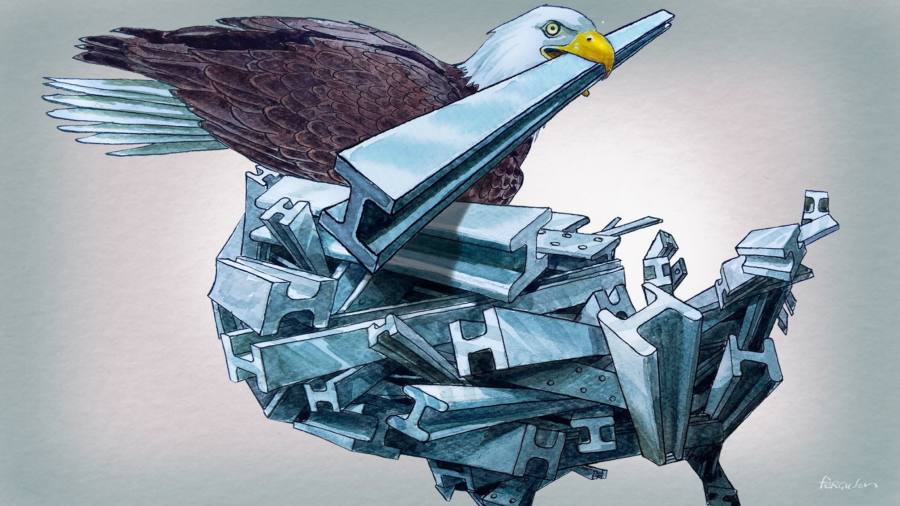
An unheralded revolution has taken place in America’s approach to international economics. As the new thinking emerges, it is reshaping the global economy and the western alliance.
The approach was set out most clearly in a speech by Jake Sullivan on April 27. The fact that Sullivan is President Joe Biden’s national security adviser is a clue. Strategic rivalry with China is central to the new thinking.
But Sullivan’s speech ranged well beyond geopolitics. It was a highly ambitious effort to pull together the domestic and international goals of the Biden administration — and turn them into a coherent whole. The US intends to use a new strategic industrial policy to simultaneously revitalise the American middle-class and US democracy, while combating climate change and establishing a lasting technological lead over China.
Many of America’s allies fear that the bit that slipped off the table was the interests of foreigners. They worry, in particular, that subsidies worth hundreds of billions of dollars to American industry and clean technology, set out in the Inflation Reduction Act, will come at the expense of producers and workers in Europe and Asia. Some also fear that pressure to “de-risk” trade with China will severely disrupt international trade. And many are concerned that US demands for reform of the World Trade Organization will end up crippling the guardian of free trade.
US officials bristle at these suggestions — pointing to Sullivan’s repeated references to the interests of western allies and the global south in his speech. They argue that America is at last taking the lead in the battle against climate change — and that this should be welcomed around the world.
Sullivan is also at pains to emphasise that “de-risking” does not mean cutting China out of global supply chains. Speaking to me last week, he said: “We’re trying to build a world in which there is more than one source for critical products . . . We’re not saying that China should not build iPhones or produce solar panels, but that other countries should too.”
Sullivan is keen to persuade America’s friends that this “new Washington consensus” can work for everyone. He thinks the US made substantial progress at the recent G7 meeting in Hiroshima — arguing that the summit achieved a “really significant step forward”. In particular, he believes America’s allies are now reassured about its plans to subsidise the green transition and have embraced a similar approach. The drive for clean energy, he argues, is “going to be more of a source of co-operation than friction going forward”.
There clearly was a significant convergence of language and approach in the G7 communiqué on issues ranging from de-risking to supply chains.
But, talking to American allies — both in the G7 and outside it — it is evident that there is still uneasiness about US policy. One repeated concern is that America will continue to roll out measures aimed at China that its “allies and partners” will then come under huge pressure to adopt.
Lawrence Wong, the deputy prime minister of Singapore — America’s closest ally in south-east Asia — warned recently that: “If de-risking is taken too far . . . we will end up with a more fragmented and decoupled world economy.” In Europe, there is still concern that a new global economic architecture designed in Washington will inevitably favour US producers and workers.
Different US allies are responding in different ways. There has always been a lobby within the EU that favours the creation of European champions, through an industrial policy. That lobby has been empowered by America’s shift towards industrial policy. Last December, the EU committed itself to “an ambitious European industrial policy” for green and digital transitions.
But there are also Europeans who are concerned that if the EU goes down the subsidy route, it will undermine its own single market. The EU has much less financial firepower than the US government, so could be blown out of the water in a subsidy race.
American allies outside the EU — such as Britain, Japan and Canada — have a separate concern. They worry that if negotiations between the US and the EU become the main way of establishing a consensus in the “global west”, those outside the two main blocs will be disadvantaged. As one diplomat puts it, the EU and the US are “like two giant pandas”. They mate very rarely. But, if they do, it threatens to be an exclusive relationship (although, technically speaking, pandas are not monogamous).
In response to the panda problem, the Canadians are examining giving the G7 a formal role in proposing and crafting the new rules for the global economy.
The British are intrigued by Sullivan’s talk of “innovative new international economic partnerships”. On his trip to Washington this week, Rishi Sunak, Britain’s prime minister, will explore areas where the UK might strike up that kind of partnership with the US — including defence technology and the regulation of artificial intelligence.
Hovering over all these economic discussions is a cloud of geopolitical fear. Russia is waging war on the borders of the EU. The Japanese fear China. All sides look to Uncle Sam for military protection. America’s allies still have their reservations about the Sullivan doctrine. But this is no time to get into an argument with the US.
Read the full article here

