


Receive free War in Ukraine updates
We’ll send you a myFT Daily Digest email rounding up the latest War in Ukraine news every morning.
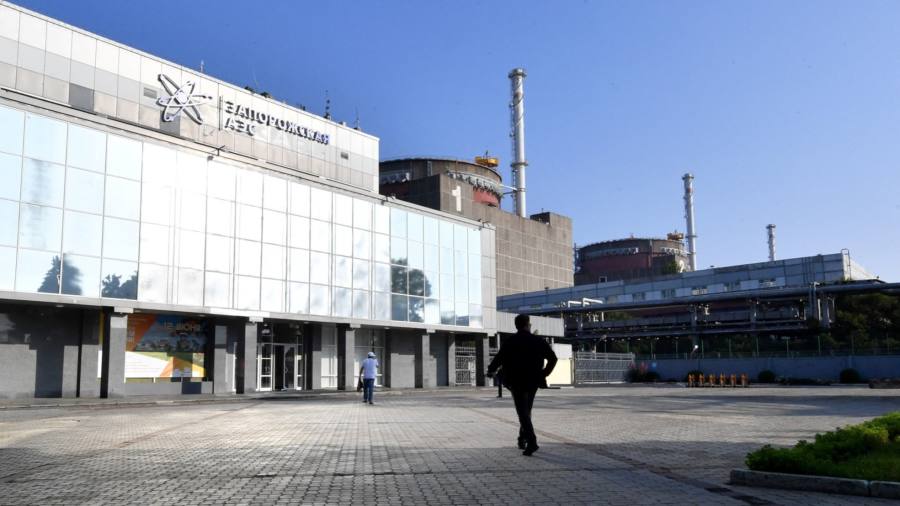
Zaporizhzhia power station, Europe’s largest nuclear plant, has become a symbol of the wider dangers posed by a prolonged conflict in Ukraine, with both Kyiv and Moscow suggesting the other is putting the continent at risk from a radiological disaster.
The plant, which was seized by Russian forces soon after Moscow’s full-scale invasion of Ukraine in February 2022, has been a focus of military activity, with the constant threat of damage from shelling and missile strikes, as well as uncertainties over electricity supplies and staffing.
The International Atomic Energy Agency said this week that it had found landmines at the site, the discovery following accusations by Ukraine that Russia had placed explosives on the roof of Zaporizhzhia’s reactors. In June the destruction of the Kakhovka dam raised concerns about the plant’s source of cooling water.
If Russia tried to cause maximum damage, for example by blowing up one of the reactors from inside and perhaps blaming Ukraine for the explosion, their actions would shock the world but the radiological impact would largely be limited to the local area, said Paul Norman, professor of nuclear energy at the UK’s Birmingham university.
Most nuclear scientists insist there is almost no chance of a catastrophe at Zaporizhzhia comparable with the 1986 explosion and fire at Chernobyl nuclear plant in northern Ukraine.
“Our experts have carefully considered worst-case scenarios, including bombardment and deliberate sabotage of the reactors and spent fuel storage canisters,” said the American Nuclear Society. “They cannot foresee a situation that would result in radiation-related health consequences to the public.”
Why are experts playing down the risks of a disaster?
One reason is the robust containment of Zaporizhzhia’s six VVER-1000 pressurised water reactors, commissioned between 1985 and 1995. Each is situated inside a reinforced concrete fortress more than a metre thick and the reactor vessel itself has a steel wall just under 1ft thick, said Norman.
Mark Foreman, associate professor of nuclear chemistry at Chalmers University of Technology in Sweden, contrasted their design with the Soviet-era reactors at Chernobyl, where “the steam explosion blew the reactor apart, punched a hole in the roof and reduced a lot of fuel into small fragments”.
“If someone sets off a bomb on [Zaporizhzhia’s] roof, then it might be possible to damage the containment building but even a cracked or damaged containment can provide some protection,” he added.
“It’s a bit like having a tank inside a fortress,” said Norman. “There are many layers of protection. It would take a lot to beat them.”
What if the reactor vessels were breached?
A second reason for experts’ confidence is that Zaporizhzhia has not been generating electricity for more than 10 months and its reactors have been shut down.
In contrast, Chernobyl and the Fukushima plant in Japan, which was overwhelmed by a tsunami in 2011, had been operating at full power shortly before those disasters.
Five reactors are completely closed down and a sixth is in “hot shutdown”, generating some heat and steam for essential purposes within the complex but operating at far less than full power.
The shut reactors produce only minimal quantities of iodine-131, the radioactive byproduct most dangerous to human health when released in a nuclear incident. It was the main source of widespread contamination from Chernobyl.
Iodine-131 has a short half-life — taking just eight days for 50 per cent of the isotope to decay. By now it “has all gone, due to the time elapsed since the reactors were operational”, said Mark Wenman, a nuclear materials specialist at Imperial College London.
Although caesium-137, a radioactive isotope with a much longer half-life of 30 years, was also an important contaminant from Chernobyl, epidemiological studies have shown that thousands of thyroid cancers caused by iodine-131 were the most significant health effect of the disaster.
Could there still be a meltdown of radioactive fuel?
Even shut reactors need some cooling to prevent overheating of fuel — which requires both a source of water and electricity for the pumps. Concerns that the Kakhovka dam breach and consequent draining of the reservoir might deprive Zaporizhzhia of essential cooling water have largely been dismissed.
“The cooling requirements are relatively modest and this plant has a multiplicity of cooling options,” said Eugene Shwageraus, professor of nuclear energy systems engineering at Cambridge university. “Though the water in the reservoir receded, there’s a pond on site measuring roughly 2-3km. There are also wells, so water can be pumped from underground, and the plant is connected to the nearby municipal water supply.”
IAEA inspectors said on Monday: “The available water supply remains relatively stable . . . The site continues to have sufficient water for some months.”
Last weekend a technical failure cut off the main external power line to the plant for eight hours, though a reserve line continued to function. Diesel generators are available to provide back-up power too.
IAEA director-general Rafael Grossi condemned the planting of mines at Zaporizhzhia. “Having such explosives on the site is inconsistent with IAEA safety standards and nuclear security guidance and creates additional psychological pressure on plant staff,” he said.
IAEA inspectors are still requesting more access to the rooftops of reactor units 3 and 4 where Ukraine has claimed that Russia has placed explosives.
Why is there alarm about the risk of a nuclear accident?
Past nuclear accidents, such as Windscale in the UK and Three Mile Island in the US as well as Chernobyl and Fukushima, fuel a longstanding fear of atomic power.
Shwageraus suggested that both sides were trying “to achieve their goals by exaggerating the dangers but I think people should know what the real risks are, rather than the perceived risks”.
But the industry’s reputation could be boosted if Zaporizhzhia survives the conflict unscathed and is able to resume its role as a source of energy for southern Ukraine, generating electricity output at or close to its capacity of 5,700MW.
“If it shows that you can put nuclear reactors in a war zone — and they remain safe because of the multiple layers of protection — that may provide a sense of perspective,” said Norman. “It would be a pity if too many people are put off nuclear, because it is such a good low-carbon energy source.”
Read the full article here

